
With 45% of housing units in the city currently renter-occupied, the primary challenge for investors isn't just finding occupants, it's maintaining the structural integrity of their margins. Many property owners recognize that maximizing rental property ROI in Grand Rapids now requires more than just collecting a monthly check. You've likely felt the pressure of rising maintenance labor rates across West Michigan and the friction caused by high turnover costs in competitive neighborhoods. It's a complex environment where the average rent has stabilized at $1,561, meaning that precision in operations is the primary lever for sustainable growth.
This article delivers a structured framework for 2026, focusing on the data-driven strategies and standardized systems necessary to optimize yield and long-term asset value. We'll show you how to move beyond reactive management toward a model of predictable monthly cash flow and standardized maintenance costs. You'll discover how to navigate evolving Michigan landlord-tenant laws while utilizing rigorous tenant screening and placement to secure high-quality, long-term residents for your portfolio. By applying these disciplined principles to your assets, you can ensure stability and professional-grade performance in a shifting market.
Key Takeaways
- Understand why the 2026 market demands a shift from passive appreciation to a structured framework focused on Net Operating Income and asset preservation.
- Identify the specific high-impact property upgrades, such as energy-efficient systems and smart tech, that provide the highest utility without reaching the point of diminishing returns.
- Learn how implementing standardized maintenance coordination is a critical component of maximizing rental property ROI in Grand Rapids by controlling rising labor costs.
- Discover how integrated management systems eliminate human error in financial reporting and rent collection to ensure predictable monthly cash flow.
- Master the rigorous tenant screening and placement protocols required to minimize vacancy periods and protect the long-term structural value of your assets.
The Grand Rapids Rental Landscape: 2026 Market Dynamics
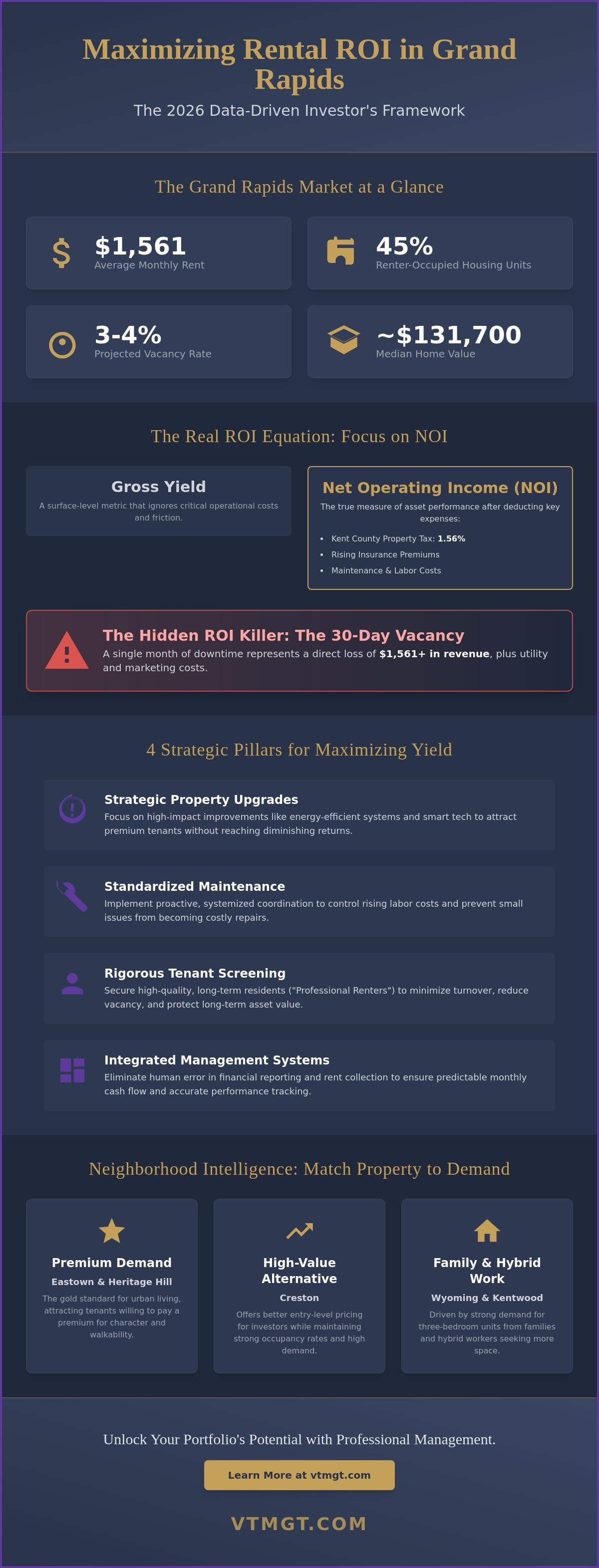
The 2026 Grand Rapids rental market is defined by structural stability rather than speculative volatility. Investors focused on maximizing rental property ROI in Grand Rapids must distinguish between raw equity growth and net cash flow. While the post-pandemic surge in property values has transitioned into a more mature growth phase, the fundamental demand remains high. The current vacancy rate, expected to stay between 3% and 4% throughout the year, indicates a market where inventory cannot keep pace with household formation. This supply-demand imbalance provides landlords with significant pricing power, provided they maintain their assets to professional standards.
Compared to coastal markets where entry prices often outpace rental yields, West Michigan offers a favorable ratio. The median home value of approximately $131,700 allows for a lower cost of entry, while average rents of $1,561 ensure that debt service coverage remains manageable. The expansion of the "Medical Mile" continues to serve as a primary catalyst for this stability. It creates a localized economy that's shielded from broader national fluctuations, attracting high-earning medical professionals who prefer the flexibility of premium rentals over immediate homeownership.
Neighborhood Intelligence: Where the Yield Is
Specific pockets within Kent County demonstrate varying performance metrics. Eastown and Heritage Hill remain the gold standard for high-demand urban living, attracting a demographic willing to pay a premium for historic character and walkability. Creston has emerged as a high-value alternative, offering better entry-level pricing for investors while maintaining strong occupancy rates. We've seen a distinct shift toward Wyoming and Kentwood, where the demand for three-bedroom units is driven by families and hybrid workers. Matching the property type to these demographic shifts is essential for minimizing vacancy. A three-bedroom home in Kentwood often yields more predictable long-term returns than a studio in a saturated downtown block.
Economic Drivers and Tenant Demographics
The stability of the local market is anchored by institutional pillars. The Grand Rapids, Michigan economy is heavily influenced by healthcare, education, and advanced manufacturing. Corewell Health and Grand Valley State University (GVSU) provide a consistent influx of reliable tenants. These institutions don't just provide jobs; they dictate the sustainable rent ceilings for the region. In 2026, we see a rise in the "Professional Renter" profile. These are individuals with stable incomes who prioritize maintenance response times and property quality over low-cost options. Understanding this demographic is the first step toward maximizing rental property ROI in Grand Rapids, as it allows for lower turnover and reduced asset wear.
The ROI Equation: Calculating Real Returns in Kent County
Investors often prioritize Gross Yield as a primary success metric, yet this is a surface-level calculation that fails to account for operational friction. For those committed to maximizing rental property ROI in Grand Rapids, Net Operating Income (NOI) is the only parameter that reflects true asset performance. NOI requires a disciplined deduction of all operating expenses, including Kent County's average property tax rate of 1.56% and rising insurance premiums, before considering debt service. By shifting focus to NOI, we identify "leakage"—those unstandardized, recurring expenses that erode profit margins through lack of oversight.
One of the most significant threats to yield is the "Hidden ROI Killer": the 30-day vacancy. In a market where the average rent is $1,561, a single month of downtime represents a direct loss of over $1,500 in revenue, plus the additional burden of utility carry costs and marketing expenses. Standardized management systems are designed to compress these transition windows. By initiating tenant placement protocols well before a lease expires, we ensure that the asset continues to produce revenue without the typical gaps found in self-managed portfolios. This level of precision is a core component of professional investing in rental property Northern Michigan strategies that we apply to the West Michigan market.
Standardized Financial Reporting
Structured financial oversight is the bedrock of industrial-grade asset management. Monthly Profit and Loss (P&L) statements are non-negotiable for investors who treat their portfolio as a business rather than a hobby. These reports allow owners to clearly distinguish between Capital Expenditures (CapEx), which enhance long-term asset value, and Operating Expenses (OpEx), which are the necessary costs of maintenance and administration. Utilizing this data allows us to identify underperforming assets and adjust strategies before minor inefficiencies become structural losses. Detailed financial reporting and accounting ensures that every dollar is tracked with engineering-level precision.
The Impact of Management Fees on Net ROI
Self-management is often perceived as a cost-saving measure, but it frequently leads to higher "leakage" due to unoptimized maintenance and slower vacancy cycles. While a professional management fee is a line item, it's often offset by a 15% or higher increase in NOI. This gain is achieved through standardized maintenance coordination and rigorous tenant screening, which prevents the high costs associated with evictions or property damage. Professional oversight transforms a property from a time-intensive liability into a streamlined, high-yield asset. When you utilize professional tenant screening and placement, you're investing in the stability of your future cash flow.
Strategic Property Upgrades: Investing for Rent Growth
Efficient capital allocation is the difference between a high-performing asset and a financial drain. When maximizing rental property ROI in Grand Rapids, investors must respect the Law of Diminishing Returns. This economic principle dictates that after a certain threshold, additional spending on renovations fails to produce a proportional increase in rental income or property value. For 2026, the focus has shifted from aesthetic "vanity" projects to upgrades that offer industrial-grade durability and address the specific functional requirements of modern tenants.
High-speed connectivity and home-office readiness are now baseline expectations for the professional renter demographic. Properties that lack integrated ethernet ports or dedicated, well-lit workspaces often face longer vacancy periods. Beyond digital infrastructure, we prioritize three specific physical upgrades for their high utility and low maintenance requirements:
- Smart Access Systems: Keyless entry reduces the operational friction of lockouts and simplifies the turnover process.
- Industrial-Grade Flooring: Luxury Vinyl Plank (LVP) provides the necessary resistance to moisture and heavy wear while maintaining a premium appearance.
- High-Efficiency Lighting: LED conversions are low-cost interventions that reduce utility burdens and improve the perceived quality of the space.
Kitchen and Bath: The ROI Powerhouses
Kitchens and bathrooms remain the primary drivers of rental premiums, but a full gut renovation is rarely the most efficient path. We've found that cost-effective refreshes, such as refacing cabinets, installing quartz countertops, and updating hardware, often capture 90% of the rent growth potential of a full remodel at 40% of the cost. In Grand Rapids, 2026 trends favor clean, neutral palettes with matte black or brushed nickel finishes. These materials aren't just modern; they're selected because they withstand high-turnover environments without showing premature wear.
Energy Efficiency as a Competitive Advantage
Energy efficiency has transitioned from a niche preference to a core value for tenants in neighborhoods like Eastown and Heritage Hill. Upgrading attic insulation and installing high-efficiency HVAC systems directly influences tenant retention by lowering their monthly cost of living. For multi-unit properties, these "Green" features allow owners to justify premium rent ceilings while minimizing the risk of utility-driven disputes. When you treat energy performance as a structural component of the asset, you create a more resilient investment that outperforms older, unoptimized inventory in the Kent County market.
Operational Excellence: Minimizing Turnover and Maintenance
Operational excellence is the final pillar in maximizing rental property ROI in Grand Rapids. While market selection and physical upgrades set the foundation, the daily management of human and technical variables determines the long-term sustainability of your yield. We view property management as a series of interconnected systems where the goal is to eliminate friction. High turnover and uncoordinated repairs are the primary sources of "leakage" in a rental portfolio. By implementing a standardized framework, investors can transform reactive troubleshooting into a predictable, industrial-grade process.
Rigorous tenant screening and placement is the first line of defense for any asset. Protecting the property begins before the lease is signed by verifying income stability and rental history with precision. This proactive approach ensures that the "Professional Renter" demographic identified in earlier sections remains the core of your tenant base. Furthermore, maintaining strict legal compliance is essential for asset protection. Staying ahead of evolving Michigan landlord laws prevents costly litigation and ensures that all lease agreements are structurally sound and enforceable under 2026 regulations.
Tenant Retention Strategies
The financial disparity between a high-quality, long-term tenant and a "bad" tenant is stark. A three-year lease agreement significantly reduces the marketing and turnover costs that erode annual returns. Our communication protocols focus on professional interaction and stability, which helps build thriving local communities within your properties. Incentivizing lease renewals doesn't always require capping rents below market value. Often, tenants prioritize the reliability of a professional management system and prompt maintenance response over marginal rent savings. Structured interaction ensures that residents feel their tenancy is a stable, long-term arrangement.
Systematized Maintenance Coordination
Uncontrolled maintenance costs are often the result of using fragmented, unvetted labor. A systematized approach to maintenance coordination utilizes a vetted vendor network to ensure quality control and reduce material markups. Transitioning from reactive repairs to a proactive model involves scheduled quarterly property inspections. These inspections allow for the identification of minor mechanical or structural issues before they escalate into high-cost emergencies. Investors should follow a disciplined rental property maintenance Northern Michigan schedule to ensure the 2026 season doesn't bring unexpected capital drains. To stabilize your portfolio's performance, consider integrating professional property management services that prioritize these standardized operational systems.
The Van Treese Advantage: Innovation and Human Interaction
The Van Treese Advantage is built on the principle that property management is essentially an engineering challenge. By treating rent collection and financial reporting as a closed-loop system, we eliminate the human error that often leads to payment delays or accounting discrepancies in self-managed portfolios. This systematic approach is a prerequisite for maximizing rental property ROI in Grand Rapids, as it ensures that capital flows remain predictable and transparent. While technology provides the framework, our local market intelligence ensures that the assets we manage remain integrated into the fabric of West Michigan neighborhoods.
Scaling a portfolio across multiple markets requires a management partner that provides uniform service levels regardless of geography. For investors looking to expand from Kent County into other regions, our standardized protocols allow for seamless oversight. This transition from a localized "landlord" mindset to a diversified "investor" strategy is only possible when the underlying operational systems are robust enough to function without constant manual intervention. We provide the structural support necessary for owners to focus on asset acquisition while we handle the technical complexities of property marketing and administration.
Expert Market Valuations
An accurate rental analysis is the foundation of any high-yield investment. Generic online tools and "Zestimates" often fail to account for the specific neighborhood-level nuances that dictate pricing power in 2026. We utilize real-time data from our existing portfolio and localized market research to set rents that reflect the true value of an asset. For multi-family units, this precision is even more critical. By optimizing the rent structure of a multi-unit property based on specific amenity demand and current occupancy trends, we've demonstrated that it's possible to increase net yields without increasing vacancy risks. Data-driven pricing ensures that your asset is never under-earning compared to the broader market.
Standardized Systems, Local Expertise
Our commitment to Northern and West Michigan property owners is rooted in the belief that professional management should provide peace of mind through technical excellence. Transitioning from a hands-on landlord to a strategic investor requires a partner that handles the complexities of lease agreement preparation and tenant placement with precision. This shift allows you to focus on capital allocation while we maintain the operational integrity of your assets. By combining industrial-grade systems with a deep understanding of the local landscape, we bridge the gap between high-tech reporting and human-centric community management.
If you're ready to stabilize your portfolio and implement a framework designed for long-term growth, the next step is a data-backed assessment of your current holdings. Contact Van Treese Management for a Professional Property Analysis to begin maximizing rental property ROI in Grand Rapids today.
Securing Long-Term Performance in Kent County
The 2026 market dynamics in Kent County reward operational precision and penalize fragmentation. Success is no longer a byproduct of market timing; it's a result of disciplined frameworks that prioritize Net Operating Income over raw equity growth. By implementing high-durability property upgrades and rigorous tenant screening, you establish a resilient foundation for your portfolio. These strategies ensure that your assets remain competitive even as tenant demographics and legal requirements evolve toward greater complexity.
Achieving a sustainable yield requires a partner that understands the technical complexities of maximizing rental property ROI in Grand Rapids. Van Treese Management provides the structural oversight necessary to eliminate operational leakage through standardized management systems and expert local market research. Our team ensures asset preservation with 24/7 emergency maintenance coordination, allowing you to transition from daily property oversight to high-level portfolio growth. It's time to treat your real estate assets with the engineering-level precision they deserve. Scale Your Grand Rapids Portfolio with Van Treese Management and ensure your investments are optimized for the years ahead.
Frequently Asked Questions
What is a good ROI for a rental property in Grand Rapids in 2026?
A strong ROI in the current Grand Rapids market is defined by a Net Operating Income that comfortably covers debt service while exceeding the 1.25% Michigan effective property tax rate. Investors should prioritize the capitalization rate of the asset over gross yield. Because the average rent has stabilized at $1,561, a "good" return is one that maintains consistent cash flow through high occupancy rather than relying on speculative appreciation.
How do professional property management fees affect my overall ROI?
Professional management fees are a structured operating expense that typically results in a net increase in ROI by eliminating operational "leakage." These fees are often offset by reduced vacancy periods and lower maintenance labor rates secured through vetted vendor networks. By utilizing standardized management systems, you prevent the high costs associated with unoptimized turnovers and legal non-compliance, which frequently erode the margins of self-managed portfolios.
Which Grand Rapids neighborhoods currently offer the highest rental yields?
Creston and the suburban markets of Wyoming and Kentwood currently provide some of the most favorable yields in Kent County. Creston offers a lower cost of entry compared to Heritage Hill while maintaining high demand from the professional renter demographic. Wyoming and Kentwood are high-performance areas for three-bedroom units, driven by families and hybrid workers who require more square footage than downtown apartments provide.
Is it better to invest in single-family homes or multi-family units in Kent County?
The choice depends on your scaling strategy and risk tolerance. Multi-family units in areas like Eastown offer higher density and lower per-unit operating costs, which can accelerate cash flow. Single-family homes in suburban Kent County often attract longer-term tenants, which reduces the turnover costs that can diminish returns. Both property types are viable for maximizing rental property ROI in Grand Rapids if they are matched to the specific demographic demands of their neighborhood.
How can I reduce vacancy rates during the Michigan winter months?
Reducing winter vacancy requires a proactive lease expiration strategy. You should structure your lease agreements to terminate during the peak spring and summer months when demand is highest. If a unit becomes vacant in November or December, it's often more cost-effective to offer a short-term rent incentive to secure a tenant quickly rather than carrying the utility and tax costs through a three-month vacancy period.
What are the most cost-effective upgrades to increase rent in Grand Rapids?
High-impact, low-maintenance upgrades like smart locks, LED lighting, and luxury vinyl plank (LVP) flooring offer the best return on investment. These features improve the property's utility and aesthetic appeal without reaching the point of diminishing returns. Tenants in 2026 also prioritize energy efficiency and home-office readiness, so ensuring high-speed connectivity and updated insulation can justify a premium rent ceiling in competitive neighborhoods.
Does Michigan law allow for automatic rent increases to match ROI goals?
Michigan law prohibits local governments from enacting rent control, which allows landlords to increase rent to any amount with proper notice. While there's no state-mandated cap, your increases must remain competitive with local market data to avoid triggering a vacancy. Using detailed market research ensures your rent adjustments stay in line with the current $1,561 average while protecting your target margins.
How does professional tenant screening impact long-term property value?
Rigorous tenant screening protects the physical and financial integrity of the asset by placing residents with a documented history of stability. High-quality tenants reduce the wear and tear on the property's mechanical and structural systems, which preserves long-term asset value. This professional placement process is a core component of maximizing rental property ROI in Grand Rapids, as it minimizes the risk of evictions and high-cost property damage.