
Handling Late Rent Payments Professionally: A Guide for Northern Michigan Landlords

Effective property management in Grand Traverse or Emmet County functions like a precision-engineered system where every component must operate within defined parameters to ensure stability. When a tenant misses a deadline, the resulting disruption to mortgage cash flow and the anxiety of personal confrontation can compromise the integrity of your investment. Handling late rent payments professionally is not a matter of emotional negotiation; it's the execution of a standardized process that prioritizes legal compliance and operational consistency. You likely built your portfolio to secure long-term financial health, and a single delinquent account shouldn't jeopardize that foundation.
This guide provides the exact frameworks and legal timelines utilized by professional managers across Northern Michigan to resolve payment issues without costly litigation. You'll learn the technical requirements of Michigan’s 7-day notice to quit and the specific "reasonableness" standards that keep late fees within the 5 to 10 percent range supported by state case law. We'll outline a repeatable system for rent collection that maintains professional boundaries, adheres to the Truth in Renting Act, and ensures your monthly income remains predictable and secure.
Key Takeaways
- Establish a standardized, written rent collection policy to mitigate legal risks and set clear operational parameters for every lease agreement.
- Execute a precise response timeline that transitions from initial reminders to formal fee assessments, ensuring consistent cash flow without emotional volatility.
- Master the specific scripts and boundary-setting techniques required for handling late rent payments professionally while maintaining a strictly business-oriented relationship.
- Understand the technical requirements for serving a Michigan 7-Day Notice to Quit to ensure full compliance with state regulations in Grand Traverse and Emmet counties.
- Discover how implementing professional management systems creates a functional buffer that increases payment reliability and removes the stress of direct collection.
Establishing a Standardized Rent Collection Policy in Northern Michigan
Consistency is the primary metric of a successful property management operation. Without a written, standardized policy, landlords in Grand Traverse or Emmet counties risk exposure to Fair Housing claims. When procedures are applied inconsistently, it creates the appearance of preferential treatment, which can lead to costly legal disputes. Handling late rent payments professionally requires removing individual discretion and replacing it with a rigorous framework. This framework ensures every tenant is treated with the same level of objectivity, regardless of their personal circumstances. By automating the initial stages of collection, you maintain a necessary buffer between ownership and the tenant, preserving the professional nature of the relationship.
Effective systems integrate human interaction with technological precision. While automated portals handle the mechanics of payment and late fee application, the landlord's role is to ensure the system's parameters are clearly communicated. A standardized approach removes the emotional weight of "asking for money" and replaces it with the execution of a pre-defined contract. This method protects the landlord's reputation and ensures that cash flow remains predictable, which is essential for meeting mortgage and tax obligations on schedule.
Lease Clarity and Northern Michigan Compliance
The lease agreement serves as the technical specification for the landlord-tenant relationship. It must explicitly define the due date, the exact moment a payment is considered delinquent, and the associated late fee structure. While Michigan law doesn't mandate a grace period, the industry standard often defaults to 5 days. However, these terms must be documented within the lease to be enforceable under broader landlord-tenant law. For owners, aligning these documents with current Michigan landlord laws is essential for maintaining a defensible legal position. Precision in your lease language prevents the ambiguity that tenants often exploit to delay payments.
Seasonal Payment Stability and Utility Considerations
Northern Michigan's climate introduces specific variables into the rent collection equation. In regions like Petoskey and Gaylord, heating costs can surge by over 40 percent during the winter months, potentially creating "heat-or-rent" financial pressures for tenants. Proactive communication in October and November helps mitigate these risks by setting expectations before the first snowfall. Additionally, the quality of rental property maintenance in Northern Michigan directly correlates with a tenant's willingness to pay on time. A property that is well-insulated and mechanically sound reduces utility burdens, fostering payment stability throughout the fiscal year. Addressing these environmental factors is a critical component of handling late rent payments professionally in our unique regional market.
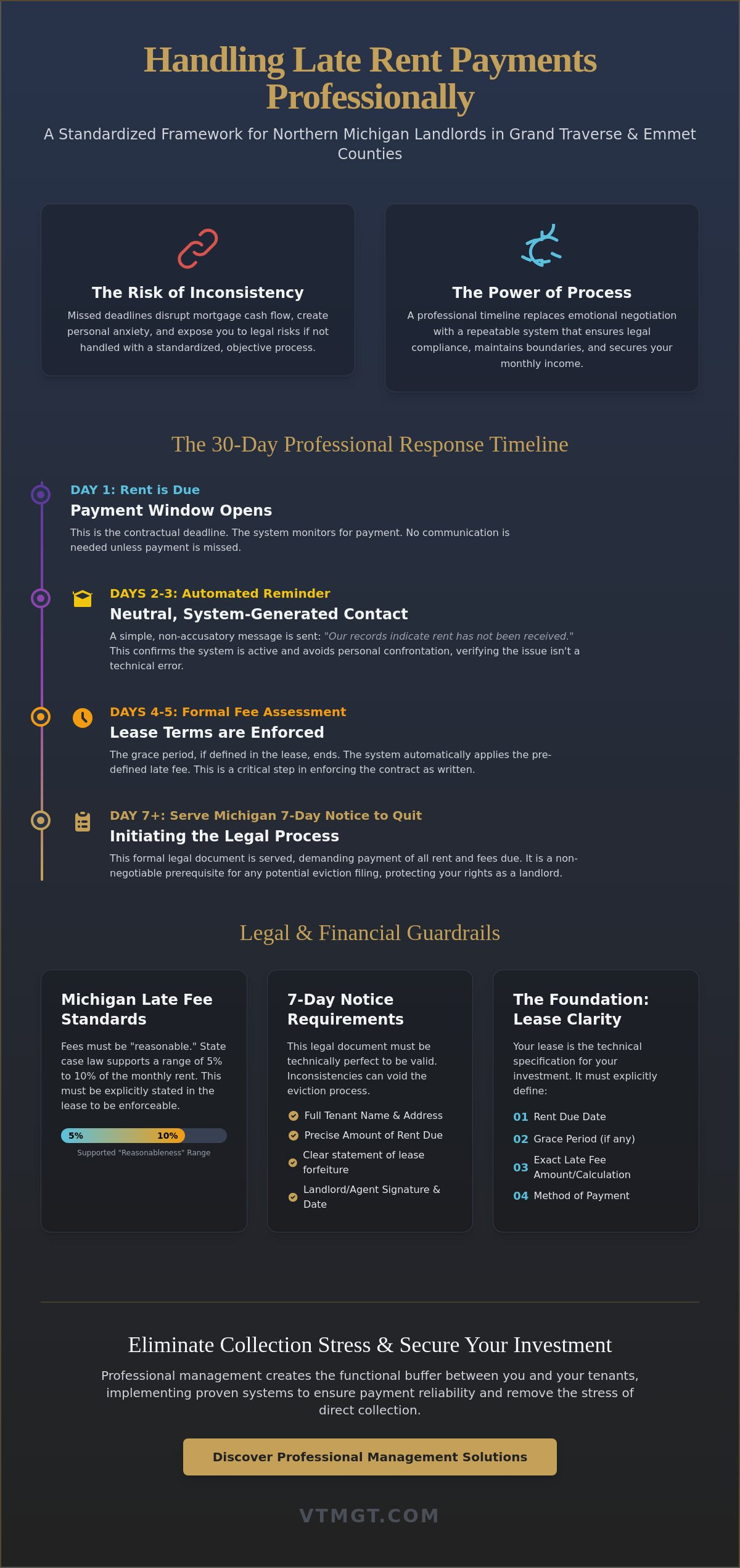
The 30-Day Professional Response Timeline for Late Rent
Managing a rental portfolio requires the same level of procedural discipline as a high-precision manufacturing line. A 30-day timeline ensures that every action is dictated by the calendar rather than emotional impulses. Handling late rent payments professionally begins the moment the due date passes without a confirmed transaction. This structured approach prevents minor oversights from escalating into significant financial losses while maintaining a clear audit trail for any necessary legal proceedings.
Days 1 to 5: Precision and Early Intervention
The first 72 hours are dedicated to verifying that the delinquency isn't a technical error. On day two, we recommend sending a neutral reminder through your management portal. This communication should be devoid of accusatory language; focus instead on the fact that the system hasn't registered the expected payment. A simple, "Our records indicate your rent for [Month] hasn't been received," is more effective than personal inquiries. It establishes that the property is under active oversight.
By day four or five, the formal late fee assessment must occur. Michigan law doesn't mandate a grace period, so fees can technically apply as soon as the rent is past due. However, consistency is the priority here. If your lease specifies a 5% late fee after day five, you must apply it without exception. Waiving fees for one tenant while enforcing them for another creates a precedent of flexibility that undermines your authority. For a detailed breakdown of legal rights during this phase, the Practical Guide for Tenants & Landlords published by the Michigan Legislature provides an essential foundation for these interactions.
Day 6 and Beyond: The Legal Shift
Once the initial five-day window closes, the process transitions from administrative follow-up to legal preparation. Day six marks the point where "friendly reminders" cease. In Emmet and Grand Traverse counties, landlords must serve a written 7-Day Notice to Quit for non-payment of rent before any eviction filing can proceed. This notice is a formal demand for possession that gives the tenant exactly seven days to either pay the full balance or vacate the premises. It's a technical requirement; failure to serve this correctly will result in a court dismissing your case immediately.
During days 11 through 30, you must evaluate the filing decision. If the tenant hasn't rectified the balance within the seven-day notice period, the file should be handed off to a legal professional or a property manager for court filing. Maintaining a "no-payment, no-stay" stance isn't about being harsh; it's about protecting the viability of your investment. Utilizing residential property management services can provide the necessary buffer during this phase, ensuring that all legal service requirements are met with engineering-grade accuracy while you remain insulated from the stress of the confrontation.
Professional Communication: Scripts and Boundary Setting
Communication in property management should function like a technical interface: clear, objective, and driven by established protocols. When a tenant fails to meet their financial obligations, the transition from "Precision Management" to "Personal Management" often leads to operational failure. Handling late rent payments professionally requires the removal of emotional variables. By utilizing pre-approved scripts, you ensure that every interaction remains within the parameters of the lease agreement. This approach prevents the landlord from becoming an unofficial financial counselor, a role that inevitably compromises the stability of the investment.
Landlords in Traverse City and Petoskey frequently encounter complex personal narratives regarding why rent is late. While empathy is a human trait, the "Professional Distance" rule dictates that your primary responsibility is the execution of the contract. When a tenant offers an excuse, the professional response doesn't involve judging the validity of the hardship. Instead, it involves restating the system's requirements. A script such as, "I understand this is a difficult situation; however, the management system requires a 7-day notice to be issued once the grace period expires," shifts the focus from your personal decision to the standardized process.
The VTMG Approach to Human Interaction
We balance technological precision with high-touch human communication to ensure tenants feel heard without compromising the landlord's legal position. One critical area is the handling of partial payments. Accepting even a small portion of the rent can complicates the legal standing of a 7-Day Notice to Quit in Michigan, as it may be seen as a waiver of the delinquency. Professional boundary setting acts as a structural stabilizer that preserves the landlord-tenant relationship by defining the exact tolerances of the lease agreement. Our team declines partial payments unless they are part of a pre-approved, legally documented repayment strategy.
Negotiating Payment Plans Without Losing Control
There are instances where a "One-Time Payment Plan" is a viable alternative to immediate legal action, particularly for long-term tenants with high reliability scores. For these plans to be valid under an Overview of Landlord-Tenant Laws in Michigan, they must be executed in writing and signed by all leaseholders. A verbal "promise to pay" holds no weight in a Traverse City court and can cause delays in the recovery of possession.
A professional payment plan must include "Drop-Dead" dates. These are specific, non-negotiable deadlines where, if the payment isn't received by 5:00 PM, the legal notice process proceeds automatically without further discussion. This ensures the tenant understands that the plan is a narrow tolerance window, not an open-ended extension. By documenting these terms, you maintain control over the timeline and ensure that handling late rent payments professionally remains a disciplined, results-oriented activity.
Navigating Michigan's 7-Day Notice and Late Fee Regulations
Operational stability in property management depends on a precise understanding of the Michigan legal framework. When a tenant fails to pay, the primary mechanism for recovery is the Michigan 7-Day Notice to Quit, also known as a Demand for Possession for non-payment of rent. Handling late rent payments professionally requires that this document is executed with 100 percent accuracy. In counties like Emmet and Charlevoix, local courts maintain a low tolerance for clerical errors. If the notice contains an incorrect balance or an improper address, the case is frequently dismissed before it reaches a hearing, forcing the landlord to restart the entire statutory timeline.
The 7-Day Demand for Possession Explained
For a notice to be legally binding, it must clearly state the tenant's name, the address of the premises, and the specific amount of rent owed. It must also provide the tenant with exactly seven days to either pay the full amount or vacate. Service methods are strictly regulated. You must utilize personal service, substituted service at the residence with a member of the family or household of suitable age, or first-class mail. While many landlords believe a simple text message or email suffices, these do not meet the technical requirements for legal service in Michigan. If you are unsure of the current service protocols, our team provides professional lease agreement preparation and notice services to ensure your filings remain compliant.
Late Fee Compliance and Legal Caps
Michigan does not have a statutory cap on late fees, but courts apply a "reasonableness" standard. Fees must be classified as liquidated damages, intended to compensate the landlord for the administrative cost of the late payment, rather than as a penalty designed to punish the tenant. Case law in Grand Traverse and surrounding counties typically supports fees in the 5 to 10 percent range. Fees exceeding 15 percent are often viewed as usurious and can jeopardize the enforceability of your entire lease agreement.
Successful investing in rental property in Northern Michigan requires this level of legal precision in all financial dealings. It's also important to note that Michigan law prohibits daily late fees; a one-time fee per late period is the only permissible structure. Additionally, Non-Sufficient Funds (NSF) fees are capped at $25 if paid within seven days and $35 if paid within 30 days. Handling late rent payments professionally means adhering to these caps to maintain your expert status in the eyes of the court. Implementing these standardized financial parameters protects your asset from the risks associated with non-compliant collection practices.
How Professional Management Eliminates Collection Stress
The transition from self-management to a professional firm introduces a structural "buffer effect" that fundamentally alters the tenant's payment behavior. Individual landlords often face the challenge of being perceived as flexible or negotiable, which can lead to inconsistent cash flow. In contrast, tenants typically treat a professional management firm with the same level of priority as a utility provider or a financial institution. Handling late rent payments professionally through a third party removes the personal friction that often delays transactions, ensuring that rent is viewed as a non-negotiable operational expense rather than a personal favor.
Our standardized management systems are designed to operate with the same reliability as a precision manufacturing line. From the initial tenant placement to monthly financial reporting, every step follows a documented protocol that eliminates guesswork. By utilizing integrated software and rigorous accounting practices, we provide owners with a level of transparency and control that is difficult to achieve through manual oversight. This systemic approach ensures that delinquent accounts are identified and addressed within hours of a missed deadline, preventing small arrears from compounding into significant debts.
Precision Systems for Petoskey and Traverse City Owners
Successful management begins long before a payment is missed. Our tenant placement process utilizes high-resolution screening parameters to identify high-reliability residents for properties in Petoskey and Traverse City. By verifying income-to-rent ratios and past performance with engineering-grade accuracy, we significantly reduce the statistical likelihood of delinquency. Furthermore, our maintenance coordination ensures that property value is preserved through a local network of vetted contractors. VTMG transforms the volatility of rent collection into a passive, data-driven reporting metric that appears on your monthly financial statement without requiring your direct intervention.
Why Local Expertise Matters in Northern Michigan
Operating within the specific legal environments of Emmet and Charlevoix counties requires more than just general knowledge; it requires local operational intelligence. We maintain a deep understanding of how local court systems function and how judges in our region interpret "reasonableness" in late fee disputes. Our local presence in Gaylord, Indian River, and Boyne City allows us to respond to property issues or serve legal notices with a speed that out-of-state firms cannot match. This proximity ensures that your asset is always under active, professional supervision.
If you are ready to move away from the stress of direct collections and implement a more stable, systematic approach to your investment, we are here to assist. Contact Van Treese Management for a professional rental analysis to see how our precision systems can optimize your portfolio's performance while handling late rent payments professionally on your behalf.
Optimizing Your Rental Operations for Long-Term Stability
Transitioning from reactive management to a proactive, system-based approach is the most effective way to secure your investment's long-term health. We've established that handling late rent payments professionally relies on the precise execution of Michigan’s 7-day notice requirements and the maintenance of clear professional boundaries. By replacing emotional negotiation with these standardized protocols, you ensure that your cash flow remains predictable regardless of seasonal utility fluctuations in Traverse City or Petoskey. This disciplined framework protects your legal standing while fostering a tenant relationship built on mutual contractual respect.
Since 2018, Van Treese Management has provided landlords across Grand Rapids and Northern Michigan with engineering-grade management systems that prioritize operational integrity. Our deep expertise in Michigan Landlord-Tenant Law and our 24/7 collection and maintenance coordination provide the stability your portfolio requires to thrive in a competitive market. It's time to reclaim your schedule and treat your property as the high-performing asset it was designed to be. Request a Professional Rental Analysis from Van Treese Management to begin implementing these precision systems today. Your path to consistent, stress-free income starts with a single, strategic operational shift.
Frequently Asked Questions
What is the legal grace period for rent in Michigan?
Michigan law doesn't mandate a grace period for rent payments. Rent is legally due on the date specified in your lease agreement, and a payment is considered late the following day. While many professional managers in Traverse City provide a voluntary 5-day administrative window before assessing fees, this is a contractual choice rather than a statutory requirement. You should clearly define your chosen policy in the lease to ensure operational consistency.
Can I charge a late fee if it isn't in the lease agreement?
You cannot legally charge a late fee unless the specific amount and conditions are documented in a written lease. Michigan’s Truth in Renting Act requires all financial obligations and penalties to be disclosed at the time of signing. Verbal agreements regarding late fees aren't enforceable in Grand Traverse County courts. If your current contract lacks this provision, you must wait until the lease renewal period to implement a standardized fee structure.
How do I serve a 7-day notice to quit for non-payment in Michigan?
You must serve a 7-day notice using one of three approved methods: personal delivery to the tenant, delivery to a member of the household of suitable age at the property, or via first-class mail. Digital communications like text messages or emails don't meet Michigan's technical requirements for legal service. Accurate documentation of the service date is essential, as it establishes the start of the statutory clock for any potential court filing in Emmet or Charlevoix counties.
Can a landlord refuse a partial rent payment in Traverse City?
Landlords have the legal right to refuse partial rent payments to maintain a clear delinquency status. Accepting even a small portion of the balance can technically void a pending 7-day notice or complicate the eviction process by resetting the legal timeline. Professional managers often decline partial funds unless they're part of a pre-approved, written repayment plan. This ensures the tenant understands that the full contractual obligation must be met to stop legal proceedings.
What happens if a tenant ignores a 7-day demand for possession?
If the tenant fails to pay or vacate within the seven-day window, you must file a Summons and Complaint in the local district court to recover possession. This initiates the formal legal process where a judge will hear the case. Landlords are strictly prohibited from "self-help" evictions, such as changing locks or disconnecting utilities. Only a court officer can legally remove a tenant and their belongings after a judgment is issued and the appeal period expires.
Are there limits on how much a landlord can charge for late fees in Michigan?
Michigan doesn't have a statutory cap on late fees, but they must meet a "reasonableness" standard to be upheld in court. Most judges in Northern Michigan consider fees between 5% and 10% of the monthly rent to be acceptable liquidated damages. Fees exceeding 15% are frequently rejected as punitive during litigation. Establishing a flat fee that aligns with these judicial expectations is a key component of handling late rent payments professionally.
How can I professionally ask for late rent without being pushy?
The most effective method is utilizing automated management systems and neutral, script-based communication. Instead of making personal inquiries, send a system-generated notice that references the specific terms of the lease agreement. This approach shifts the focus from a personal confrontation to a technical oversight in the payment system. Using an objective tone reinforces that you're handling late rent payments professionally and following a standardized protocol that applies to every resident in your portfolio.
Should I accept a payment plan from a tenant who is behind on rent?
You should only accept a payment plan if the tenant has a verified history of reliability and the agreement is executed in writing. The plan must include specific dates for each installment and be signed by all adult leaseholders to be enforceable. If the tenant misses a single deadline, the agreement should state that the legal notice process resumes automatically. This structured framework prevents the delinquency from becoming an unrecoverable debt while providing a controlled path for resolution.