
Commercial Property Valuation Petoskey: A 2026 Investor’s Framework
A high summer cap rate in Northern Michigan often masks the structural erosion caused by the regional climate and Michigan's aggressive property tax uncapping rules. Achieving an accurate commercial property valuation Petoskey requires investors to look beyond peak tourism cycles and focus on the technical frameworks that govern year-round performance. You're likely aware that while the US-31 corridor enhancements and waterfront upgrades create significant opportunity, the 2.7% taxable value increase for 2026 and the inherent seasonal vacancy rates can quickly destabilize a loosely planned investment if they aren't factored into the initial acquisition model.
We understand that uncertainty regarding Emmet County's specific market drivers often leads to hesitation for even the most experienced developers. This framework provides the professional clarity you need to master these local variables and secure your assets. You'll gain a comprehensive checklist of financial metrics and a deeper understanding of how standardized management systems mitigate the high maintenance costs associated with our northern environment. We'll preview the essential data points that define the current market, giving you the confidence to project long-term cash flow with precision and ensure your portfolio remains resilient against both environmental and economic shifts.
Key Takeaways
- Analyze the impact of regional economic pillars, including healthcare expansion and the "Northward Migration" trend, on Petoskey’s 2026 commercial asset demand.
- Master the technical application of Net Operating Income (NOI) and Cap Rate analysis specifically calibrated for a commercial property valuation Petoskey.
- Quantify the long-term financial liabilities associated with Michigan’s property tax "uncapping" rule to ensure accurate post-acquisition ROI projections.
- Incorporate the "Winter Premium" into operational budgets by utilizing standardized maintenance systems to mitigate the costs of the Northern Michigan climate.
- Reduce operational friction and protect asset value through rigorous tenant screening and the integration of a vetted local contractor network.
Understanding Petoskey Commercial Real Estate Dynamics in 2026
Petoskey's commercial landscape in 2026 is defined by a strategic shift toward year-round operational stability. While the tourism industry remains a vital economic pillar, the presence of McLaren Northern Michigan and a robust regional commerce sector provides a structural floor for asset values. Investors conducting a commercial property valuation Petoskey must recognize that the 49770 zip code serves as the professional and medical epicenter for Emmet County. This regional status insulates long-term commercial assets from the volatility often seen in purely recreational or seasonal markets.
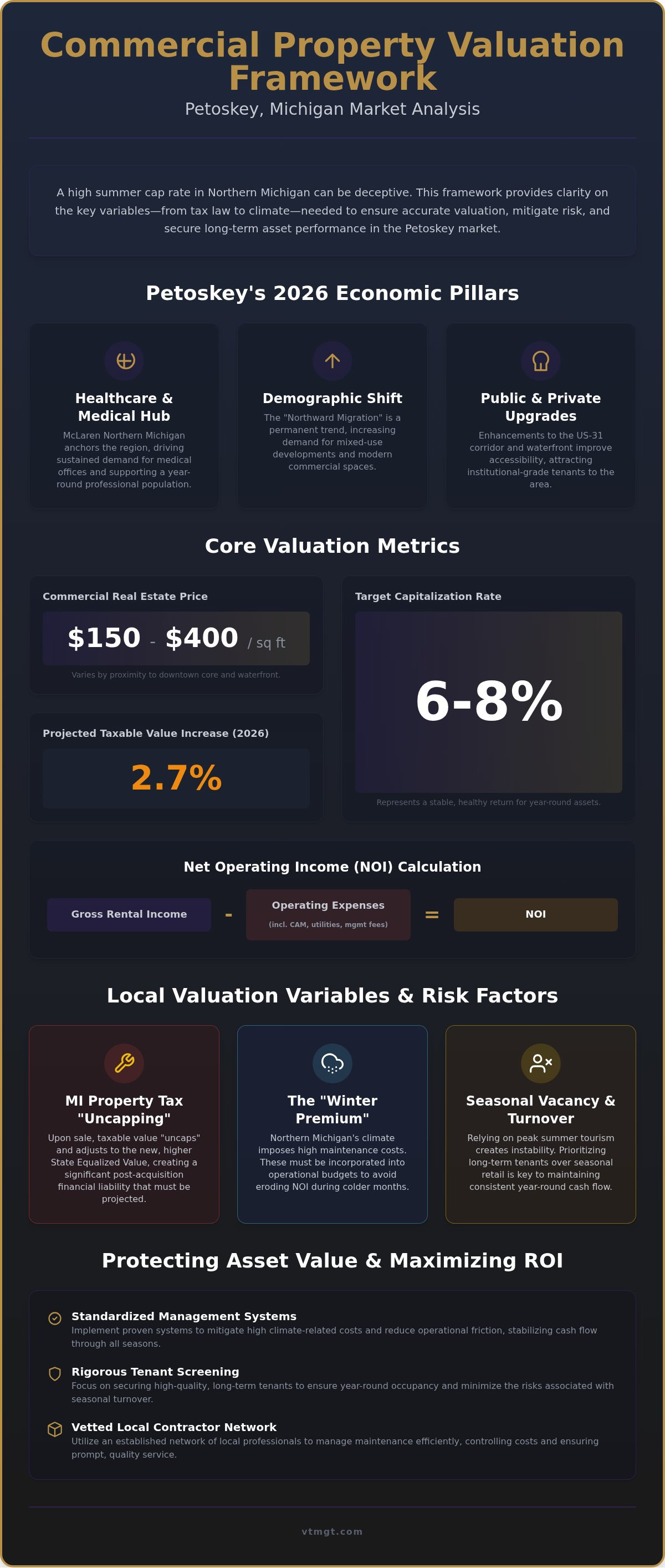
The "Northward Migration" has evolved from a temporary trend into a permanent demographic shift. Professional populations are increasingly relocating to Northern Michigan, driving sustained demand for mixed-use developments and modern office spaces. As of late 2026, the market has entered a more normalized phase compared to the inventory shortages of 2024. However, commercial supply remains tight. This scarcity supports property values, with commercial real estate prices currently ranging from $150 to $400 per square foot depending on proximity to the downtown core or the waterfront.
Macro-Economic Drivers in Emmet County
The expansion of regional healthcare facilities is the primary catalyst for medical office demand. McLaren Northern Michigan’s influence extends beyond its immediate campus, creating a ripple effect through the Indian River and Boyne City commercial corridors. These areas are seeing increased activity as the year-round professional population grows. When applying standard real estate valuation methods, analysts must account for these major infrastructure investments. Projects like the US-31 Corridor enhancements and waterfront upgrades have fundamentally improved accessibility, making long-term commercial assets more appealing to institutional-grade tenants.
The Long-Term vs. Seasonal Landscape
Seasonal retail in downtown Petoskey offers high visibility during peak months but carries significant opportunity costs due to winter turnover. We prioritize long-term commercial assets because they allow for the implementation of standardized management systems that stabilize cash flow throughout the year. The regulatory environment in Emmet County is increasingly supportive of mixed-use redevelopment; this is evidenced by the 2026 rehabilitation of downtown landmarks like the former Leo's Tavern. Investors must balance the allure of summer-peak retail with the structural necessity of year-round occupancy to maintain a healthy 6% to 8% cap rate. Successful valuation in this region requires a disciplined look at how a property performs during the "shoulder seasons" rather than just the high-demand summer months.
Financial Metrics for Accurate Petoskey Property Valuation
Precision in financial modeling is the only safeguard against the seasonal volatility inherent in the Northern Michigan market. A professional commercial property valuation Petoskey relies on the rigorous application of the income approach to determine an asset's true market position. We prioritize technical data over speculative growth, ensuring that every acquisition is supported by a structured analysis of cash flow and operational liabilities.
Calculating Net Operating Income (NOI)
Net Operating Income (NOI) is defined as Gross Rental Income minus all operating expenses except debt service. To maintain the integrity of this metric, we account for local utility escalations and common area maintenance (CAM) costs that often fluctuate due to the regional climate. It is essential to factor in professional commercial property management Northern Michigan fees during this phase. Including these costs ensures the valuation reflects real-world operational requirements rather than idealized projections that fail to account for the complexities of local oversight.
Cap Rate and Market Comparison
Average cap rates in Petoskey have stabilized between 6% and 8% as of mid-2025, providing a reliable benchmark for regional yield expectations. While these rates are competitive, they must be weighed against larger Michigan markets like Grand Rapids or Traverse City. Identifying accurate "comps" requires a focused analysis of Emmet and Charlevoix counties, where the Michigan property tax system and local millage rates directly impact net yields. The duration and structure of existing leases also play a critical role; long-term agreements with credit-worthy tenants typically compress cap rates but provide the stability necessary for institutional-grade portfolios.
We standardize vacancy rates at 5% to 8% to account for regional market cycles and the friction associated with specialized tenant placement. For investors utilizing leverage, calculating the Cash-on-Cash return is a mandatory step in the valuation process. With Michigan mortgage rates for commercial assets remaining significant in 2026, the spread between the cost of capital and the asset's cap rate must be wide enough to maintain a healthy debt service coverage ratio. Utilizing standardized management systems allows owners to minimize operational friction and protect these calculated margins against unforeseen maintenance spikes or tenant turnover. This disciplined approach to financial metrics transforms a speculative purchase into a predictable, long-term commercial asset.
Local Valuation Variables: Taxes, Climate, and Maintenance
Accurate commercial property valuation Petoskey requires more than a review of current rent rolls; it demands a technical audit of statutory tax resets and climate-driven operational expenses. Investors often fail to account for the erosion of net income caused by local variables that are unique to the Emmet County landscape. We mitigate these risks by applying standardized management frameworks to every asset under our oversight, ensuring that calculated yields remain resilient against regional fluctuations.
Navigating Michigan Property Tax Laws
The most significant statutory risk for new investors is Michigan’s "uncapping" rule. When a commercial property title transfers, the Taxable Value resets to match the State Equalized Value (SEV), which represents approximately 50% of the true market value. While the state-mandated taxable value increase for 2026 is limited to 2.7% for existing owners, a new acquisition triggers a substantial tax reset in the second year of ownership. In Petoskey, where the median effective property tax rate is approximately 0.85% for Emmet County, this "tax shock" can destabilize a leveraged investment if the post-sale liability isn't accurately projected. Reviewing Michigan landlord laws is essential to ensure that lease structures allow for the pass-through of these increasing tax burdens where applicable.
Seasonal Maintenance and Asset Preservation
The Northern Michigan climate introduces a "Winter Premium" that must be factored into every valuation model. Commercial structures in the 49770 zip code require aggressive preventative care, including ice dam prevention, professional roof shoveling, and specialized HVAC winterization. These are not elective services; they are structural requirements to preserve the long-term integrity of the asset. Historic buildings in downtown Petoskey are particularly susceptible to deferred maintenance risks, such as masonry fatigue and aging roofing systems. We utilize a vetted network of local contractors to execute rental property maintenance Northern Michigan, ensuring that costs remain predictable and asset devaluation is prevented. Standardizing these maintenance workflows allows owners to maintain the calculated ROI even during the most severe winter cycles, protecting the asset from the high costs of emergency repairs.
Risk Assessment: Common Pitfalls in Northern Michigan Investing
A precise commercial property valuation Petoskey must account for the psychological trap of peak-season data. Investors frequently overestimate annual rental income by extrapolating summer retail performance across the entire fiscal year. This optimism ignores the reality that many boutique or hospitality-focused tenants struggle during the first quarter. Failing to bake standardized management fees into the initial ROI projection is another common error; these costs aren't optional expenses but are structural requirements for maintaining asset stability in a remote market. Accurate modeling requires a disciplined approach that prioritizes year-round occupancy over summer-peak lease rates.
Tenant Quality vs. Lease Rate
The hidden cost of tenant turnover in a small community like Petoskey is often underestimated. While a higher square-foot rate looks attractive on a pro forma, a tenant who fails after six months triggers marketing costs, legal fees for lease termination, and lost revenue during the "shoulder season" vacancy. Comprehensive screening and placement are more valuable than a slightly higher lease rate. We utilize standardized systems to evaluate tenant creditworthiness and business viability, reducing vacancy duration and ensuring that the tenants in your Emmet County assets contribute to long-term stability rather than short-term volatility. Maintaining a high-quality tenant base is the most effective way to protect the asset's structural floor.
Regulatory and Compliance Risks
Regulatory shifts in Northern Michigan can fundamentally alter an asset's utility. For example, as of May 2026, new short-term rentals in Petoskey are restricted strictly to business districts. Mixed-use assets also require strict adherence to Fair Housing Act considerations for their residential components. Local ordinances regarding signage, parking, and exterior maintenance in the B-2 Central Business District are designed to preserve historic character; ignoring these leads to significant fines. Zoning amendment fees, currently $600 for map amendments and $750 for text amendments, should be factored into any redevelopment plan. Pro-active risk management through professional property management in Petoskey ensures that your portfolio remains compliant with these evolving local standards.
Maintaining a disciplined approach to these variables is the only way to protect your principal. To ensure your portfolio is built on verified data rather than seasonal projections, partner with Van Treese Management for comprehensive commercial oversight and strategic asset preservation.
Maximizing ROI with Standardized Management Systems
A successful commercial property valuation Petoskey is only as accurate as the operational framework that follows the acquisition. While the initial financial modeling establishes the potential yield, the actualized ROI depends on the mitigation of operational friction. Standardized management systems serve as the technical engine that protects an asset's value from the inefficiencies of reactive maintenance and inconsistent tenant oversight. By implementing structured processes for every phase of the investment lifecycle, owners can ensure that their long-term cash flow projections remain resilient against the specific pressures of the Northern Michigan market.
The stability of a commercial asset is frequently tied to the quality of its physical preservation. We maintain a vetted local contractor network specifically trained in our standardized maintenance systems. This proactive approach prevents the high costs associated with emergency repairs in Emmet and Charlevoix counties. Beyond physical care, rigorous financial reporting acts as a vital tool for ongoing performance analysis. Accurate accounting allows investors to track every dollar of Net Operating Income, providing the data necessary for mid-cycle valuation adjustments and strategic refinancing decisions.
The Van Treese Advantage in Petoskey
We believe that building thriving local communities requires a balance of professional human interaction and disciplined technology. Our standardized systems for rent collection and lease compliance eliminate the ambiguity that often leads to tenant disputes or revenue loss. We provide 24/7 emergency response coordination, ensuring that critical issues are addressed before they escalate into structural liabilities. By leveraging ongoing Northern Michigan market research, we help our partners navigate shifting demand cycles in the 49770 zip code. This continuous oversight ensures that your property is positioned for long-term appreciation through professional, high-standard management that exceeds the capabilities of traditional brokerage models.
Data-Driven Commercial Property Analysis
The difference between a "market guess" and a standardized valuation report lies in the depth of the technical data utilized. We move beyond surface-level listing prices to analyze the specific economic drivers of Petoskey and Boyne City. Our analysis helps investors identify hidden opportunities in underperforming assets that can be stabilized through the application of professional management frameworks. This structured approach transforms a speculative purchase into a predictable industrial-grade asset. To ensure your investment is supported by precision and local expertise, contact Van Treese Management for a detailed property analysis and take the first step toward securing a stable, high-performing commercial portfolio.
Securing Long-Term Asset Stability in Northern Michigan
Achieving a precise commercial property valuation Petoskey requires a shift from speculative projections to a data-driven framework that accounts for Michigan's unique tax resets and the regional climate. Success in this market isn't found in chasing summer retail peaks; it's found in the disciplined application of standardized management systems that stabilize cash flow throughout the year. By quantifying the "Winter Premium" and anticipating 2026 tax liabilities early, you position your portfolio for resilience and long-term appreciation.
We provide the detailed Northern Michigan market research and vetted local contractor network necessary to execute these complex strategies. Our focus on technical precision ensures that your property remains a high-performing asset regardless of seasonal shifts or economic cycles. This structured approach transforms operational complexity into predictable growth, allowing you to focus on portfolio expansion rather than day-to-day friction.
Secure Your Northern Michigan Investment with Professional Management
We look forward to partnering with you to build a stable and profitable commercial future in Emmet County.
Frequently Asked Questions
Is Petoskey a good place for commercial property investment in 2026?
Petoskey remains a stable environment for commercial investment in 2026 due to its diverse economic foundation. The combination of healthcare expansion at McLaren Northern Michigan and a permanent shift toward year-round professional residency provides a consistent floor for demand. While the market has transitioned from the rapid growth of 2024 to a more normalized phase, limited inventory in the B-2 Central Business District continues to support long-term appreciation for well-managed assets.
What is a typical Cap Rate for commercial rentals in Petoskey, MI?
Typical cap rates for commercial assets in the Petoskey region generally stabilize between 6% and 8% as of mid-2025. These yields reflect the market's balance between tourism-driven retail volatility and the steady income generated by medical or professional office spaces. Achieving these returns requires a technical approach to commercial property valuation Petoskey that accounts for local operational costs. Investors should compare these figures against larger Michigan markets to ensure their risk-adjusted returns remain competitive.
How do property taxes work for Michigan commercial properties after a sale?
Michigan operates under an "uncapping" rule that triggers a property tax reset upon the transfer of ownership. While annual taxable value increases are capped at 2.7% for 2026 for existing owners, a sale allows the local assessor to reset the taxable value to match the State Equalized Value (SEV). This often results in a significant tax liability increase in the second year of ownership. Investors must estimate these post-sale millage rates during due diligence to avoid income erosion.
Should I choose a long-term or seasonal lease for my Petoskey commercial space?
We prioritize long-term leases because they provide the structural stability required for predictable ROI. While seasonal retail leases in downtown Petoskey may offer higher peak-summer rates, they carry significant opportunity costs related to winter vacancies and tenant turnover friction. Long-term agreements with credit-worthy tenants reduce the administrative burden of frequent placement and allow for the implementation of standardized management systems. This approach ensures consistent cash flow regardless of the regional tourism cycle.
What are the most common maintenance issues for Northern Michigan commercial buildings?
The Northern Michigan climate presents specific challenges, most notably ice dam formation and heavy snow loads on commercial flat roofs. Preventative maintenance must include professional roof shoveling and aggressive gutter clearing to prevent structural water damage. Additionally, HVAC systems require specialized winterization to handle extreme temperature fluctuations. Utilizing a vetted local contractor network for these tasks is essential to mitigate the "Winter Premium" and preserve the long-term integrity of the building envelope.
How much do property management firms in Petoskey typically charge for commercial assets?
Commercial management fees in the Petoskey market are structured to reflect the complexity of the asset and the scope of required oversight. These professional fees typically cover lease compliance, common area maintenance coordination, and detailed financial reporting. Rather than focusing solely on the fee percentage, investors should evaluate the value of standardized systems in reducing vacancy and maintenance costs. Professional administration ensures that the calculated ROI is protected through disciplined operational control and rigorous tenant screening.
What are CAM charges and how are they calculated in Northern Michigan?
Common Area Maintenance (CAM) charges represent the tenant's pro-rata share of operating expenses for shared spaces, including parking lot plowing, landscaping, and exterior lighting. In Northern Michigan, these calculations must account for the high costs of snow removal and seasonal maintenance. Calculations are typically based on the square footage occupied by each tenant relative to the total leasable area. Accurately projecting these costs during a commercial property valuation Petoskey ensures that lease agreements remain fair and sustainable.
How does the McLaren Northern Michigan hospital impact local commercial valuations?
McLaren Northern Michigan serves as a primary economic anchor that stabilizes commercial valuations throughout the 49770 zip code. The hospital’s presence drives consistent demand for medical office space and professional services, insulating the local market from broader economic downturns. This healthcare infrastructure creates a ripple effect, supporting nearby retail and hospitality sectors that cater to employees and visitors. Investors often view proximity to this medical hub as a significant factor in reducing long-term vacancy risk and securing high-quality tenants.