
Capital Expenditures on Rental Property: The 2026 Landlord’s Strategic Guide
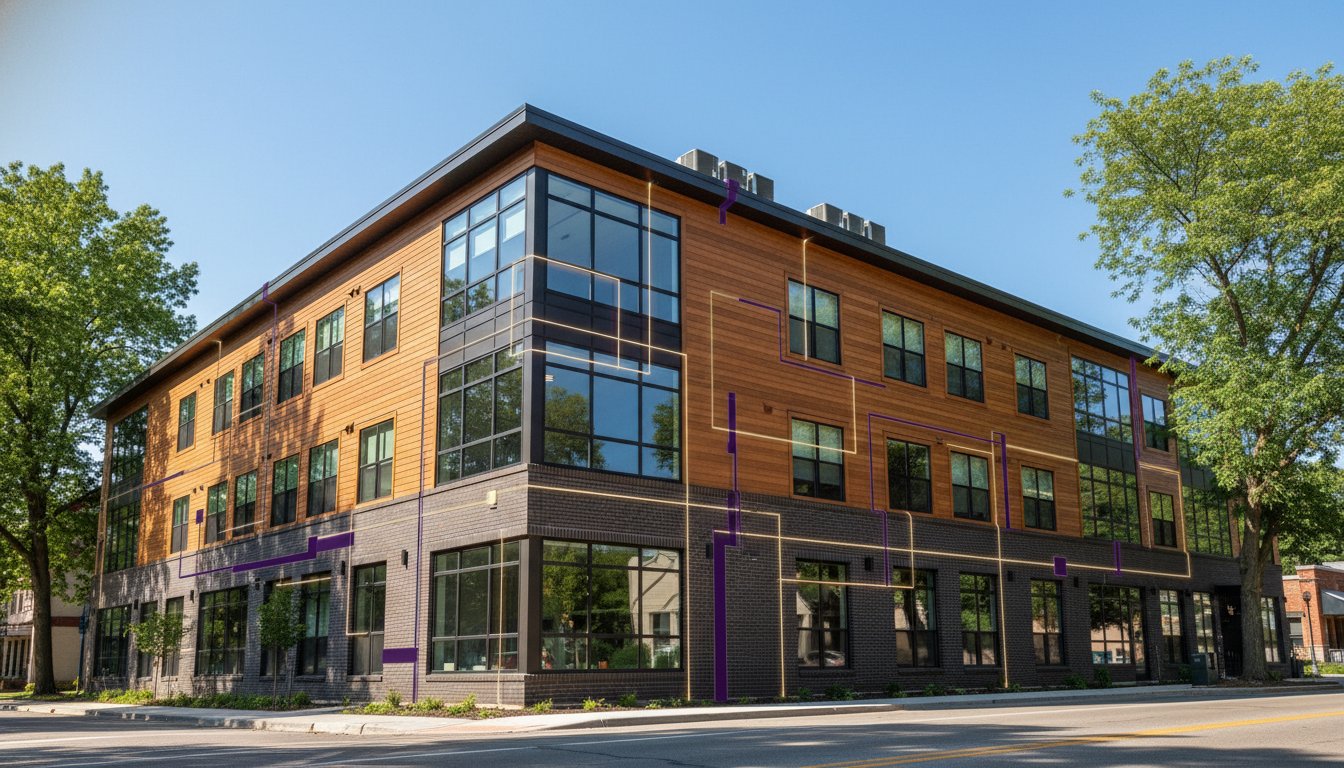
For a landlord in Petoskey or Boyne City, a failing HVAC system in mid-January isn't just a maintenance emergency; it's a critical test of your long-term capital strategy. While routine repairs keep a building functional, the way you classify and fund capital expenditures on rental property determines whether your Northern Michigan investment thrives or merely survives. You've likely felt the frustration of deciphering complex IRS "Betterment, Restoration, Adaptation" rules while facing a five-figure estimate for a structural roof replacement in a region where reliable vendors are often booked months in advance.
We understand that managing high-value assets requires a disciplined, technical approach to financial reporting and maintenance coordination. This guide provides a professional framework to help you master the distinction between immediate expenses and long-term improvements. You'll learn how to leverage the permanent 100% bonus depreciation established by the One Big Beautiful Bill Act to maximize your 2026 tax benefits. We also examine a data-backed budgeting model that accounts for the 20% to 35% increase in material costs seen since 2020. This analysis ensures you maintain full control over your property’s lifecycle and long-term appreciation through precise, structured financial planning.
Key Takeaways
- Apply the "BAR" framework—Betterment, Restoration, and Adaptation—to accurately define which property improvements qualify for long-term depreciation.
- Distinguish routine repairs from capital expenditures on rental property by applying the "one-year rule" to protect against IRS audits and maximize tax benefits.
- Utilize structured budgeting strategies, such as the 1% rule or the square foot method, to build resilient financial reserves for major asset replacements.
- Account for Northern Michigan’s specific environmental stressors, such as extreme snow loads, which significantly accelerate the replacement lifecycle of critical building systems.
- Leverage professional maintenance coordination and standardized reporting to identify capital needs early and secure competitive pricing through vetted vendor networks.
Understanding Capital Expenditures (CapEx) in Real Estate
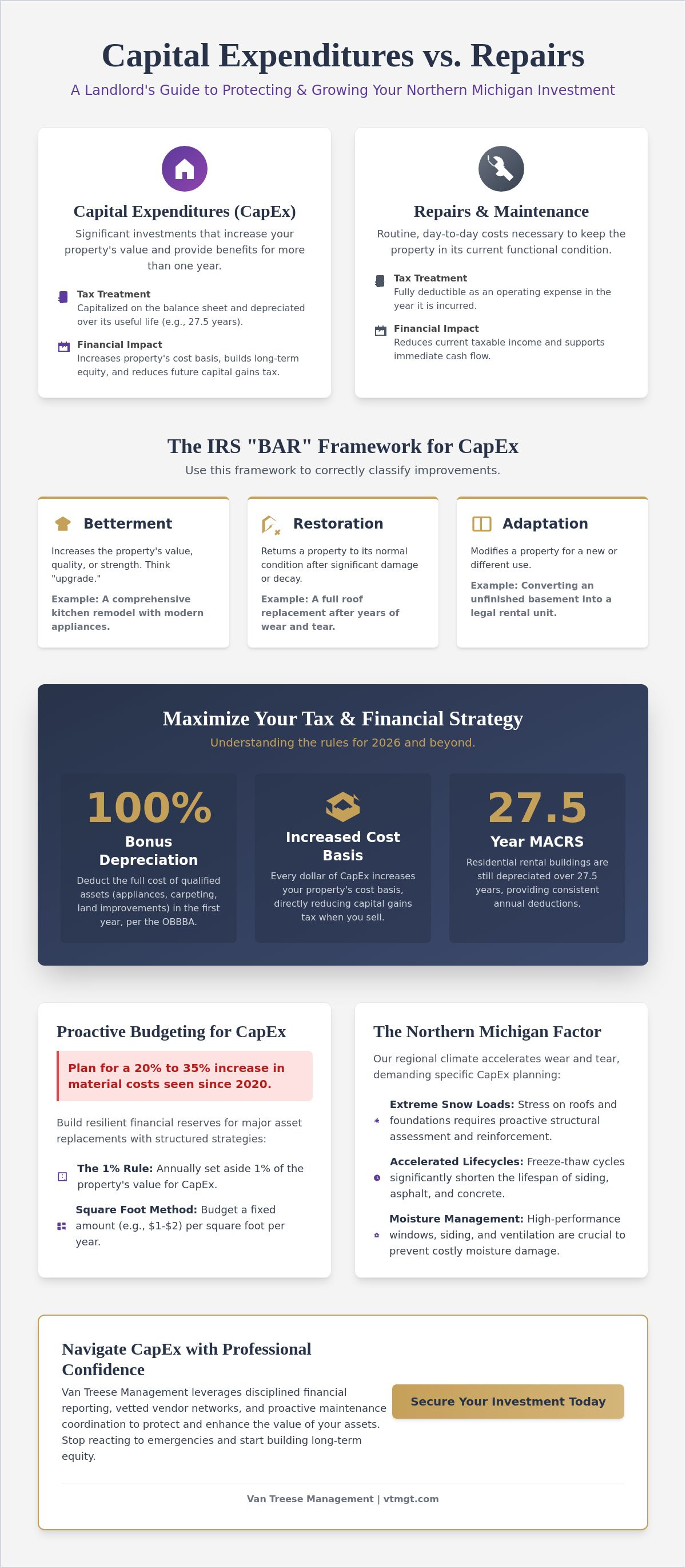
In a disciplined investment strategy, distinguishing between routine maintenance and a Capital expenditure is essential for long-term portfolio stability. A capital expenditure represents a significant investment in a physical asset that provides a benefit lasting beyond a single tax year. It's about precision. Unlike operating expenses (OpEx), which cover day-to-day costs like property taxes or minor leaks, capital expenditures on rental property are capitalized on the balance sheet and recovered over time through depreciation. This technical distinction is vital because it affects your immediate cash flow, your tax liability, and the structural value of your Northern Michigan holdings.
The IRS utilizes the "BAR" framework to categorize these costs, and we apply this same rigor to our financial reporting processes. Betterment refers to an expenditure that increases the property's value, quality, or strength. Restoration involves returning a property to its normal condition after significant damage or decay. Adaptation occurs when you modify a property for a new or different use. This structured approach ensures that every dollar spent is correctly classified for both tax compliance and internal performance tracking. We don't view these as mere costs; they're strategic reinvestments in the asset’s lifecycle that build long-term equity.
The 2026 Tax Landscape for Capital Improvements
The regulatory environment for 2026 offers unique advantages for proactive landlords who understand the shifting rules. Under the One Big Beautiful Bill Act (OBBBA), 100% bonus depreciation is now a permanent fixture for qualified property acquired and placed in service after January 19, 2025. This allow you to deduct the full cost of eligible assets, such as appliances, carpeting, or land improvements, in the very first year. While residential rental buildings still follow the standard 27.5-year MACRS depreciation period, these accelerated deductions for specific components provide a powerful tool for immediate tax relief. Each capital improvement you make also increases the property's cost basis, which directly reduces your potential capital gains liability when you eventually sell the asset.
Common Examples of Residential CapEx
Capital projects are typically classified by their impact on the building's core systems or structural integrity. We categorize these into three primary groups to help our clients plan their reserves:
- Structural Upgrades: This includes full roof replacements, foundation stabilization, and the installation of high-durability siding designed for Northern Michigan's climate.
- Systemic Improvements: Complete HVAC overhauls, whole-house plumbing repiping, and electrical panel upgrades to meet modern load demands.
- Interior Betterments: Comprehensive kitchen or bathroom remodels and the addition of finished square footage, such as a basement conversion or a new deck.
Focusing on these high-impact capital expenditures on rental property ensures your investment retains its competitive edge in the Petoskey and Boyne City markets. By treating these improvements as engineering projects rather than simple repairs, you ensure the long-term viability of your real estate portfolio.
CapEx vs. Repairs: The Critical Distinction for Landlords
Misclassifying a financial transaction isn't merely a clerical error; it's a structural risk to your investment's stability. If you expense a major roof replacement as a routine repair, you invite a potential IRS audit. Conversely, if you capitalize a minor plumbing fix, you lose the immediate tax savings that support your current cash flow. Precise classification ensures your financial reporting remains beyond reproach and aligns with the technical standards required for high-performing assets. Understanding the threshold for capital expenditures on rental property is the first step in maintaining a transparent and compliant ledger.
The primary technical filter for this decision is the "One-Year Rule." If an expenditure provides a functional benefit that extends beyond 12 months, it generally qualifies as a capital improvement. However, landlords should also leverage the De Minimis Safe Harbor. For the 2026 tax year, the threshold remains at $2,500 per item or invoice for taxpayers without an applicable financial statement. This provision allows you to immediately expense smaller purchases that might technically be capital in nature, such as a single appliance or a mid-range water heater. For a deeper technical breakdown of these regulations, IRS Publication 527 serves as the definitive guide for residential rental property standards.
While major upgrades are inevitable, proactive rental property maintenance in Northern Michigan is the most effective method for extending the lifecycle of your building systems. Consistent inspections and minor adjustments prevent small mechanical failures from escalating into premature capital expenditures on rental property.
The Repair vs. Improvement Decision Matrix
Differentiating between these categories requires a structured evaluation of the work performed. Consider these common scenarios found in the Petoskey and Boyne City markets:
- Plumbing: Fixing a localized leak or replacing a single faucet is a repair. Replacing the entire plumbing stack or installing a new main sewer line is a capital improvement.
- Surfaces: Patching cracks or filling potholes in a driveway is a repair. A full asphalt resurfacing or the installation of a new concrete pad is a capital improvement.
- Aesthetics: Touch-up painting during a tenant turnover is a repair. A complete exterior siding paint job that provides a new protective layer to the structure is a capital improvement.
Financial Impact of the Distinction
The distinction between these categories creates a divergent impact on your balance sheet. Repairs offer immediate cash flow benefits because you deduct the full cost in the current tax year, reducing your taxable income instantly. Capital improvements, while requiring depreciation over 27.5 years for residential structures, build long-term equity and increase the asset's overall valuation. Utilizing professional financial reporting and accounting ensures that every dollar spent is tracked with precision, providing a clear audit trail and optimized tax outcomes for your portfolio.
Budgeting for CapEx: Strategies for Northern Michigan Investors
Effective financial stewardship requires a transition from reactive spending to a structured reserve strategy. While the legal definition of capital expenditures establishes the boundary for what must be capitalized, it doesn't dictate the specific methodology for accumulating the necessary capital. We advocate for a data-driven approach that accounts for both the physical dimensions of the asset and the current economic climate. In 2026, landlords must navigate a landscape where construction material costs for HVAC systems and roofing have increased by 20% to 35% compared to pre-2020 levels. A disciplined budget ensures that capital expenditures on rental property are funded through consistent contributions rather than disruptive, out-of-pocket hits.
Two primary frameworks dominate professional budgeting: the 1% Rule and the Square Foot Method. The 1% Rule suggests allocating one percent of the property’s total value annually for major items. However, institutional data in 2026 indicates that for buildings over 30 years old, this figure should ideally rise to 2.4% or higher. Alternatively, the Square Foot Method estimates reserves based on the physical size of the asset, which is often more accurate for commercial or multi-unit residential properties. Regardless of the method, the persistent Northern Michigan labor shortages in 2026 necessitate an additional 10% to 15% buffer in your reserves to account for premium contractor rates and extended project timelines.
The most precise technique is component-based budgeting. This involves maintaining a detailed ledger that tracks the installation date, cost, and remaining useful life of every major system. By treating the property as a collection of interdependent mechanical and structural components, you can predict exactly when a boiler or a roof will reach its failure point. This level of technical oversight transforms capital expenditures on rental property from unpredictable emergencies into scheduled, manageable engineering projects.
Building and Managing a Capital Reserve Account
Maintaining a dedicated, interest-bearing escrow or savings account for CapEx funds is a non-negotiable requirement for long-term stability. This separation of funds prevents "CapEx shock," which occurs when multiple high-value systems fail within the same fiscal year. Successful investing in rental property in Northern Michigan requires more aggressive reserves due to seasonal wear and the rapid degradation caused by extreme temperature fluctuations. We recommend automated monthly transfers to ensure your reserve targets are met without exception.
Strategic Sequencing of Improvements
Prioritizing the building envelope is the most effective way to protect your equity. Roofs, windows, and siding must be addressed first to prevent moisture infiltration from damaging interior assets. When possible, sequence these major upgrades during tenant turnovers to minimize vacancy loss and operational friction. In competitive markets like Traverse City or Petoskey, these documented capital improvements provide the technical justification for rent increases, as they directly enhance the tenant's quality of life and the property's overall efficiency.
Regional Climate Impacts on CapEx Planning in Petoskey & Beyond
Environmental stressors in Northern Michigan impose a "climate tax" on physical assets that standard national budgeting models fail to address. While a property in a temperate zone might see a roof last 25 years, the freeze-thaw cycles and extreme snow loads of Emmet County often compress this lifecycle significantly. For a landlord, these environmental realities transform routine maintenance into essential capital expenditures on rental property. Ignoring the technical requirements of a cold-weather climate leads to premature structural failure and restorative costs that could have been mitigated through proactive engineering and adaptation.
Roofing systems require specific capital attention due to the persistent threat of ice dams and snow accumulation. In 2026, high-performance roofing CapEx involves more than just shingle replacement; it includes the installation of robust ice and water shields and improved ventilation systems to manage thermal transfer. Similarly, HVAC strategy has shifted toward high-efficiency dual-fuel systems. These units are no longer just "green" upgrades. They're critical adaptations that ensure property habitability during sub-zero stretches while managing the 20% to 35% increase in energy and material costs observed since 2020. Lake-effect humidity also necessitates a disciplined approach to exterior siding and deck longevity, where moisture-resistant materials are the only viable long-term capital choice.
Winter-Proofing as a Capital Investment
Upgrading a building's thermal envelope through advanced insulation and precision air sealing qualifies as an "Adaptation" under the IRS framework. These improvements do more than lower utility bills; they protect the building's core structure from moisture-related decay. Installing heated gutter systems is another strategic capital move that prevents the need for expensive structural restoration caused by water backup. These priorities are often driven by Michigan landlord laws regarding habitability, which mandate that heating and structural integrity meet specific standards throughout the winter season. Failure to plan for these upgrades can result in both legal liability and asset devaluation.
Local Vendor Coordination for Major Projects
The 2026 labor market in resort towns like Charlevoix and Petoskey remains exceptionally tight, making vendor coordination a primary operational challenge. The seasonal nature of construction in Northern Michigan means that the most reliable contractors are often fully committed months in advance. Booking major capital expenditures on rental property 6 to 12 months ahead of the target start date has become the new industry standard. This lead time allows for precise project scoping and ensures you don't over-improve for the local market by using overly specialized materials that are difficult to service locally. Professional maintenance coordination is essential to navigate these scheduling complexities and maintain the structural integrity of your portfolio.
Professional Execution: How Van Treese Manages Your CapEx Lifecycle
While software can track a balance sheet, it can't oversee a structural roof installation or verify the quality of a high-efficiency HVAC overhaul. We bridge the gap between financial theory and physical execution through standardized management systems. By identifying capital expenditures on rental property during routine inspections, we eliminate the operational friction of emergency replacements. Our approach treats your property as a complex mechanical system that requires disciplined, human oversight to maintain its peak performance and market value. We don't just record costs; we manage the engineering lifecycle of your asset.
We leverage a vetted network of local contractors to secure competitive pricing for our clients. Because we manage a high volume of assets in Petoskey and Boyne City, we're able to negotiate priority scheduling and better rates than an individual owner can achieve alone. Our financial reporting and accounting systems are built with technical precision. We provide clear, categorized statements that separate operating expenses from capital improvements, ensuring your CPA has an accurate data set for year-end tax filings. This structured documentation is essential for maximizing the tax benefits provided by current depreciation laws.
Maintenance Coordination and Vendor Oversight
Our maintenance coordination team manages the entire lifecycle of a capital project. We handle the technical bidding process for major replacements, ensuring that every quote is evaluated against current market standards and material specifications. We don't just hire a vendor; we provide on-site project management to ensure the work meets our quality benchmarks. This oversight is particularly valuable for out-of-area owners who need a reliable partner to manage large-scale renovations without the stress of daily site visits. We maintain full control over the process from the initial scope to the final inspection.
Maximizing ROI Through Strategic Improvements
Not all capital expenditures on rental property yield the same return. We consult with our clients on which improvements provide the highest rent premiums in the specific Northern Michigan market. Using detailed market research and historical performance data, we validate your investment decisions before a single dollar is spent. This ensures your capital is deployed into projects that enhance both immediate cash flow and long-term equity. Partner with Van Treese Management to streamline your property’s long-term financial strategy and ensure your assets are managed with engineering-level precision.
Optimizing Your Investment for Long-Term Structural Stability
Managing a property portfolio in Petoskey or Boyne City requires more than simple oversight; it demands a technical understanding of asset lifecycles and tax regulations. By applying the BAR framework and building resilient reserves, you protect your capital from the accelerated degradation caused by Northern Michigan's extreme climate. Precise classification of capital expenditures on rental property ensures that your financial reporting remains compliant while maximizing the benefits of the 2026 tax landscape. This disciplined approach transforms your real estate from a collection of maintenance tasks into a high-performing financial engine.
Since 2018, we've provided standardized maintenance systems and detailed financial reporting to landlords throughout Emmet and Charlevoix counties. Our local expertise allows us to identify CapEx needs before they become structural emergencies, ensuring your investment remains competitive and profitable. Get a Professional Property Management Quote for Your Northern Michigan Rental today to secure your property's future. With a structured strategy in place, you can grow your investment with confidence and precision.
Frequently Asked Questions
Is a new roof considered a capital expenditure or a repair?
A full roof replacement is classified as a capital expenditure on rental property because it constitutes a restoration of a major structural component. Unlike minor shingle patching or leak mitigation, which are routine repairs, a total installation extends the asset's functional lifecycle and increases its overall value. This distinction is critical for maintaining an accurate balance sheet and ensuring compliance with IRS "Restoration" standards.
How long do I have to depreciate capital improvements on a residential rental?
Standard capital improvements to the building structure are depreciated over a 27.5-year period using the Modified Accelerated Cost Recovery System (MACRS). However, specific components like appliances or land improvements may qualify for shorter recovery periods. Under the One Big Beautiful Bill Act of 2026, 100% bonus depreciation remains a permanent option for qualified personal property, allowing for immediate first-year deductions on eligible items.
Can I use CapEx to justify a rent increase in Michigan?
Michigan law does not impose rent control, allowing landlords in markets like Petoskey or Boyne City to adjust rates based on property enhancements. Strategic capital investments that improve tenant utility or energy efficiency provide the technical justification for market-rate increases. Documenting these improvements helps demonstrate the increased value of the living space during lease negotiations or renewals.
What is the De Minimis Safe Harbor limit for landlords in 2026?
The De Minimis Safe Harbor threshold remains at $2,500 per item or invoice for the 2026 tax year for taxpayers without an applicable financial statement. This provision allows you to treat smaller purchases as current expenses rather than capital improvements. It's a precise tool for managing cash flow, as it permits the immediate deduction of items like mid-range appliances or water heaters that would otherwise require depreciation.
How much should I save monthly for capital expenditures in Northern Michigan?
A disciplined reserve strategy involves saving 1% to 2.4% of the property's total value annually. For buildings in Northern Michigan that are over 30 years old, this figure should ideally increase toward 4% to account for extreme environmental stressors. Dividing this annual target by 12 ensures you have a consistent, structured fund to handle major system failures without disrupting your operational liquidity.
Does painting the interior of a rental count as CapEx?
Interior painting is typically categorized as a routine repair or maintenance expense, not a capital improvement. It's considered a cost of keeping the property in an ordinary efficient operating condition. The only technical exception is when painting is performed as part of a larger, comprehensive restoration or a significant structural addition that qualifies as a betterment under the BAR framework.
What happens to my CapEx depreciation if I sell the property?
When you sell an asset, you're subject to depreciation recapture on the capital expenditures on rental property you've claimed over the years. The IRS taxes the portion of the gain attributable to depreciation at a maximum rate of 25%. This recapture is a standard part of the exit strategy and underscores the importance of precise financial reporting throughout the entire ownership period.
Are energy-efficient window upgrades considered CapEx or a tax credit item?
Energy-efficient window upgrades are primarily capital improvements because they provide a long-term betterment to the building envelope. While they're capitalized and depreciated over time, they also frequently qualify for federal or state-level tax credits, such as the Energy Efficient Home Improvement Credit. This dual benefit allows landlords to increase property value while simultaneously reducing their immediate tax liability through specialized incentives.