
The Value of a Professional Lease Agreement: What Landlords Gain

What if the lease you use to simplify renting leaves out details that shape how your property is managed? The value of a professional lease agreement lies not just in having written terms, but in recording the rental arrangement, property details, and expectations that matter to the people involved. A generic template can provide a starting point, but it may not reflect the practical details of your tenancy.
Preparing an agreement involves more than filling in names and dates. Owners need to confirm that the property information and agreed terms are accurate, and consider how the lease connects with tenant screening, communication, and day-to-day property operations. A well-prepared agreement gives owners and tenants a shared reference for their responsibilities and expectations.
In this article, you’ll learn how professional preparation differs from relying on a template alone, what to consider when deciding how your lease should be prepared, and how written expectations can support consistent rental management. We’ll also look at how lease preparation connects with marketing, applications, screening, rent reporting, tenant communication, and property oversight across Northern Michigan.
Key Takeaways
- The value of a professional lease agreement depends on how well its written terms reflect the property and the actual rental arrangement.
- A generic template can be a starting point, but owners still need to check that its details fit the property, agreed terms, and management needs.
- Connect lease preparation with the tasks that follow, including tenant communication, rent reporting, and maintenance coordination.
- Before deciding how to prepare a lease, identify the property type, clarify the rental arrangement, and plan for ongoing management tasks.
- Van Treese Management connects lease preparation with leasing and screening services for residential properties in Petoskey and surrounding Northern Michigan communities.
What Is the Value of a Professional Lease Agreement for a Landlord?
A landlord deciding how to document a rental arrangement can start with a generic template or use professional lease preparation. The value of a professional lease agreement comes from organizing the written terms around the actual property and the parties’ arrangement, instead of assuming a general form captures every relevant detail. It gives both sides a clearer reference for what they have agreed to, supporting more consistent conversations during the tenancy.
A professional lease agreement is a written record of rental terms agreed upon by the landlord and tenant. It brings those terms together in one document, rather than leaving expectations scattered across conversations or informal notes. For a general introduction to leases and their common elements, see Understanding Lease Agreements.
The agreement has a defined role. It can make expectations easier to review and discuss, but it doesn’t manage the property or guarantee a problem-free tenancy. Owners still need to plan for ongoing tasks such as tenant communication, rent collection, and maintenance coordination. The lease supports that work by documenting the arrangement those tasks relate to.
What does a lease agreement document in practice?
An agreement typically records the rental property, the parties, the rental period, and responsibilities they have agreed to. The details to include depend on the property and arrangement. For example, a unit in a multifamily building may involve shared areas and related expectations, while a single-family home has different property details to record.
A signed document is not a substitute for day-to-day tenancy management. It provides a written point of reference; regular communication and operational follow-through remain separate responsibilities.
Why can a generic template leave owners with questions?
A template offers a structure, but owners still need to decide which fields and terms apply, enter accurate details, and assess whether the form reflects their arrangement. Ask practical questions as you review it: Are the property details specific enough? Are the parties’ agreed responsibilities clear? Does the document match the rental period and expectations discussed?
Incomplete details or unclear wording can leave room for questions later. Professional preparation focuses on organizing the written terms around the actual rental setup, helping owners communicate expectations clearly without promising that disagreements will never arise.
The useful comparison is not simply “document versus no document.” It is whether the chosen approach captures the terms that matter for this property and gives both parties a shared reference. A carefully prepared agreement can support clarity and consistency, while ongoing management keeps the tenancy operating in practice.
How Professional Lease Preparation Connects to Rental Operations
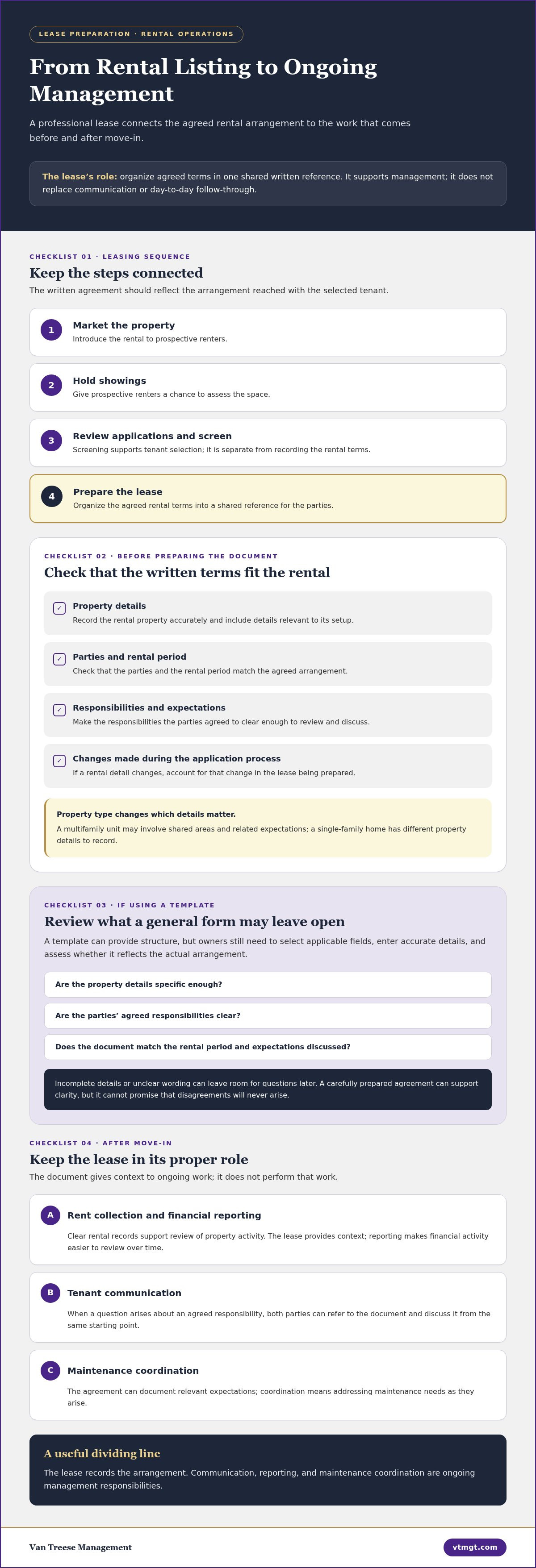
A lease is one step in a larger operating process. Marketing introduces a property to prospective renters, showings let them assess the space, and applications and screening support tenant selection. Lease preparation comes next: the agreed rental terms are organized in writing for the parties to use as a shared reference. The document doesn’t replace the conversations that establish expectations or the communication that continues after move-in.
This sequence matters because the written agreement should reflect the arrangement reached with the selected tenant. If a rental detail changes during the application process, the owner should account for that change when preparing the lease. Connecting the steps helps maintain continuity between what was discussed, what was agreed, and what is recorded.
Where lease preparation fits in the leasing process
Lease preparation follows marketing, showings, applications, and screening, but it is distinct from each activity. Screening concerns the applicant selection process; the lease records the rental terms agreed with the chosen resident. Before preparation, review the property details and responsibilities you intend to document. A clear written record supports later conversations, but it doesn’t remove the need to communicate with residents.
How documented expectations relate to ongoing management
After move-in, documented terms intersect with recurring management tasks. Rent collection and financial reporting rely on clear rental records, so owners can follow the activity associated with a property. The lease provides context for those records; reporting makes financial activity easier to review over time. Neither task substitutes for the other.
A shared written reference can also help focus tenant communication. If a question arises about an agreed responsibility, the parties can refer to the document and discuss it from the same starting point. It can support consistent communication, although it can’t guarantee that every issue will be resolved without further discussion.
Maintenance coordination is another separate operational responsibility. The agreement can document relevant expectations, while coordination involves addressing maintenance needs as they arise. Keeping those roles clear helps owners see how lease preparation fits into management without treating the document as a complete operating system. For a general overview of the broader landlord-tenant relationship, Cornell Law School’s Legal Framework of Landlord-Tenant Relationships offers useful context.
The value of a professional lease agreement extends beyond signing day when its terms are considered alongside leasing records, financial reporting, communication, and property oversight. Van Treese Management connects lease preparation with marketing, showings, applications, screening, and ongoing residential management tasks in Northern Michigan. Owners can explore Van Treese Management to see how these services fit together.
Professional Lease Agreement vs. Generic Template: What Should Owners Compare?
A template and professional preparation can both help an owner put rental terms in writing, but they involve different amounts of owner-led work. A template provides a structure; the owner must identify which details apply and complete them accurately. Professional preparation provides structured support in organizing a lease around the particular rental arrangement. Neither approach guarantees a trouble-free tenancy. The value of a professional lease agreement depends on how well the chosen process fits the property, the owner’s needs, and the work involved in leasing it.
Compare the approaches across four practical dimensions:
Property fit
Template: Offers a general format that the owner assesses against the property. Professional preparation: Supports preparing terms with the specific property and rental setup in view.
Owner input
Template: The owner identifies relevant terms, gathers details, and completes the document. Professional preparation: The owner provides the arrangement details while receiving structured help preparing the lease.
Clarity
Template: Gives the owner a starting structure, but the owner determines whether entries and terms are clear. Professional preparation: Focuses on organizing agreed expectations into a readable document.
Connection to management
Template: Can be prepared independently of screening and placement. Professional preparation: Can form part of a connected leasing process that includes applications, screening, and placement.
When might an owner use a template?
An owner may use a template when they want to organize basic rental information independently and have time to assess what the form needs. The owner remains responsible for identifying details relevant to the arrangement, such as property information and agreed responsibilities. A template provides structure, but completing it still requires careful attention to the specific rental setup.
When can professional preparation add practical value?
Professional preparation can be useful when an owner wants structured support turning rental details into a lease document. It may be especially relevant when preparation is part of a broader leasing workflow that includes marketing, showings, applications, screening, and placement. The focus is on clarity and fit: helping the written agreement reflect the arrangement, not promising a particular result or removing the need for ongoing management.
To choose an approach, consider the property’s details, how straightforward the rental arrangement is, and how much time and confidence you have to identify and organize the relevant information. Owners who prefer to manage that work themselves may begin with a template. Those seeking support preparing the lease as part of leasing may prefer professional preparation. Choose the approach that aligns with the property, the agreement being documented, and your capacity to complete the process carefully.
How to Assess Whether Professional Lease Preparation Fits Your Rental
Choosing how to prepare a lease starts with the rental itself, then moves to the work required to operate it. A practical assessment can help you decide whether to organize the agreement independently or use structured preparation. It also keeps the document in perspective alongside the ongoing responsibilities attached to the property. The value of a professional lease agreement is best assessed in that wider context.
- Identify the property. Note whether you’re renting a single-family home, a unit in a multifamily property, or space in a mixed-use building. Each setting can involve different property details and day-to-day considerations. Consider seasonal properties separately, since their intended occupancy periods and operating needs may differ from those of a year-round rental.
- Clarify the arrangement. Record the intended occupancy and the core rental terms the parties have discussed. Consider which property-specific details may affect communication or oversight. Shared areas in a multifamily setting, for example, may call for different expectations than seasonal use of a property.
- Assess preparation needs. Consider whether you have the time and capacity to identify relevant details, organize them, and prepare the lease document. If the property or arrangement has several moving parts, structured support can help keep the document aligned with the details you intend to record.
- Plan ongoing tasks. Decide who will handle tenant communication, rent collection, and property oversight. Also consider whether maintenance coordination and financial reporting are needed. These tasks continue beyond lease preparation and should be planned as separate parts of operating the rental.
Start with the property and rental arrangement
Use the property type and intended use to frame the preparation process. A year-round residential tenancy, a multifamily unit, mixed-use space, and a seasonal rental may each call for different property details and operational considerations. Identify the information that will help the parties understand the arrangement and help whoever manages the property communicate about it consistently. Keep seasonal occupancy distinct from other rental contexts rather than assuming one approach fits every property.
Assess the support needed beyond preparing the document
Lease preparation produces a written record, while ongoing management covers recurring responsibilities. List which tasks you plan to manage yourself and which need support: tenant communication, rent collection, reporting, maintenance coordination, and property oversight. This distinction helps you decide whether your need is limited to preparing the lease or extends to the operating process around it. For separate state-specific reading, see this Michigan landlord laws guide.
For residential property owners who want lease preparation connected with leasing and screening, explore Van Treese Management and its property management services in Northern Michigan.
How Van Treese Management Connects Lease Preparation With Property Management
A lease records agreed terms, while leasing and property management involve preparing a property, placing a tenant, and overseeing the tenancy. Van Treese Management is locally owned and based in Petoskey, Michigan. The firm serves residential property owners in Petoskey, Harbor Springs, Boyne City, Gaylord, Traverse City, and surrounding Northern Michigan communities.
For owners, the value of a professional lease agreement is easier to assess when preparation is viewed alongside the steps before and after it. Marketing and showings introduce a home to prospective renters; applications and screening support tenant placement; lease preparation documents the rental arrangement. Once the tenancy begins, separate management tasks support communication, financial visibility, and property oversight.
What Van Treese Management’s leasing service covers
Van Treese Management’s residential leasing services include property marketing, showings, applications, tenant screening, and lease preparation. These activities connect presenting a rental and reviewing applicants with preparing the agreement for the selected tenant. Lease preparation is one defined part of that workflow. It documents the arrangement, while screening and placement are distinct steps and do not promise a particular tenant outcome.
Understanding each step helps owners see what the process involves. Marketing and showings present the property; applications and screening support tenant placement; lease preparation concerns the document. Keeping the steps connected can help maintain continuity from offering a rental to documenting its terms, without treating the lease as a substitute for communication or ongoing oversight.
How local management support continues after preparation
After lease preparation, management needs continue. Van Treese Management’s services include rent collection and reporting, tenant communication, maintenance coordination, and property oversight. Rent collection and reporting give owners financial visibility into rental activity, while tenant communication supports ongoing interactions. Maintenance coordination and property oversight address separate operational aspects of managing a property.
These responsibilities are related, but they are not interchangeable. A lease records agreed expectations; communication and coordination handle matters as they arise. Reporting offers another view of property operations, rather than replacing the written agreement or the work required to manage a tenancy. Together, the services let owners consider lease preparation within a broader residential management process.
Local rental conditions and property needs can vary across Northern Michigan. Owners comparing rental arrangements in Petoskey, Boyne City, Indian River, Gaylord, Traverse City, or Grand Rapids should consider the specific property, its intended use, and the management work involved. Van Treese Management serves Petoskey, Harbor Springs, Boyne City, Gaylord, Traverse City, and surrounding Northern Michigan communities. Owners can discuss their rental property with Van Treese Management to explore how lease preparation and listed management services relate to their property’s needs.
Set a Clear Plan for Your Rental’s Next Step
Before preparing your next lease, decide what you need the document to record and how it will fit into your rental’s day-to-day operation. Identify the terms you want clearly written, then consider who will handle tenant communication, financial records, and property needs after the agreement is in place. This planning can help you choose an approach that matches both your property and the time you can devote to managing it.
The value of a professional lease agreement depends on how well its preparation reflects the actual arrangement, not simply on the presence of a signed document. A thoughtful process gives you a clearer starting point for managing responsibilities as the tenancy develops, while leaving room for the communication and oversight every rental requires.
To plan lease preparation and ongoing management for your Northern Michigan rental, discuss your property with Van Treese Management.
Frequently Asked Questions
What is the value of a professional lease agreement?
The value of a professional lease agreement is in how clearly it records the rental arrangement and gives both parties a shared point of reference. If a tenant asks who handles a particular property responsibility, for example, the written terms can help guide the discussion. The document supports communication, but it doesn’t perform management tasks or prevent every disagreement. Owners still need a plan for questions and issues that arise during the tenancy.
Is a professional lease agreement better than a free template?
Neither option is automatically better; the right choice depends on your rental arrangement and the preparation support you need. A template can help organize basic information, such as the rental period and property details. Professional preparation offers structured help documenting the specific arrangement. Before deciding, consider whether you can identify and complete the relevant terms yourself and whether you want support with leasing tasks connected to preparing the agreement.
Can a professional lease agreement improve tenant communication?
It can give a landlord and tenant a shared reference when a question arises about an agreed term. If either party is uncertain about a documented responsibility, they can refer to the same written record before discussing next steps. This can make conversations more focused, but it doesn’t replace direct communication. Questions about changing circumstances, maintenance needs, or other day-to-day matters still require attention from the people managing the tenancy.
What should a landlord consider before preparing a lease agreement?
Start by identifying the property and rental arrangement, then decide who will handle the operational work after the document is prepared. Consider whether you’ll manage tenant questions, track rent collection, coordinate maintenance, and review financial reports yourself. An owner who lives far from a rental, for example, may plan communication and maintenance oversight differently from one who handles those tasks directly. Separating preparation from ongoing responsibilities helps clarify the support you need.
Does a professional lease agreement guarantee a problem-free tenancy?
No. A lease can document agreed terms, but it can’t control how people communicate or ensure that every situation will proceed as expected. If a maintenance concern or question about responsibilities comes up, the document may offer a useful reference, while communication and property management address the issue in practice. Treat lease preparation as one part of an operating plan that also assigns responsibility for tenant contact, rent records, and property needs.
Can Van Treese Management prepare lease agreements for Northern Michigan rentals?
Yes. Van Treese Management includes lease preparation in its leasing and screening services for residential properties. The leasing process also includes marketing, showings, applications, and screening. Separate ongoing services include rent collection and reporting, tenant communication, maintenance coordination, and property oversight. Based in Petoskey, the firm serves Petoskey, Harbor Springs, Boyne City, Gaylord, Traverse City, and surrounding Northern Michigan communities. These distinct services help owners consider preparation alongside ongoing rental operations.