
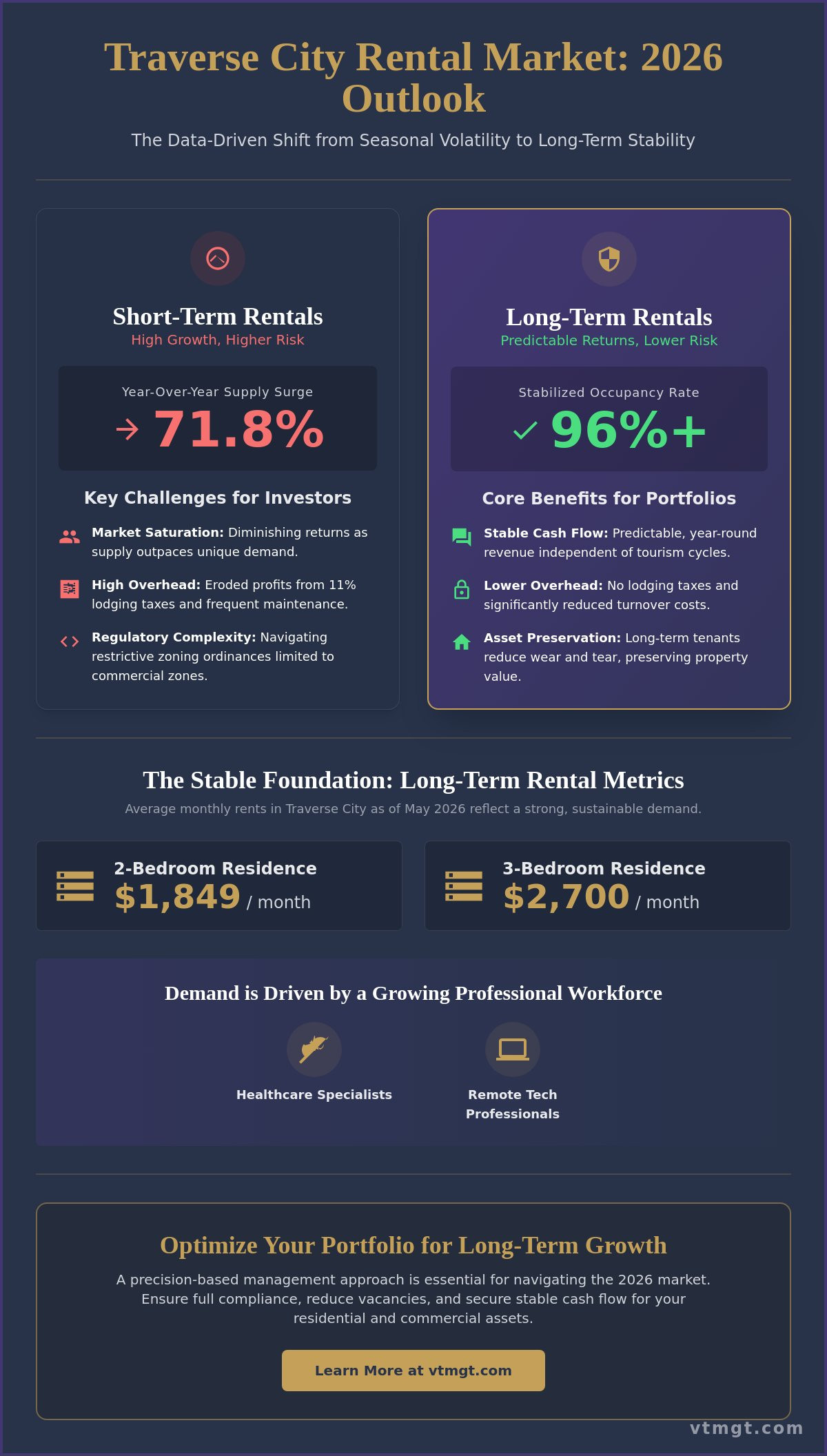
While the 71.8% year-over-year surge in short-term rental supply might suggest a gold rush, the most resilient investors in Northern Michigan are looking in the opposite direction. You've likely felt the pressure of oversaturated vacation markets and the increasingly complex web of local zoning ordinances that now restrict whole-home rentals primarily to commercial zones. It's difficult to maintain predictable margins when 11% lodging taxes and high maintenance costs erode your returns. Analyzing the rental property market trends Traverse City 2026 reveals that a structured pivot toward professionalized long-term leasing is the most stable path for residential and commercial assets.
We recognize that professional investors require a portfolio that operates with the reliability of a precision-engineered system. This guide provides the data-driven insights you need to optimize your holdings for 2026, ensuring full compliance with Michigan landlord laws, including the 30-day security deposit return requirement. We'll examine how implementing professionalized management and screening systems can reduce vacancy rates and secure the stable cash flow necessary for long-term growth in the Grand Traverse region.
Key Takeaways
- Understand the fundamental shift from seasonal volatility to year-round stability as Traverse City matures into a consistent economic center.
- Analyze the latest rental property market trends Traverse City 2026 to identify why long-term occupancy rates for residential units are reaching 96% or higher.
- Navigate the complex regulatory landscape, including updated city ordinances and strict Michigan security deposit requirements, to ensure full legal compliance.
- Learn to implement structured maintenance coordination and professional screening systems to preserve asset value and reduce tenant turnover.
- Discover how a precision-based management approach integrates technical efficiency with human expertise to stabilize long-term residential and commercial portfolios.
The 2026 Traverse City Rental Landscape: Beyond the Vacation Buzz
Traverse City's identity is undergoing a fundamental structural shift. In 2026, the region has moved beyond its historical reputation as a seasonal resort town to become a robust, year-round economic center. Many investors who previously focused on the high-turnover vacation sector are now recalibrating their portfolios. This shift is driven by a critical "saturation point" in the short-term market. With short-term rental supply growth reaching 71.8% year-over-year, nightly margins have compressed while operational complexity has increased. Analyzing the rental property market trends Traverse City 2026 reveals that the most sustainable growth now lies in long-term residential and commercial assets that offer stability over seasonal volatility.
Residential property management has become a cornerstone of this transition. As the local workforce expands, the demand for reliable, long-term housing has outpaced the available inventory. Professional management systems are no longer just a convenience; they're a technical necessity for maintaining the integrity of the local housing stock. By prioritizing long-term tenancy, owners contribute to the community's structural health while securing a predictable revenue stream that isn't dependent on tourism cycles or fluctuating weather patterns.
Traverse City Economic Drivers in 2026
The regional economy is no longer tethered solely to the cherry harvest or summer festivals. The expansion of the regional healthcare sector and a burgeoning tech corridor have created a consistent demand for high-quality housing. As a primary "drive-to" destination, Traverse City, Michigan attracts permanent residents who prioritize proximity to regional employment hubs over temporary vacation amenities. Recent completion of several local infrastructure projects has directly enhanced property valuations, making long-term residential investments more capital-efficient than in previous years.
The Long-Term vs. Short-Term Rental Debate
While short-term rentals (STRs) often report higher gross revenue, the net ROI for long-term rentals (LTRs) has become more attractive in 2026 due to lower overhead. Vacation properties face 11% lodging taxes and frequent cleaning fees, whereas long-term tenancy offers a more predictable financial trajectory. There's also a significant structural benefit: long-term residents treat properties as homes rather than temporary lodging, which reduces wear and tear. For owners of multi-property portfolios, the predictability of monthly leasing simplifies financial reporting and accounting, allowing for more precise long-term capital planning.
The 2026 market rewards precision. By moving away from the "vacation buzz" and focusing on the year-round needs of the community, investors can bypass the volatility of saturated tourist markets. This strategic pivot ensures that assets remain productive throughout every season of the Northern Michigan year.
Traverse City Rental Metrics: Analyzing 2026 Performance
Precision in data analysis is essential for maintaining a high-performance real estate portfolio. In 2026, the rental property market trends Traverse City 2026 demonstrate a significant divergence between seasonal volatility and permanent housing stability. While the short-term rental market trends often focus on nightly peaks, the long-term sector has reached a stabilized occupancy rate of 96% or higher. This high utilization reflects a structural shortage of workforce housing and a growing preference for year-round residency among the region's professional class.
Residential Rent Growth and Demographics
As of May 2026, the average monthly rent for a 2-bedroom unit in Traverse City has reached $1,849, while 3-bedroom residences command an average of $2,700. These figures represent a disciplined growth curve that aligns with the regional professional demographics. We've observed that the tenant base is increasingly composed of healthcare specialists and remote technical professionals who prioritize lease stability over temporary accommodations. The rent-to-income ratios in Grand Traverse County remain a critical metric for owners to monitor when adjusting their long-term strategies. For a deeper analysis of these regional shifts, you may consult our resource on Investing in Rental Property in Northern Michigan: The 2026 Investor Guide.
Commercial Real Estate Trends
Downtown Traverse City is experiencing a shift in retail and office lease structures. Tenants are moving toward more standardized agreements that require precise Common Area Maintenance (CAM) oversight. Managing multi-unit commercial assets requires a rigorous approach to technical maintenance and financial tracking. We prioritize the implementation of standardized management systems to ensure that commercial assets remain competitive and physically sound. Utilizing professional financial reporting and accounting ensures that owners maintain full transparency over their operating expenses while maximizing net operating income.
Operating expenses (OpEx) in Northern Michigan require specific technical consideration due to the local climate. Snow load management, thermal efficiency, and proactive mechanical maintenance for HVAC systems are critical variables in 2026. Investors who fail to account for these seasonal stressors often face unplanned capital expenditures. A structured maintenance coordination system is vital for preserving the physical integrity of the asset and ensuring that the high occupancy rates we see today translate into long-term financial stability. By focusing on these core metrics, owners can navigate the complexities of the 2026 market with confidence and technical accuracy.
Navigating Regulatory Shifts: Zoning, Caps, and Compliance
The 2026 regulatory framework in Traverse City demands a high level of administrative precision from property owners. As the city refines its housing strategy, the rental property market trends Traverse City 2026 indicate a clear preference for long-term residential stability over transient lodging. Investors must navigate a landscape where whole-home short-term rentals are generally restricted to commercial and mixed-use zones. For those operating within these permitted areas, the administrative burden has increased, with a $200 annual renewal fee and a rigorous application process. These local ordinances are designed to manage the 71.8% growth in short-term supply while protecting the availability of workforce housing.
Compliance isn't limited to local zoning. The State of Michigan maintains rigorous standards for residential tenancies, particularly through the Landlord-Tenant Relationships Act. In 2026, landlords must adhere to a strict security deposit limit of 1.5 months' rent. Furthermore, the 30-day deadline for returning security deposits remains a critical legal benchmark. Failure to meet these timelines or exceeding deposit caps can result in significant financial liability. Standardized lease agreement preparation is the only reliable method to ensure that every contractual clause aligns with current state and federal mandates, including the Truth in Renting Act.
Traverse City Rental Ordinances
Landlords must stay informed about the 2026 license renewal process to avoid operational interruptions. While city officials have focused on coordinating resources for housing affordability rather than imposing new restrictive regulations on private long-term landlords, zoning changes continue to favor multi-family residential developments in high-density corridors. For a comprehensive breakdown of these requirements, review our Michigan Landlord Laws: A 2026 Guide for Northern Michigan Property Owners.
Risk Mitigation through Professional Screening
Professional tenant screening and placement serve as the primary defense against legal and financial instability. A standardized background check must evaluate credit history, criminal records, and past rental performance with technical accuracy. In 2026, the cost of a "bad tenant" extends beyond lost rent; it includes potential legal fees and property remediation costs. Utilizing a professional system for screening ensures Fair Housing Act compliance and reduces the risk of discriminatory pitfalls. By implementing these rigorous placement protocols, owners protect their assets and ensure that their lease agreements are executed with qualified individuals who respect the structural integrity of the property.
Maintaining a portfolio in Northern Michigan requires more than just local knowledge; it requires a commitment to legal and operational excellence. Standardized systems for lease preparation and financial reporting provide the transparency necessary for multi-property owners to remain compliant in an evolving market. This disciplined approach to management minimizes risk and maximizes the long-term viability of both residential and commercial investments.
Strategic Portfolio Optimization for 2026 Owners
Optimizing a real estate portfolio in 2026 requires a transition from passive ownership to active, data-driven management. Current rental property market trends Traverse City 2026 indicate that while median list prices have reached $513,583, the true value of an asset is defined by its operational efficiency and net yield. Owners should begin with a comprehensive 2026 property valuation and rental analysis to ensure their rates align with the current $1,928 monthly average. This baseline allows for precise capital planning and identifies opportunities for structural improvements that directly impact long-term valuation.
Implementation of a proactive maintenance coordination system is the next critical step. In Northern Michigan, neglect of seasonal stressors like ice dams or furnace efficiency leads to compounding capital expenditures. Transitioning to digital financial reporting and rent collection further stabilizes the portfolio by providing real-time oversight of cash flow. Finally, optimizing for energy efficiency is no longer optional. With rising utility costs, properties equipped with high-efficiency thermal envelopes and modernized HVAC systems command higher retention rates among the region's professional workforce.
Maintenance as a Value Driver
Functional reliability is the primary factor in tenant retention for long-term residential and commercial assets. Unlike vacation rentals where aesthetics dominate, permanent residents prioritize the immediate resolution of mechanical failures. A structured maintenance system ensures that emergency responses are handled with technical precision, preserving the property's integrity. By leveraging a network of vetted local contractors, owners achieve cost efficiency that isn't possible through ad-hoc repairs. For a detailed technical framework, see our Rental Property Maintenance in Northern Michigan: The 2026 Landlord’s Guide.
Financial Reporting and Accounting
Standardized accounting is the foundation of a professionalized portfolio. Moving beyond manual spreadsheets to integrated financial reporting allows for accurate ROI tracking and simplified tax preparation. For commercial property owners, precise management of Common Area Maintenance (CAM) charges is essential for maintaining tenant trust and lease compliance. Transparent reporting provides the data necessary to make informed decisions about future acquisitions or divestments. To ensure your assets are managed with this level of industrial rigor, consider our professional property management systems to stabilize your 2026 operations.
Professional Management Systems: The Van Treese Advantage
Successfully navigating the rental property market trends Traverse City 2026 requires more than just an awareness of rising rents or shifting zoning laws. It requires a commitment to technical precision and a structured operational framework. Van Treese Management operates with the understanding that a rental property is a complex asset that demands rigorous oversight. We've developed the Van Treese System to replace the ad-hoc methods of the past with standardized protocols that ensure every residential and commercial unit performs at its peak technical capacity. This approach moves beyond the "vacation experience" to focus entirely on the long-term stability and ROI of the owner's portfolio.
Our management philosophy balances high-level technological integration with the necessity of expert human oversight. We utilize standardized digital systems for lease agreement preparation and financial reporting, yet we maintain a disciplined, professional presence in every tenant interaction. By prioritizing long-term residential management, we help build thriving local communities where workforce housing needs are met with high-quality, well-maintained inventory. The Van Treese System manages the entire lifecycle of the asset, from rigorous tenant screening and placement to maintenance coordination, ensuring that structural integrity is never compromised by neglect or seasonal stressors.
Residential and Commercial Solutions
We provide tailored management solutions for both single-family residential units and multi-unit commercial assets throughout Grand Traverse County. Our fee structures are transparent and designed to align with the long-term goals of professional investors, covering everything from monthly oversight to one-time tenant placement. Our deep local expertise allows us to manage properties with the same level of industrial rigor regardless of their location. For investors seeking regional consistency across Northern Michigan, we also provide Professional Rental Management in Charlevoix, MI: Long-Term Stability & Systems.
Next Steps for Traverse City Landlords
2026 is the year to transition your portfolio from a collection of properties into a streamlined, professionalized investment system. The transition from short-term volatility to long-term stability is already underway, and those who implement structured management now will be best positioned for the decade ahead. We invite you to request a detailed market research report and property valuation to determine exactly how your assets can be optimized for the current economic landscape. To begin this process, Schedule a Consultation with Van Treese Management and ensure your portfolio is managed with the precision it deserves.
Securing Long-Term Asset Stability in Traverse City
The transition toward professionalized long-term leasing represents the most technically sound strategy for investors in 2026. By analyzing rental property market trends Traverse City 2026, it's clear that the combination of high short-term saturation and strict local zoning requires a pivot toward year-round residential and commercial assets. Success in this landscape is no longer about seasonal peaks but about the consistent application of rigorous management standards. Owners who prioritize functional maintenance and legal compliance will secure the highest net yields as the region continues its economic maturation.
Van Treese Management provides the structural oversight necessary to protect your real estate holdings. Since 2018, we've applied our local Northern Michigan expertise to help owners implement standardized financial reporting and 24/7 emergency maintenance coordination. Our systems ensure that your portfolio operates with precision while maintaining full compliance with evolving state laws. Optimize Your Traverse City Rental Portfolio with Van Treese Management to transform your properties into high-performance, long-term assets. We look forward to establishing a reliable partnership that supports your investment objectives throughout 2026 and beyond.
Frequently Asked Questions
What are the current rental property market trends in Traverse City for 2026?
The rental property market trends Traverse City 2026 indicate a transition toward year-round occupancy driven by growth in the healthcare and tech sectors. While short-term supply has grown by 71.8% year-over-year, long-term residential units maintain an occupancy rate of 96% or higher. Average monthly rents have reached $1,849 for two-bedroom units. This shift reflects a maturing economy where permanent residents prioritize functional stability over seasonal lodging.
How have Traverse City rental ordinances changed for long-term landlords?
Local officials are currently focusing on coordinating existing resources to address housing affordability rather than implementing restrictive new regulations for long-term landlords. While short-term rentals face strict zoning caps and $200 annual renewal fees, long-term residential assets remain governed primarily by standard Michigan statutes. Investors should monitor township-specific rules, as some areas have implemented caps on the total number of rental licenses available within their jurisdictions.
Is long-term residential property more profitable than short-term rentals in 2026?
Long-term residential properties often provide a more stable net ROI in 2026 due to lower overhead and reduced vacancy risks. Short-term rentals face an 11% total lodging tax and high maintenance costs associated with frequent guest turnover. As the short-term market reaches a saturation point, the predictability of long-term leasing eliminates the volatility of tourism cycles and ensures consistent cash flow throughout the winter months.
What is the average property management fee in Traverse City?
Industry data indicates that full-service property management fees typically range from 8% to 12% of the monthly rent. Owners can also expect setup fees around $185 and tenant placement fees often equivalent to one month's rent. Lease renewals may involve additional costs, frequently calculated as 25% of one month's rent. You should verify specific fee structures with individual providers to ensure they align with your portfolio's technical requirements.
Do I need a special license for long-term rentals in Traverse City?
Long-term rentals generally don't require the specialized Vacation Home Rental licenses mandated for short-term properties. However, landlords must still comply with city safety inspections and standard registration requirements where applicable. The 2026 regulatory environment distinguishes between owner-occupied Tourist Homes and whole-home rentals. It's essential to check specific township ordinances, as some local jurisdictions require registration for all rental types to ensure building code compliance.
How does Northern Michigan weather affect rental property maintenance costs?
Northern Michigan's climate necessitates a structured approach to maintenance to prevent compounding operating expenses. Heavy snow loads and extreme thermal cycles require proactive HVAC inspections and ice dam prevention. Properties without professional maintenance coordination often face higher capital expenditures due to frozen pipes or structural roof damage. Implementing a year-round service schedule preserves the asset's physical integrity and reduces unplanned repair costs for owners.
What should be included in a 2026 Traverse City lease agreement?
A 2026 lease agreement must strictly adhere to the Michigan Truth in Renting Act and the Landlord-Tenant Relationships Act. It should clearly define the security deposit limit of 1.5 months' rent and the 30-day return deadline. Additionally, clauses should specify maintenance responsibilities for snow removal and thermal management. Standardized agreements ensure that both parties are protected under current state laws while minimizing the risk of legal disputes.
How can professional property management improve my ROI in 2026?
Professional management improves ROI by implementing technical systems for tenant screening and maintenance coordination. Rigorous screening reduces the high cost of turnover and potential evictions by placing qualified, long-term residents. Standardized financial reporting allows owners to track net operating income with precision and identify tax-saving opportunities. These systems transform a property from a high-maintenance liability into a streamlined, cash-flowing asset with predictable long-term growth.