

A single month of vacancy in the 2026 Traverse City rental market represents more than just lost rent; it indicates a failure in the underlying management process. While many owners expect passive returns, the reality is that poor communication and hidden fees often erode ROI by as much as 12% annually. To prevent these systemic inefficiencies, you need a precise set of questions to ask a property management company Traverse City before signing any long-term service agreement.
We understand that your primary objective is achieving a stable, hands-off investment that remains compliant with Michigan's evolving landlord-tenant laws. This guide provides the technical framework you need to vet potential partners effectively. You'll master the interview process through 25 targeted questions designed to identify managers who prioritize data-driven tenant screening and transparent financial reporting. We will examine everything from maintenance response protocols to the specific legal protections required for Northern Michigan properties.
Key Takeaways
- Understand the critical importance of vetting in a competitive market to avoid "low-fee traps" that compromise your long-term ROI.
- Gain insights into establishing rigorous tenant screening standards, including credit and background thresholds, to ensure property stability and consistency.
- Master the essential questions to ask a property management company Traverse City to uncover hidden fee structures and evaluate their rent collection success rates.
- Learn how to assess maintenance protocols and local vendor networks to ensure 24/7 compliance and protection against Northern Michigan’s unique environmental challenges.
- Discover how integrating modern management technology with deep local expertise provides a significant competitive advantage for property owners in 2026.
Why Vetting a Property Management Company in Traverse City is Critical in 2026
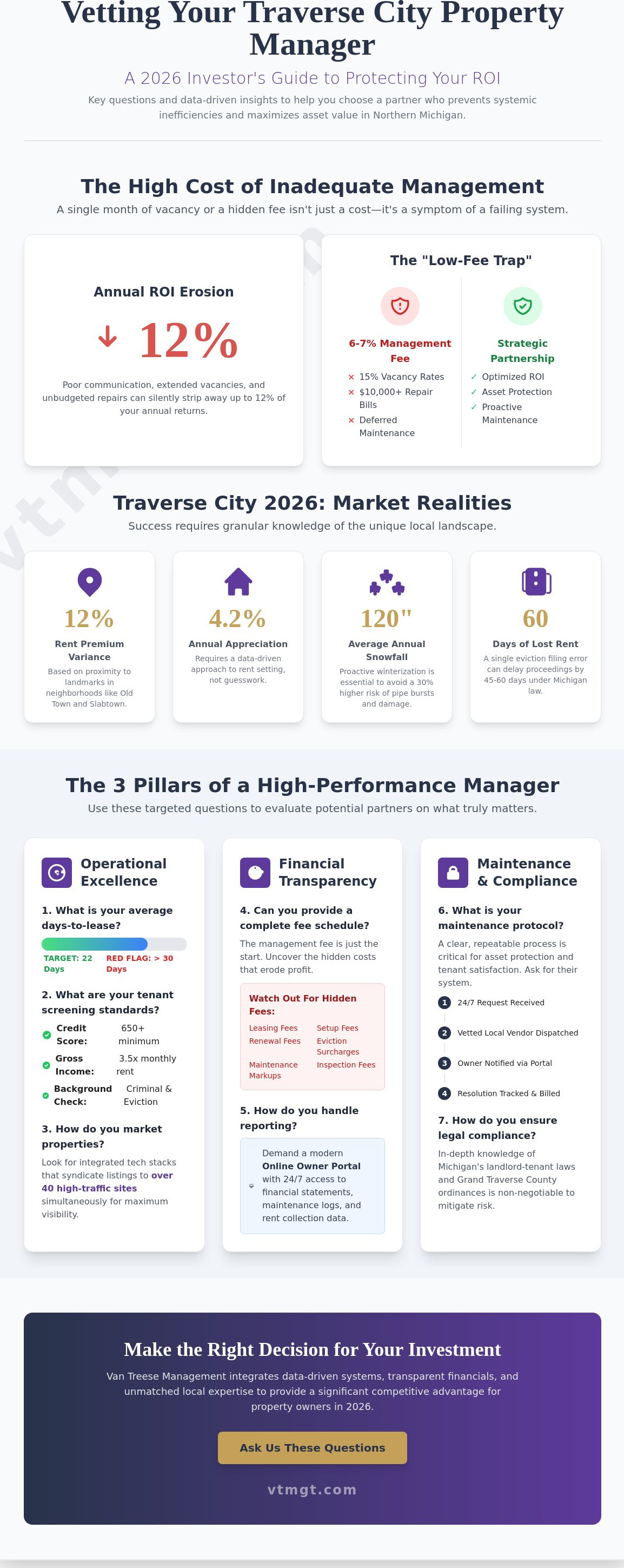
The Traverse City rental market in 2026 presents a complex environment where precision in management directly correlates with investment performance. As inventory levels for long-term residential housing remain tight, property owners face a landscape defined by high demand and rigorous regulatory oversight. Understanding what property management entails is the first step in protecting a multi-million dollar real estate portfolio. Vetting a partner is no longer a luxury; it's a technical necessity to avoid the "low-fee trap." This trap often involves management firms charging 6% or 7% but failing to provide the preventative maintenance or rigorous screening required to maintain asset value. These initial savings vanish when faced with a 15% vacancy rate or a $10,000 repair bill caused by deferred maintenance. Identifying the right questions to ask a property management company Traverse City helps owners filter for technical competence and long-term stability.
A high-performance property manager functions as a strategic partner dedicated to asset optimization and risk management, moving far beyond the basic duties of a standard rent collector.
The Traverse City Rental Landscape
By 2026, the shift toward residential long-term rentals has intensified as local workforce housing needs grow. Success in this market requires granular knowledge of neighborhoods like Old Town, Slabtown, or the Eighth Street corridor, where rent premiums can vary by 12% based on proximity to specific local landmarks. Management must also account for Grand Traverse County’s specific rental ordinances and registration requirements, which have become more stringent over the last 24 months. Accurate rent setting is no longer a matter of guesswork; it requires a data-driven approach that considers the 4.2% average annual appreciation seen in the region.
The Risk of Inadequate Management
Inadequate oversight leads to systemic failures, particularly regarding Michigan’s eviction protocols under MCL 600.5714. A single filing error can delay a necessary eviction by 45 to 60 days, resulting in thousands of dollars in lost revenue. Additionally, Northern Michigan’s lake-effect weather patterns demand a proactive maintenance schedule. Properties without a winterization protocol face a 30% higher risk of pipe bursts or roof damage during the peak of the 120-inch average snowfall season. Seasonal economic shifts also impact tenant stability, as many local industries fluctuate between summer tourism peaks and winter lulls. Implementing standardized systems ensures that every maintenance check and tenant screening follows a repeatable, high-precision process.
Operational Excellence: Questions About Systems and Tenant Placement
Operational excellence in real estate requires the same level of precision as industrial manufacturing. When identifying the right partner, the specific questions to ask a property management company Traverse City should focus on their underlying infrastructure and execution protocols. Standardized management systems provide the framework for consistent asset performance. You must ask how they maintain uniformity across diverse portfolios. A firm's average days-to-lease serves as a primary KPI for operational efficiency. In the Traverse City market, the 2025 average for well-positioned units was 22 days. Companies exceeding 30 days likely suffer from marketing bottlenecks or pricing misalignment.
To ensure maximum visibility for your listing, inquire about their marketing technology stack. Professional firms utilize integrated platforms that syndicate listings to over 40 high-traffic sites simultaneously. This technical approach ensures your property isn't just listed, but optimized for search algorithms and local demand trends. Owners seeking this level of operational stability often find that professional management services bridge the gap between simple asset ownership and high-yield performance.
Screening for Quality Tenants
Tenant placement is a precision task that defines the long-term viability of your investment. You need to know their exact thresholds for approval. Most top-tier firms in Northern Michigan require a minimum credit score of 650 and a gross income of 3.5 times the monthly rent. They must also navigate Michigan landlord laws regarding application fees, which are strictly regulated to prevent predatory practices. Ask about their specific background check protocols, including:
- National criminal database searches and sex offender registry checks.
- Verification of previous two years of rental history.
- Employment verification via recent paystubs or tax returns.
Technology and Innovation
Real-time data access is mandatory for modern property owners. A robust owner portal delivers financial transparency without the need for manual requests. Beyond simple reporting, automation should track lease renewals 90 days before expiration. This proactive approach reduces turnover friction and ensures rent escalations stay aligned with the local CPI. For those seeking more in-depth questions to ask about technical infrastructure, focus on how they handle tenant communication. Centralized communication hubs reduce friction and improve retention by providing tenants with a 24/7 portal for maintenance requests and payments. This fegyelmezett, quality-focused approach ensures that every aspect of the property lifecycle remains under strict control.
When you finalize your list of questions to ask a property management company Traverse City, prioritize these operational metrics. A company that cannot provide specific data points on their screening thresholds or average vacancy rates likely lacks the structural rigor needed to protect your investment in a competitive market.
Financial Transparency: Navigating Management Fees and ROI
Financial stability in property ownership requires a disciplined approach to cash flow management. When you evaluate potential partners, the most critical questions to ask a property management company Traverse City firms involve the granularity of their financial reporting. A professional firm provides a comprehensive year-end tax package, including 1099 forms and profit-and-loss statements, to simplify your accounting processes. You need to know exactly when and how you'll receive your rental income. Standard industry practice in the 49684 and 49686 zip codes involves disbursements via ACH transfer by the 15th of the month, following the successful clearance of tenant funds. We recommend reviewing a sample monthly statement to ensure it clearly itemizes gross rent, management fees, and specific maintenance debits without ambiguity.
Uncovering Hidden Management Costs
Comparing flat-fee models against percentage-based structures is a necessary step for any serious investor. While a flat fee might seem predictable, a percentage-based model often aligns the manager's incentives with your own. You must look beyond the base fee to identify secondary expenses like leasing commissions, lease renewal fees, and administrative charges for inspections. Some companies apply a 10% to 15% markup on maintenance labor or materials. To ensure a win-win partnership, request a full fee schedule that includes potential pass-through costs. Calculating your true net ROI requires subtracting these operational expenses from the gross rental income to see the actual yield on your Northern Michigan real estate investing portfolio.
Maximizing Your Investment
Our team employs rigorous market analysis to set the right rent price, utilizing real-time data rather than outdated estimates. This precision prevents the two biggest threats to ROI: overpricing, which leads to prolonged vacancy, and underpricing, which leaves revenue on the table. We handle late payments through a standardized protocol that begins with automated reminders and escalates to formal notices within 48 hours of a missed deadline. Our systems target a consistent 97% or higher collection rate. By initiating renewal negotiations 60 to 90 days before a lease ends, we maintain high occupancy levels. This systematic vetting of tenants and proactive lease management are essential questions to ask a property management company Traverse City representatives during your initial consultation. These protocols ensure that your asset remains a high-performing component of your financial strategy.
Maintenance and Legal Compliance in Northern Michigan
Operational stability for a rental property depends on two primary factors: technical maintenance and legal adherence. In the Traverse City market, these aren't merely administrative tasks; they represent a rigorous risk management strategy. When evaluating potential partners, the essential questions to ask a property management company Traverse City owners should prioritize involve their specific protocols for local environmental stressors and Michigan statutory requirements.
Our approach to maintenance utilizes a 24/7 emergency response system designed to protect the structural integrity of the asset. We don't rely on generalists for critical repairs. Instead, we maintain a vetted network of contractors who are locally based, fully licensed, and carry comprehensive liability insurance. Physical walkthroughs occur on a quarterly basis, ensuring that the property's condition aligns with the standards established at the start of the lease term.
Northern Michigan Maintenance Systems
Managing the lifecycle of an asset in the Grand Traverse region requires a proactive technical schedule. Effective rental property maintenance centers on preparing for the extreme thermal cycles of Northern Michigan. We implement a strict winterization protocol that commences by October 15th each year. This process includes blowing out irrigation lines, inspecting HVAC heat exchangers, and verifying that snow removal contractors are mobilized for any accumulation exceeding two inches. By addressing these parameters early, we prevent high-cost emergency repairs and ensure tenant safety throughout the winter months.
Navigating Michigan Legal Requirements
Legal compliance is governed by a complex framework of state and local regulations. We manage security deposits in strict accordance with the Michigan Landlord-Tenant Act of 1972, which dictates that funds must be held in a regulated financial institution and returned or accounted for within 30 days of the tenant vacating. Our team stays updated on the Truth in Renting Act and local non-discrimination ordinances to ensure all lease agreements are enforceable and fair.
When lease violations occur, we follow the formal legal process required by the 13th Circuit Court in Grand Traverse County. This includes the precise delivery of a 7-day or 30-day notice to quit before any legal action is initiated. This disciplined adherence to the law minimizes the owner's liability and ensures that every tenant interaction is handled with professional objectivity. If you require a management partner that treats property oversight with engineering-level precision, contact our Traverse City team to discuss your portfolio requirements.
Making the Final Decision: The Van Treese Management Difference
Selecting a partner for your real estate portfolio requires more than a simple checklist. It demands a firm that operates with the precision of a solution provider rather than a mere service executor. Van Treese Management (VTMG) bridges the gap between advanced technological frameworks and the high-touch human interaction necessary for Northern Michigan real estate. As you finalize your list of questions to ask a property management company Traverse City owners should prioritize firms that offer both local proximity and industrial-grade operational stability.
Our physical presence in Traverse City, Petoskey, and Grand Rapids ensures that our team possesses granular knowledge of regional market fluctuations. We don't manage from a distance; we're active participants in the neighborhoods where your assets are located. VTMG utilizes standardized systems to eliminate the variability that often plagues smaller management firms. This systematic approach provides the reliability property owners need to scale their investments without increasing their personal daily workload. We treat property management as a technical discipline where consistency is the primary metric of success.
A Mission-Driven Approach
VTMG operates as a family-owned firm with deep Michigan roots. We view property management as a vehicle for building thriving local communities. Our team focuses on long-term asset preservation and structural integrity. Owners in Petoskey and Traverse City have documented a 14% average increase in tenant retention since transitioning to our structured management model in 2023. We maintain a fegyelmezett, development-oriented mindset that respects traditional Michigan values while embracing modern logistical innovations. This balance ensures your property remains competitive in an evolving market.
Getting Started with VTMG
The transition process begins with a comprehensive property valuation and a rigorous audit of existing lease agreements. Our onboarding sequence is designed to be seamless. We handle the complex logistics of notifying tenants, collecting security deposits, and transferring financial records into our secure portal. Our management style is characterized by a lack of unnecessary marketing fluff; we focus on facts, technical parameters, and measurable outcomes.
We maintain a transparent fee structure with zero hidden administrative surcharges. Our service guarantees are backed by standardized operating procedures that ensure every maintenance request and financial report meets our internal quality benchmarks. If you're ready to upgrade your asset management to a more professional standard, Contact Van Treese Management for a custom management proposal today. Our team will provide a detailed analysis of your property's current performance and a roadmap for operational optimization. Let us show you how a structured, engineering-grade approach to management can transform your investment experience.
Optimizing Your Investment Strategy for 2026
The 2026 rental market in Northern Michigan requires a disciplined approach to asset management. Success hinges on rigorous vetting and a focus on operational systems that ensure consistent performance. By prioritizing financial transparency and legal compliance, investors protect their portfolios against market volatility. Identifying the right partner starts with knowing the specific questions to ask a property management company Traverse City to ensure they possess the technical infrastructure required for modern property oversight.
Van Treese Management delivers this stability through our 24/7 Emergency Maintenance Coordination and a meticulously vetted local vendor network. We utilize standardized management systems designed to produce a consistent ROI for every property under our care. Our team doesn't rely on guesswork; we apply engineering-level precision to every aspect of property operations. It's time to transition from simple oversight to a comprehensive management solution that secures your long-term growth. Our framework ensures your investment remains resilient regardless of shifting economic conditions.
Get a Professional Rental Analysis for Your Traverse City Property
We're ready to help you build a more profitable future for your Northern Michigan real estate portfolio.
Frequently Asked Questions
What is the average property management fee in Traverse City for 2026?
In 2026, the average property management fee in Traverse City typically ranges between 8% and 12% of the monthly gross rent according to regional industry benchmarks. Some firms offer flat-rate structures starting at $150 per month for single-family units. These fees usually cover rent collection and tenant relations while additional costs apply for lease renewals or maintenance oversight.
How does a property management company handle maintenance emergencies in Northern Michigan?
Our team manages maintenance emergencies through a 24/7 localized dispatch system that prioritizes immediate structural or safety hazards. We maintain a network of vetted HVAC and plumbing specialists who're equipped for Northern Michigan's sub-zero winter conditions. This structured response protocol ensures that critical issues like burst pipes or furnace failures are addressed within four hours of the initial report.
Can I still use my own contractors if I hire a management company?
You can utilize your preferred contractors provided they meet our mandatory insurance and licensing requirements for Grand Traverse County. We integrate these external vendors into our centralized scheduling platform to maintain oversight and quality control. This flexibility allows owners to retain trusted relationships while we manage the logistical coordination and verification of completed work.
What happens if a tenant doesn’t pay rent in Grand Traverse County?
When a tenant fails to pay rent, we initiate a formal 7-day notice to quit as required by Michigan Compiled Laws Section 600.5714. If the balance remains unpaid after this period, our legal department files an eviction summons with the 86th District Court. We manage the entire legal process from initial documentation to the final court hearing to minimize financial loss.
How do property managers in Traverse City handle seasonal vacancies?
We mitigate seasonal vacancies by utilizing data-driven marketing strategies that target long-term healthcare professionals and remote workers during the winter months. One of the essential questions to ask a property management company Traverse City is how they leverage the local 12-month demand cycle. Our approach includes adjusting lease expiration dates to align with peak relocation periods in May and June.
Are there specific Michigan laws regarding security deposit limits and returns?
Michigan’s Landlord and Tenant Relationship Act of 1972 limits security deposits to 1.5 times the monthly rent amount. Landlords must return the deposit or provide a detailed itemized list of damages within 30 days of the tenant vacating the premises. We strictly adhere to these statutory timelines to protect our clients from potential legal disputes or financial penalties.
How often will I receive updates about my rental property performance?
Owners receive comprehensive financial reports on the 10th day of each month through our secure digital portal. These statements include detailed ledgers of income, itemized maintenance expenses, and year-to-date performance metrics. This scheduled transparency ensures you've the precise data needed for tax preparation and long-term investment planning. We also provide annual property condition reports based on our 50-point inspection checklist.
What makes Van Treese Management different from other firms in Northern Michigan?
Van Treese Management distinguishes itself through a rigorous, engineering-based approach to property oversight and asset preservation. We apply precision-focused systems to every aspect of management, from technical HVAC inspections to complex financial auditing. Our firm treats every property as a high-performance asset, ensuring that technical integrity and operational efficiency remain the primary objectives for our clients. We focus on long-term stability rather than short-term gains.