
Property Portfolio Management for Retirement: 2026 Guide

The best retirement portfolio may be the one that asks less of you, not the one with the most properties. Managing a property portfolio for retirement means looking beyond rental income to the time, maintenance, and decisions each property can require. If you’re used to handling tenant calls and coordinating repairs yourself, it’s reasonable to ask whether that workload still fits the retirement you want.
A dependable plan starts with a clear view of each property’s cash flow, costs, condition, and operating demands. Rental income can support retirement priorities, but it isn’t guaranteed. A portfolio that depends on constant personal attention may also limit your flexibility.
This guide explains how to assess which properties still fit your goals, organize operations, and compare self-management with professional management. You’ll also learn how to plan a practical transition, including which responsibilities to delegate and what to clarify in a management agreement, so your next steps reflect your priorities rather than habit.
Key Takeaways
- Start managing a property portfolio for retirement by aligning each property’s role with the time, involvement, and flexibility you want in retirement.
- Use your records to map property income, expenses, condition, and operating responsibilities before deciding what to keep or change.
- Compare self-management and professional management by the control, communication, and operational support each approach provides, then review the specific agreement.
- Prepare for a transition by organizing lease details, maintenance records, vendor contacts, and preferences for owner approvals.
- Separate property operations from retirement and investment planning. Consult relevant advisers for financial, tax, or legal decisions, then choose an operating approach that fits your priorities.
Why managing a property portfolio changes as retirement approaches
Managing a property portfolio for retirement means aligning the way each rental is operated with your changing priorities. There is no standard retirement formula. One owner may want to keep direct control and handle tenant communication, while another may prefer to reduce routine tasks or reconsider properties that require frequent attention.
This is an operational decision, not a forecast of rental income or investment performance. Property management covers day-to-day responsibilities, while decisions about investments, taxes, estate planning, and retirement finances call for advice from appropriately qualified professionals. A professional property management company may handle agreed operating tasks, but you remain responsible for deciding what fits your wider plans.
What changes when an owner approaches retirement?
Retirement can change how much time you want to spend responding to tenant questions, arranging repairs, and making property decisions. Start by defining your preferred level of involvement rather than assuming every retiree should sell, delegate, or continue managing personally. Consider asking a qualified financial or tax professional how rental income, planned property sales, liquidity needs, and tax consequences fit your circumstances.
Which properties and responsibilities belong in the review?
Build a property-by-property inventory before deciding what to change. Record each location, occupancy status, lease terms, known condition issues, and recurring operating responsibilities. Then note the time you spend on tenant communication, rent collection, and maintenance coordination. Reviewing those tasks alongside the property records can show which parts of ownership fit your preferred routine and which may need a different operating arrangement.
- Property and tenancy: location, occupancy, lease details, and renewal dates.
- Condition and upkeep: known repair needs, maintenance history, and current coordination tasks.
- Owner workload: recurring tenant communications, rent collection, and decisions that need your attention.
For owners considering opportunities and conditions specific to the region, the Northern Michigan rental investment guide offers related context. Use your own records to assess each property rather than relying on broad assumptions about what a rental should earn or how much work it should require.
This review gives you a practical starting point: retain the current arrangements, adjust your role, or explore professional support for defined operational responsibilities.
How to assess a rental portfolio for retirement readiness
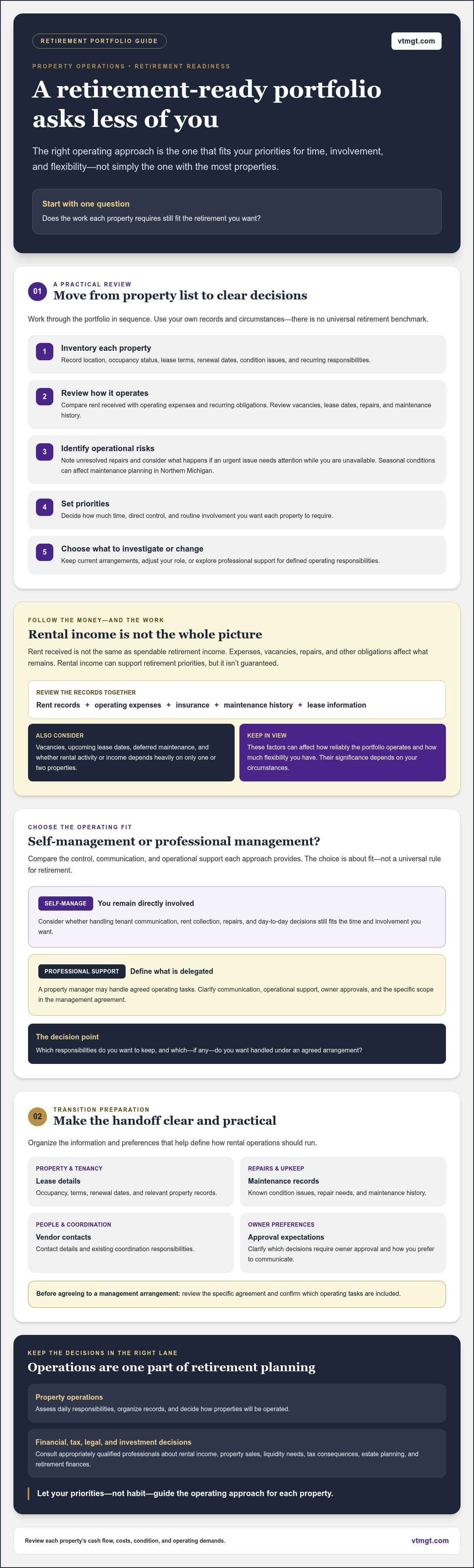
A structured review turns a collection of properties into a set of informed decisions. Work through the portfolio in sequence: inventory the assets, review how each one operates, identify risks, set priorities, and decide what to investigate or change. The goal isn’t to meet a universal benchmark. It’s to understand how your actual properties and responsibilities fit your retirement plans.
For each property, use your records to compare rent received with operating expenses and recurring obligations. Consider vacancies, upcoming lease dates, deferred maintenance, and whether a large share of your rental activity or income depends on only one or two properties. These factors can affect how reliably the portfolio operates and how much flexibility you have, but their significance depends on your circumstances.
Which records help clarify portfolio performance?
Gather property-level rent records, operating expenses, insurance documents, maintenance history, and current lease information. Review them together rather than relying on memory or gross rent alone. Rent received isn’t the same as spendable retirement income: expenses, vacancies, repairs, and other obligations affect what remains. A qualified financial or tax professional can help you evaluate how the figures relate to your broader plans.
How should owners identify operational risks?
Look beyond the accounts. Review each property’s condition, unresolved repair needs, and what would happen if an urgent issue required action while you were unavailable. In Northern Michigan, seasonal conditions can affect maintenance planning and the timing of property work. The Northern Michigan rental maintenance guide provides relevant local context.
As you identify risks, distinguish between an issue you can address with better documentation, one that may need professional operational support, and a decision that calls for financial, tax, estate, or investment advice. These are separate areas of expertise. If you’re considering alternatives to owning properties directly, the U.S. Securities and Exchange Commission explains the structure of Real Estate Investment Trusts (REITs). Review any investment choice with a qualified adviser.
Once the records and risks are clear, rank next steps by priority. You might investigate deferred maintenance, prepare for a lease decision, or explore who could handle specific operational tasks. Owners in Northern Michigan can also review residential property management services as one option for property operations, while retaining responsibility for investment decisions.
Self-management or a property manager: compare the retirement trade-offs
As retirement approaches, the choice between self-management and professional management is less about which option is universally better and more about which operating model fits your time, property needs, and desired level of control. Self-management avoids a management fee, but you remain responsible for recurring tasks and tenant matters. A manager can take on responsibilities defined in an agreement. Fees and any other charges affect net proceeds, so weigh them against the services included.
Delegating operations doesn’t transfer ownership decisions. You remain responsible for choices about holding, selling, or changing your investments, as well as your retirement planning. The aim of managing a property portfolio for retirement is to choose an arrangement that supports your priorities without assuming that any one approach guarantees a particular financial outcome.
When might self-management remain practical?
Self-management may suit owners who have the time, relevant experience, and willingness to handle tenant communication, rent collection, and maintenance coordination. Proximity to the property, organized records, and dependable access to contractors can also make hands-on oversight more manageable. Capacity and property needs can change, so review the arrangement periodically rather than assuming today’s workload will remain suitable.
What should owners evaluate in a property manager?
Compare the specific duties offered, the reporting process, and how communication and decisions are handled. Ask how tenant placement, rent collection, tenant communication, maintenance coordination, and financial reporting are addressed. Clarify emergency procedures, your preferences for approvals, and which responsibilities remain yours. Read the management agreement closely so the scope, exclusions, fees, and other charges are clear before you delegate.
For a local overview of residential management considerations, consult the Petoskey property management guide. Use it as context, then confirm that a prospective manager’s service area and agreement match your property and requirements.
A simple comparison can bring the trade-offs into focus:
- Time: Identify which recurring tasks you want to keep handling and which you may delegate.
- Control: Decide how involved you want to be in routine operations and owner approvals.
- Communication: Establish how updates, records, and decisions will be shared.
- Support: Confirm which tenant and maintenance responsibilities are included in the agreement.
Choose based on documented responsibilities and your priorities, not on a general claim that professional management is always easier or self-management is always more profitable.
How to prepare rental operations for a retirement transition
A transition works best when planned in stages rather than treated as a single handoff. First, decide which responsibilities you want to retain and which you may delegate. Next, assemble current property information, discuss the proposed scope with a prospective provider, and document agreed procedures before changing day-to-day operations. This helps surface gaps while there is still time to resolve them.
As part of managing a property portfolio for retirement, verify Michigan landlord obligations with qualified legal counsel. A property manager can handle only the operational duties defined in the agreement. Legal and investment decisions require appropriate professional advice. Evaluate whether a provider’s services fit your properties and priorities, and read the contract for its scope, exclusions, communication terms, and owner responsibilities.
What information should an owner organize before handoff?
Prepare a clear, current file for each property. Include details that help someone else understand its status and operating history, rather than relying on informal conversations or scattered records.
- Property records: property details, access instructions, and relevant documentation.
- Lease information: current agreements, key dates, and tenant contact details where appropriate.
- Maintenance history: completed work, known issues, open requests, and relevant records.
- Vendor contacts: names and contact information for contractors or other providers already involved.
- Owner preferences: preferred communication methods, approval thresholds, and emergency contacts.
Before sharing documents or access information, confirm how the selected provider handles access, privacy, and document exchange. Agree on a secure, practical process and identify who should receive sensitive information.
How can owners preserve appropriate oversight?
Delegation shouldn’t leave responsibilities unclear. Set a reporting cadence and agree on what information you’ll receive, how maintenance requests and urgent issues will be communicated, and which decisions require your approval. Clarify how issues will be recorded and how completed work will be reported. Confirm these procedures in writing and make sure they align with the management agreement.
Before selecting a provider, compare its proposed services with the work you want to delegate, then confirm that its coverage and contract terms suit your properties. Van Treese Management provides residential property management services. Review the available options and agreement details to assess operational fit: residential property management options.
Choosing next steps for a retirement-ready Northern Michigan portfolio
Once you’ve reviewed your properties and operating needs, move from assessment to a defined decision. Clarify what you want your portfolio to support, review your current records, consult relevant advisers, then select an operating approach that matches your priorities. You might continue managing properties yourself, delegate agreed responsibilities, or consider other ownership decisions with professional guidance. This sequence connects property operations to your retirement goals without treating management choices as financial advice.
Which professionals may support different parts of the decision?
Different questions call for different expertise. A qualified financial professional can advise on investment allocation and retirement projections. A tax professional can address tax questions, while an attorney can advise on legal and estate matters. Property management is operational support: it can cover agreed responsibilities for rental properties, but it doesn’t replace individualized financial, tax, or legal guidance.
How can owners start a property management conversation?
Prepare a short overview of each property’s location, your current management arrangements, and the operational concerns you want addressed. For example, note whether tenant communication, rent collection, maintenance coordination, or financial reporting takes the most attention. This gives a prospective provider a practical basis for discussing service fit and clarifying which responsibilities would remain with you.
Van Treese Management provides residential property management that includes tenant communication, rent collection, maintenance coordination, tenant placement, and financial reporting. Property owners in Petoskey, Boyne City, Indian River, Gaylord, Traverse City, and Grand Rapids can ask about current coverage for a specific property. Review the proposed agreement carefully so its scope, communication process, and owner responsibilities are clear. You retain decisions about your investments and retirement plan.
Managing a property portfolio for retirement is ultimately a personal operating decision. A well-prepared discussion can help establish whether available services align with your properties and desired level of involvement, without assuming a particular financial outcome.
For an overview of residential property management services, visit Van Treese Management.
Set a Clear Operating Plan for the Years Ahead
Managing a property portfolio for retirement starts with understanding how each property, its costs, and its day-to-day demands fit your priorities. Use current records to assess operations and risks, then decide which responsibilities you want to keep and which may be delegated. For financial, tax, and legal decisions, consult professionals qualified in those areas.
For owners considering operational support in Northern Michigan, Van Treese Management provides residential property management that includes rent collection and tenant communication, with maintenance coordination through a network of vetted local contractors. Your management agreement should clearly define the responsibilities you delegate, the reporting you’ll receive, and the decisions that remain yours.
To discuss whether residential management fits your property needs, contact Van Treese Management about residential property management. A measured review and a well-documented plan can help you move toward retirement with a clearer operating approach.
Frequently Asked Questions
Can rental properties provide income during retirement?
Yes, rental properties can provide income during retirement, but the amount available can vary. Consider rent collected alongside operating expenses, vacancies, maintenance, insurance, and other obligations. Gross rent isn’t the same as spendable income, and rental income isn’t guaranteed. Review property-level records and discuss how rental income may fit your retirement budget with a qualified financial professional before relying on it to meet planned expenses.
Should I sell or keep my rental properties when I retire?
There’s no single right choice for every owner. Compare each property’s operating history, condition, workload, and role in your plans, then weigh those factors against your desired involvement and need for flexibility. Selling, retaining, or changing how a property is managed can have financial, tax, and legal implications. Discuss those consequences with qualified financial, tax, and legal professionals before making a decision.
Is hiring a property manager worthwhile for a retirement portfolio?
It may be worthwhile if the operational support fits your needs and the agreement clearly defines the work. A property manager may take agreed recurring tasks, such as tenant communication or maintenance coordination, off your plate. Management fees and other charges affect net proceeds, so compare them with the services included. The decision depends on your preferred level of control, the property’s needs, and your capacity to manage it personally.
How do I compare self-managing with professional property management?
Compare the time and responsibilities you’ll retain with the support a manager agrees to provide. Self-management gives you direct involvement, but you handle tenant matters, rent collection, and maintenance coordination yourself. With professional management, clarify communication, reporting, owner approvals, and how maintenance issues are handled. Review the agreement and applicable charges, then decide which arrangement better matches your property requirements and preferred level of involvement.
What records should I review before retiring as a landlord?
Review records for each property, including rent received, operating expenses, insurance documents, current leases, lease dates, vacancy history, and maintenance records. Note recurring obligations, unresolved repairs, and time spent on tenant communication, rent collection, and coordinating work. Use current documentation rather than estimates from memory. This operational review can clarify what needs attention, but a qualified financial or tax professional should assess how the records relate to your retirement plan.
Can a property manager handle tenant communication and maintenance?
Yes, a property manager can handle tenant communication and coordinate maintenance when those duties are included in the management agreement. Confirm how residents contact the manager, how requests are documented, how contractors are selected, and which work requires your approval. Van Treese Management provides residential property management that includes tenant communication and maintenance coordination through a network of vetted local contractors. Review the agreement to confirm the specific scope and responsibilities.
What should I ask a Michigan property manager before signing an agreement?
Ask which services are included, how tenant communication and maintenance requests are handled, what reporting you’ll receive, and which decisions require owner approval. Review fees, other charges, contract duration, termination terms, and emergency procedures in writing. Ask how the manager addresses applicable landlord responsibilities, then verify legal questions with a Michigan attorney. If your property is in Petoskey, Boyne City, Indian River, Gaylord, Traverse City, or Grand Rapids, confirm current service coverage directly.