
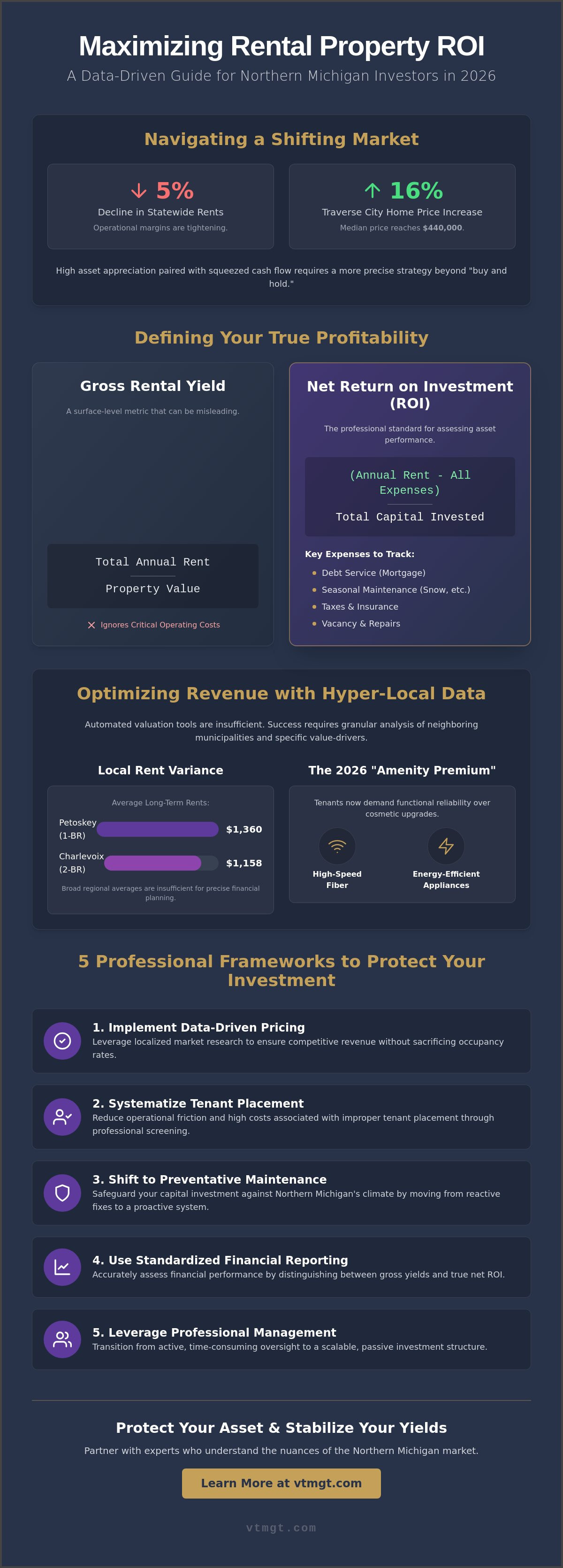
With Traverse City median home prices climbing 16% to $440,000 while statewide rents have dipped nearly 5%, the traditional buy and hold strategy is no longer a guarantee of profit. Success in this environment requires a precise, data-driven approach to maximizing rental property ROI Northern Michigan. Landlords today must navigate a landscape where asset appreciation is high, but operational margins are squeezed by rising seasonal maintenance costs and evolving housing laws.
It's understandable if you feel the pressure of maintaining predictable cash flow while managing the technical complexity of local short-term rental caps or pending state legislation like Senate Bill 21. This guide provides the professional frameworks and local market insights you need to stabilize your yields and protect your investment against market volatility. We'll examine current Petoskey and Charlevoix data, standardized tenant screening systems, and the specific operational shifts required to ensure your property remains a high-performing asset throughout 2026.
Key Takeaways
- Distinguish between gross yields and net ROI to accurately assess the financial performance of your assets in a fluctuating 2026 interest rate environment.
- Implement data-driven pricing models that leverage localized market research to ensure your revenue remains competitive without sacrificing occupancy rates.
- Utilize professional frameworks for maximizing rental property ROI Northern Michigan by reducing operational friction and the high costs associated with improper tenant placement.
- Shift from reactive to preventative maintenance systems to safeguard your capital investment against the specific environmental demands of the Northern Michigan climate.
- Leverage standardized financial reporting and professional management to transition from active oversight to a scalable, passive investment structure.
Defining Rental ROI in the 2026 Northern Michigan Market
Effective asset management begins with a precise understanding of financial performance metrics. While many investors focus on gross rental yield, a professional framework requires a deeper analysis of Return on Investment (ROI) to account for the total cost of capital and operational overhead. In the current 2026 environment, maximizing rental property ROI Northern Michigan depends on your ability to distinguish between top-line revenue and the actual net profit that remains after accounting for debt service and regional maintenance requirements.
The 2026 interest rate environment has introduced new variables for debt-leveraged properties. With average 30-year fixed mortgage rates in Michigan ranging between 6.38% and 6.91%, and investment property premiums adding an additional 0.50% to 0.875%, the cost of borrowing significantly impacts your net margins. Successful landlords in Emmet and Charlevoix counties are increasingly viewing their holdings through the lens of "Yield Assets" rather than "Lifestyle Assets." While a lakefront home may offer significant capital appreciation in the "Golden Triangle" of Petoskey, Harbor Springs, and Charlevoix; its monthly cash flow must be strictly audited against rising carry costs.
Calculating Your Net Operating Income (NOI)
A structured approach to NOI must include the specific environmental and regulatory costs of the region. Northern Michigan winters necessitate higher budget allocations for seasonal utility spikes and snow mitigation services. Additionally, while short-term rentals face a 6% Michigan use tax on stays of 30 days or less, long-term residential assets avoid this specific levy, offering a more streamlined tax profile. In the Northern Michigan residential market, ROI is defined as the net annual profit after all operating expenses and debt service are deducted, expressed as a percentage of the total capital invested in the property.
The 2026 Economic Outlook for Local Landlords
Projected rental demand remains robust in Traverse City and Petoskey due to persistent inventory scarcity. With the median home sale price in Traverse City reaching $440,000 in early 2026, many residents are priced out of homeownership, sustaining a high-demand environment for quality long-term leasing. We're observing a strategic shift among sophisticated investors who are moving away from the regulatory uncertainty of short-term vacation rentals in favor of stable, long-term residential management. This transition reduces vacancy risks and provides a more predictable trajectory for long-term asset appreciation.
Optimizing Revenue: Data-Driven Rent Pricing Strategies
Relying on automated valuation models often leads to suboptimal yield. These tools fail to capture the granular shifts in the Emmet and Grand Traverse markets. For maximizing rental property ROI Northern Michigan, a systematic analysis of comparable long-term listings is required. We evaluate properties based on technical parameters such as square footage efficiency, thermal insulation quality, and proximity to regional employment hubs. A property priced slightly above market might sit vacant for 45 days. This results in a net annual loss that takes months of premium rent to recover.
The 2026 "Amenity Premium" is driven by functional reliability rather than purely cosmetic upgrades. High-speed fiber connectivity and energy-efficient appliances are now non-negotiable for qualified long-term tenants. Professional property valuations identify these specific value-drivers. This allows landlords to capture higher rents without increasing the risk of turnover. Balancing aggressive pricing with vacancy risk requires a disciplined look at the local absorption rate of similar units.
Hyper-Local Market Analysis
Data indicates significant variance between neighboring municipalities. Petoskey average long-term rents for a 1-bedroom unit hover around $1,360, while 2-bedroom units in Charlevoix average approximately $1,158. These figures demonstrate why a broad regional average is insufficient for precise financial planning. If you require rental management Charlevoix, your pricing strategy must account for these local variances to avoid yield erosion. Identifying the "sweet spot" for 12-month renewals ensures tenant retention while maintaining pace with inflation.
Strategic Lease Structuring
Lease agreements must be structured as rigid legal frameworks. Standardized escalations provide multi-year stability for both parties. It's essential that your 2026 contracts adhere to the latest Michigan landlord laws to mitigate litigation risk. You can review the comprehensive Michigan landlord-tenant laws to understand the statutory limits on security deposits and notice periods. Professional lease agreement preparation transforms a simple transaction into a protected investment. This systematic approach to documentation is a primary driver of long-term asset security.
Reducing ROI Erosion through Professional Tenant Placement
In the specialized Northern Michigan market, a single month of vacancy or a neglected property can erase an entire year's worth of net yield. Professional tenant placement isn't just about filling a unit; it's a risk mitigation protocol. Unlike competitors who prioritize occupancy speed over applicant quality, our focus remains on the long-term stability of the asset. Understanding the fundamentals of rental property ROI requires recognizing that tenant quality is a primary driver of cost control. A "bad" tenant represents more than just unpaid rent. It includes the technical costs of legal eviction, physical asset damage, and the significant loss of management time.
Standardized screening is the backbone of this process. We employ a rigorous methodology that includes comprehensive background checks, credit analysis, and verified local references. For landlords, maximizing rental property ROI Northern Michigan is achieved by securing residents who view the property as a long-term home. This stability allows for predictable cash flow and reduces the friction of constant turnover. When the right systems are in place, tenant placement becomes a predictable engineering task rather than a gamble.
The Van Treese Tenant Screening Framework
Our screening protocols are designed to identify high-caliber professionals. In the 2026 economy, we maintain strict income-to-rent ratios, typically requiring gross monthly income to be at least three times the monthly rent. We conduct direct verification with local Northern Michigan employers, ranging from healthcare providers to regional engineering firms. Professional "showings" also serve as a critical assessment phase. They allow us to evaluate an applicant's punctuality and communication style before a lease is ever signed.
Maximizing Retention to Eliminate Turn-Over Costs
Retention is the silent multiplier of profitability. If a unit sits vacant for 30 days, the owner loses 8.3% of their potential annual revenue immediately. This loss is often unrecoverable. Proactive communication and rapid response to maintenance requests are essential tools for securing lease renewals. By fostering stable environments, we reduce tenant churn and the associated costs of cleaning, marketing, and re-listing. This systematic approach ensures that maximizing rental property ROI Northern Michigan remains a realistic, achievable objective for every property in your portfolio.
Maintenance Systems: Protecting Your Capital Investment
Maximizing rental property ROI Northern Michigan is fundamentally linked to the physical preservation of the asset. Standardized maintenance systems serve as the structural backbone of high-yield portfolios; they transform reactive repairs into a predictable engineering workflow. Without these frameworks, property owners often face compounding liabilities that erode net profit. We prioritize a systematic approach that utilizes a vetted network of local contractors to ensure cost efficiency and technical precision in every repair. This professional oversight prevents the significant markups and inconsistent quality often associated with uncoordinated vendor management.
Asset protection also requires a robust 24/7 emergency response protocol. In a region where winter temperatures frequently drop below zero, a furnace failure or a burst pipe isn't just a tenant inconvenience; it's a threat to the building's structural integrity. By maintaining a constant state of readiness, we mitigate the risk of catastrophic water damage or frozen plumbing. This level of technical vigilance ensures that your capital remains protected and your insurance premiums stay manageable over the long term.
Seasonal Maintenance as ROI Preservation
Proactive winterization is a non-negotiable requirement for properties in Petoskey and Gaylord. This process involves a technical audit of thermal envelopes, heat tape functionality, and drainage systems to prevent ice damming. You can find a detailed breakdown of these protocols in our guide to rental property maintenance Northern Michigan. In Michigan, deferred maintenance acts as a compounding liability that accelerates asset depreciation and triggers catastrophic repair costs during peak winter months. Addressing these issues before the first freeze is the most effective way to stabilize your annual operating budget.
Maintenance Coordination Fees vs. DIY Savings
Many landlords underestimate the "opportunity cost" of managing their own repairs. When an owner spends hours sourcing parts or supervising contractors, they're sacrificing time that could be spent on higher-level portfolio strategy. Professional maintenance coordination provides a standardized oversight layer that ensures every dollar spent on the property adds measurable value. Regular property inspections further protect your yield by ensuring lease compliance and identifying minor issues before they require major capital expenditures. This disciplined approach to upkeep is what separates a professional investment from a high-stress second job.
The ROI Multiplier: Professional Management vs. Self-Management
Many property owners view management fees as a traditional line-item expense. This perspective is a fundamental miscalculation of asset performance. Professional management acts as a force multiplier that converts the labor-intensive duties of a landlord into a scalable, passive financial instrument. For those focused on maximizing rental property ROI Northern Michigan, the transition from active oversight to system-driven management is essential. It replaces individual effort with standardized protocols for maintenance, tenant relations, and financial tracking.
Scalability is the primary differentiator between a hobbyist and a professional investor. Managing a single unit personally might seem cost-effective, but the model breaks down as the portfolio grows. Transitioning from one to ten units requires the implementation of rigid systems that don't rely on the owner's physical presence. Van Treese Management focuses on the intersection of technological innovation and disciplined human interaction. We provide the structural framework needed to handle complex portfolios while maintaining the local relationships that are vital in smaller Northern Michigan communities.
Transparency through Financial Reporting
Precision in accounting is the only way to verify the success of your investment strategy. Detailed monthly financial reporting and accounting allow landlords to track every dollar, identifying areas where operational friction is eroding yield. These standardized reports simplify year-end tax preparation for Northern Michigan investors; to ensure your broader financial strategy is optimized, you can find out more about professional wealth management and tax solutions. If you're currently evaluating your portfolio's performance, our guide on investing in rental property Northern Michigan offers additional insights into long-term financial planning.
Choosing a Local Partner in Petoskey
Effective management requires "boots on the ground" from Grand Rapids through Traverse City and up to Petoskey. A local partner provides a level of responsiveness that national, tech-only platforms cannot replicate. Our deep roots in these communities drive better tenant relationships and ensure that vendors are held to professional standards. This local presence is a critical component of maximizing rental property ROI Northern Michigan, as it ensures your asset is never left unattended during the harsh winter months or peak summer seasons. Schedule a consultation to maximize your property ROI today.
Securing Long-Term Asset Performance in 2026
Sustaining profitability in the current housing market requires a shift from reactive oversight to a disciplined, system-driven strategy. We've established that net yield is protected through rigorous tenant screening, preventative winterization, and precise financial reporting. These standardized management systems transform a high-maintenance property into a stable, passive investment. By utilizing detailed market research and structured accounting, you ensure that every operational decision is backed by technical data rather than intuition.
Since 2018, our team has provided professional oversight from Petoskey to Grand Rapids, focusing on the technical preservation of residential assets. Achieving your financial objectives for maximizing rental property ROI Northern Michigan depends on the implementation of these professional frameworks. We invite you to transition from active management to a scalable portfolio model that prioritizes long-term appreciation and consistent monthly cash flow. Get a Professional Rental Analysis of Your Property to determine the optimal trajectory for your investment. Your property deserves the precision of a professional partner.
Frequently Asked Questions
What is a good ROI for a rental property in Northern Michigan in 2026?
A target net ROI of 8% to 12% is considered a strong benchmark for long-term residential assets in the current market. While 2026 mortgage rates between 6.38% and 6.91% put pressure on cash-on-cash returns, the consistent capital appreciation in areas like Traverse City helps maintain total yield. Investors should focus on net operating income rather than gross revenue to accurately measure success.
How do property management fees impact my overall rental yield?
Professional management fees are a strategic investment that typically pays for itself by reducing vacancy periods and turnover costs. A single month of vacancy represents an 8.3% loss in annual revenue. By implementing standardized systems for tenant placement and maintenance, professional managers protect the asset from the high costs of "bad" tenants and reactive repairs, ultimately stabilizing your long-term yield.
Can I increase my ROI by allowing pets in my Petoskey rental?
Allowing pets can significantly increase your pool of qualified applicants and allow for marginal rent premiums. In Petoskey, where 1-bedroom rents average approximately $1,360, pet-friendly policies reduce vacancy time by appealing to a larger demographic. We recommend using structured pet agreements and non-refundable fees to mitigate potential wear while maximizing rental property ROI Northern Michigan.
What are the biggest ROI killers for Michigan landlords?
Extended vacancy and deferred maintenance are the primary drivers of yield erosion. In Northern Michigan, failing to perform seasonal winterization can lead to catastrophic pipe failures or roof damage that costs thousands to remediate. Additionally, the legal costs and lost rent associated with improper tenant screening can quickly turn a profitable quarter into a significant net loss.
How does the 2026 Michigan housing market affect long-term rental rates?
High median home prices, such as the $440,000 average in Traverse City, have priced many residents out of homeownership. This inventory scarcity sustains high demand for long-term rentals. While statewide rents have seen slight dips of nearly 5%, the localized demand in Northern Michigan employment hubs keeps long-term lease rates stable and provides a reliable environment for predictable cash flow.
Is it better to invest in residential or commercial property for ROI in Northern Michigan?
Residential property currently offers more predictable stability due to the persistent regional housing shortage. While commercial assets can provide higher absolute yields, they often carry longer vacancy risks and more complex maintenance requirements. For most investors, residential long-term rentals provide a more straightforward path to steady appreciation and consistent monthly income in the 2026 economic climate.
How often should I raise the rent to maintain a high ROI?
Rent adjustments should be evaluated annually during the lease renewal process. It's vital to use hyper-local data from Petoskey or Charlevoix rather than generic state averages. Small, incremental increases that keep pace with inflation are usually more effective than aggressive hikes. This strategy maintains your yield without triggering a costly turnover that could result in 30 or 60 days of zero income.
What maintenance tasks provide the best return on investment for rentals?
Thermal envelope improvements and HVAC system optimization provide the highest returns by preventing emergency failures. In our region, ensuring proper insulation and furnace efficiency reduces utility strain and prevents ice damming. These preventative measures protect the building's structural integrity and appeal to quality tenants who value functional reliability. Proactive upkeep is always more cost-effective than reactive, emergency repairs during peak winter months.