
Emotional Support Animal Laws for Landlords in Michigan: A 2026 Compliance Guide

Nearly 60% of fair housing complaints received by HUD involve the denial of reasonable accommodations for individuals with disabilities. For property owners, understanding emotional support animal laws for landlords Michigan is a critical component of professional risk management. You've likely encountered the frustration of "certified" letters purchased from internet registries or feared the potential for property damage from unauthorized animals. We recognize that maintaining the integrity of your assets while respecting tenant rights requires a disciplined, process-oriented approach.
This guide provides the technical clarity needed to master these regulations to protect your rental investment and ensure full compliance with the Fair Housing Act. We'll outline a standardized verification checklist, define the functional differences between ESAs and service dogs, and identify the specific legal parameters for denying a request. By implementing these structured protocols, you can handle every accommodation request with professional precision and confidence.
Key Takeaways
- Understand why the Fair Housing Act classifies ESAs as assistive tools rather than pets, which prohibits the collection of standard pet fees or deposits.
- Differentiate between ADA-governed service animals and FHA-governed ESAs to ensure your property access policies remain legally sound and precise.
- Establish rigorous verification protocols to distinguish legitimate documentation from fraudulent online certificates by focusing on "bona fide" healthcare provider relationships.
- Navigating emotional support animal laws for landlords Michigan requires a disciplined interactive process when communicating with tenants about their specific accommodation requests.
- Shift from a reactive mindset to a proactive compliance model to mitigate the risk of HUD complaints and protect the stability of your rental investments.
Understanding Emotional Support Animal (ESA) Laws in Michigan (2026)
Michigan property owners must operate within a structured legal environment where federal and state mandates intersect. The primary authority governing emotional support animal laws for landlords Michigan is the federal Fair Housing Act (FHA). This legislation requires housing providers to grant reasonable accommodations to individuals with disabilities. An Emotional Support Animal (ESA) provides therapeutic benefits to a person with a diagnosed mental health condition or emotional disability. Unlike service animals, which are trained for specific physical tasks, an ESA’s presence provides the necessary support. To understand the baseline requirements, landlords should review What is an Emotional Support Animal? to distinguish these from standard household pets. Compliance isn't optional; it's a technical requirement for any professional rental operation.
The Legal Framework: FHA vs. Michigan State Law
The FHA serves as the supreme regulatory standard across all Michigan municipalities. While the state doesn't have a unique ESA-specific statute, the Michigan Persons with Disabilities Civil Rights Act (PWDCRA) reinforces these protections at a local level. The Michigan Department of Civil Rights (MDCR) serves as the primary enforcement body, investigating claims where a landlord has allegedly failed to provide a reasonable accommodation. In 2020, HUD reported that nearly 60% of all fair housing complaints were related to the denial of such accommodations. This high frequency of litigation underscores the necessity for a standardized, compliant response protocol. We focus on these facts to ensure our processes remain aligned with current legal trends and enforcement priorities.
Why ESAs are NOT Pets in the Eyes of the Law
The legal system categorizes an ESA as an assistive tool, similar to a wheelchair or an oxygen tank, rather than a pet. Consequently, standard "no pet" policies are legally unenforceable against a verified ESA request. Landlords cannot demand pet deposits, monthly pet rent, or additional insurance premiums for these animals. Violating these rules exposes the property owner to significant liability and potential discrimination lawsuits. We maintain that treating an ESA as a pet is a fundamental error in property management logic. Failure to recognize this distinction often leads to avoidable legal disputes and financial penalties. A request can only be denied if it presents an undue financial or administrative burden, or if the specific animal poses a direct threat to the safety of others. These exceptions are narrowly defined and require rigorous documentation to survive a legal challenge. Precision in these matters protects the long-term stability of your real estate assets.
ESA vs. Service Animals: Key Differences for Michigan Landlords
The Americans with Disabilities Act (ADA) and the Fair Housing Act (FHA) operate as separate regulatory structures with distinct compliance requirements. The application of emotional support animal laws for landlords Michigan requires a clear distinction between these animals and service animals to mitigate legal exposure. Service animals are exclusively dogs that have undergone specific task training to assist individuals with physical or mental disabilities. ESAs, conversely, do not require specialized training and can encompass a broader range of common household animals, including cats, rabbits, or birds. This classification difference dictates the level of verification you can legally perform during the screening process.
Landlords are restricted to two specific inquiries regarding service animals: whether the animal is required because of a disability and what work or task it has been trained to perform. You cannot legally demand a demonstration of the task or documentation of the dog’s training. For ESAs, however, the verification process allows for the request of a formal letter from a healthcare professional if the disability is not readily apparent. The University of Michigan explains the FHA as the primary driver for these housing accommodations, ensuring tenants have equal access to dwellings through established legal channels.
The ADA and Service Dogs in Rental Housing
A dog is classified as a service animal only when it performs a function that directly relates to the handler's disability. Psychiatric Service Dogs (PSDs) fall under this category because they are trained to recognize and respond to psychiatric episodes. These are distinct from ESAs, which provide comfort through their presence alone. In Michigan rentals, PSDs must be treated with the same high level of access as guide dogs for the visually impaired. Attempting to apply ESA verification standards to a service dog is a technical failure that often results in civil rights complaints. Landlords must accept the tenant's verbal confirmation of the dog's training if the tasks are clearly defined.
Public Access vs. Housing Rights
Public access rights do not extend to ESAs. While a service dog may enter grocery stores, restaurants, and medical facilities, an ESA’s legal protection is generally limited to the dwelling unit. In Petoskey and across Northern Michigan, tenants often mistakenly believe their ESA has the same public access rights as a service dog. Landlords should clarify that while an ESA is permitted in the rental unit, they must still follow standard community rules in common areas of multi-family buildings. They shouldn't roam freely in shared lobbies or laundry rooms without proper restraint. Professional residential property management provides the structured oversight necessary to enforce these boundaries while maintaining full legal compliance.
Identifying Legitimate ESA Documentation vs. Fraudulent Certificates
The rise of internet-based "ESA mills" has introduced significant noise into the verification process. These platforms often sell certificates and registrations that hold no legal weight under federal or state law. To maintain compliance with emotional support animal laws for landlords Michigan, property owners must look beyond these generic documents. A valid request requires a letter from a licensed healthcare professional who has an established, ongoing relationship with the tenant. This ensures the recommendation is based on a legitimate clinical assessment rather than a transactional online fee. We view this verification as a technical requirement, much like inspecting a building's structural integrity.
The "Bona Fide" Relationship Requirement
HUD’s 2020 guidance clarified that documentation from the internet is generally insufficient if it comes from a professional who lacks personal knowledge of the individual’s disability. A "bona fide" relationship means the provider has provided services to the tenant beyond just writing the ESA letter. Red flags include letters from out-of-state providers, generic templates that don't mention a specific disability-related need, and certificates from "registries" that claim to grant legal status. You should verify that the provider’s license is active and valid in Michigan or the tenant’s previous state of residence. In the Flint area, for instance, landlords may see documentation from established clinics like Optima Physical Therapy that demonstrate a clear, ongoing relationship with the patient. This technical check is a standard part of professional risk management. It's not about skepticism; it's about adhering to a standardized regulatory framework.
Michigan’s Legislative Efforts Against ESA Fraud
Michigan has seen specific legislative attempts to address the misrepresentation of ESAs. While House Bill 4910 and 4911 were ultimately vetoed in late 2020, they highlight a clear trend toward stricter oversight. These bills sought to criminalize the act of knowingly providing false documentation for an ESA. Even without these specific state laws, providing fraudulent information to a housing provider can be grounds for lease termination under standard contract law. Landlords in Northern Michigan who suspect fraud can report these instances to the Michigan Department of Civil Rights. We recommend a structured approach to verification that respects privacy while demanding technical accuracy.
A legitimate ESA letter must include the provider’s letterhead, their professional license number, the date of issuance, and a clear statement that the individual has a disability-related need for the animal. You aren't permitted to ask for specific medical records or a detailed diagnosis. Instead, focus on the nexus between the disability and the support the animal provides. This balanced approach ensures you fulfill your duty of "reasonable accommodation" without compromising the security of your rental investment. Standardizing this intake process removes the emotional friction from the transaction and replaces it with a reliable, fact-based framework. It's the most effective way to ensure long-term operational stability.
The Landlord Protocol: Step-by-Step Guide to Processing a Request
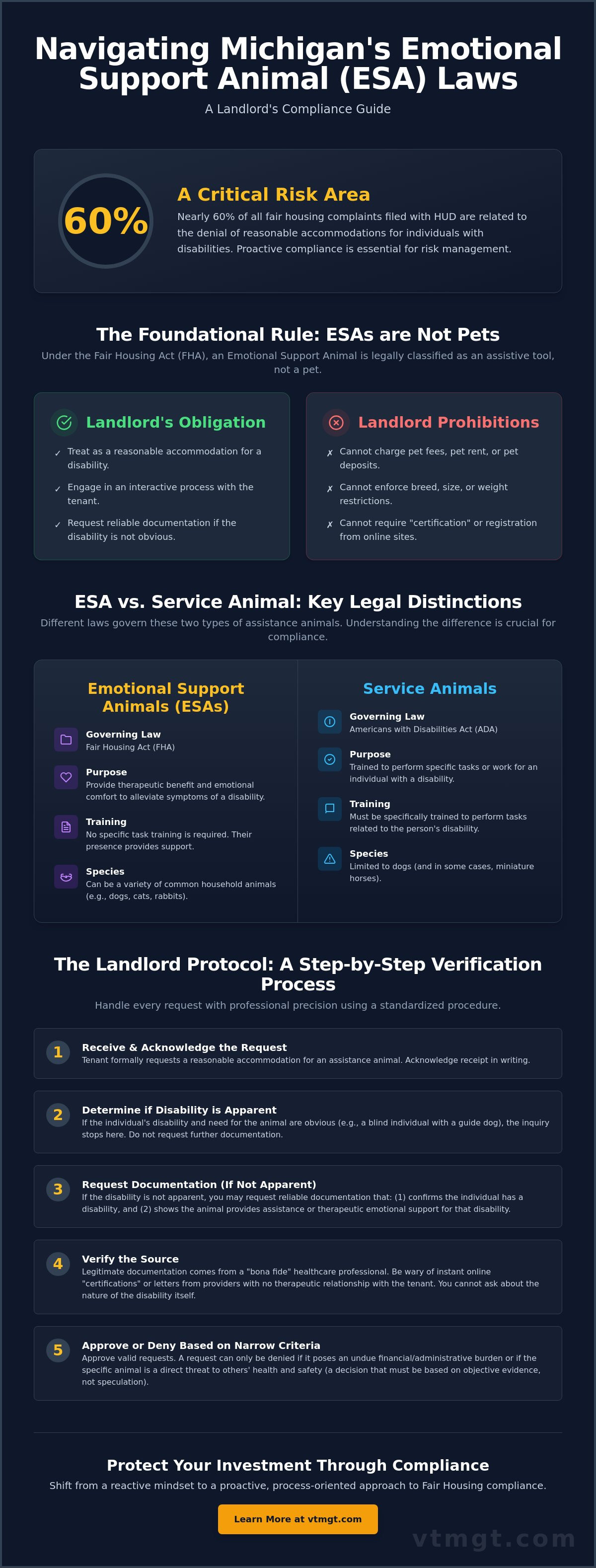
Managing emotional support animal laws for landlords Michigan requires a disciplined operational sequence to ensure every request is handled with technical precision. When a tenant or applicant submits a request for an ESA, your first action is to determine if the disability is visible or already known. If the disability is not apparent, you have the legal right to request reliable documentation that confirms the disability-related need for the animal. This initial screening phase must be consistent across all applicants to avoid claims of disparate treatment. We recommend maintaining a standardized intake form to record the date of the request and the specific documents provided.
The "Interactive Process" is a mandatory dialogue between the housing provider and the tenant. It's not a gatekeeping exercise but a good-faith effort to find a solution that accommodates the tenant's needs while maintaining the property's operational standards. If the initial documentation is incomplete, use this process to specify what technical information is missing, such as the provider's license number or the date of the last clinical contact. Documentation of these conversations is essential for risk mitigation. Every email, letter, or phone log serves as evidence of your compliance with fair housing mandates.
Once you verify the documentation, issue a formal decision in writing. If the request is granted, update the lease using a dedicated Animal Addendum rather than a standard pet addendum. This document should outline behavioral expectations, waste disposal protocols, and the tenant's liability for any physical damage caused by the animal. It's a technical specification for the animal's presence on the property. By using precise language that avoids "pet" terminology, you reinforce the animal's legal status as an assistive tool. This structured approach protects the long-term stability of your rental assets.
When Can a Landlord Legally Deny an ESA?
Denials are only permissible under specific parameters defined by HUD and the FHA. You may deny a request if the specific animal poses a direct threat to the health or safety of others that cannot be reduced or eliminated by another reasonable accommodation. Other valid reasons include the animal causing substantial physical damage to the property or if the accommodation creates an undue financial and administrative burden. These claims require objective evidence, such as specific repair estimates or documented behavioral incidents. Generalizations about a species or size are insufficient; the threat must be linked to that specific animal’s history.
Handling Breed Restrictions and Insurance Policies
Insurance conflicts often arise when a tenant requests an ESA of a breed excluded by a property’s liability policy. If your carrier threatens to cancel or significantly increase the cost of your policy, this may constitute an undue burden. However, you must first engage in the interactive process to determine if an alternative insurance provider can offer comparable coverage without the breed restriction. Michigan legal precedents generally protect the tenant's right to a specific animal unless that individual animal is proven dangerous. For assistance with residential property management and lease preparation, professional oversight ensures these complex interactions remain fully compliant with federal standards.
Protecting Your Northern Michigan Investment through Professional Compliance
Attempting a DIY approach to emotional support animal laws for landlords Michigan often leads to avoidable technical errors. These mistakes frequently result in HUD complaints, which carry significant financial and reputational risks. Professional management replaces guesswork with a structured framework designed to ensure 100% compliance. By utilizing standardized intake forms and verified legal templates, we remove the subjectivity that often triggers discrimination claims. This disciplined method maintains the integrity of your real estate portfolio while respecting the legal rights of all residents. It's a matter of applying engineering precision to the management of human variables and legal mandates.
The Van Treese Standardized Management System
Our operational model relies on a rigorous screening infrastructure that filters out fraudulent requests before they become liabilities. We don't rely on gut feelings; we follow a technical checklist that verifies the "bona fide" relationship between the tenant and their healthcare provider. This process is integrated into our broader tenant screening and placement services, ensuring that every applicant is treated with the same level of scrutiny. Maintenance coordination also requires specific protocols when an ESA is present on the property. We ensure that vendors and contractors are notified of the animal's presence to prevent safety incidents or lease violations. This proactive communication is a core component of our 24/7 compliance strategy across Northern Michigan.
Peace of Mind for Property Owners
Maintaining property value in markets like Petoskey and Grand Rapids requires a balance of tenant satisfaction and rigorous asset protection. Local expertise in Emmet and Charlevoix counties is essential because regional court attitudes toward housing disputes can vary. Our team understands these nuances, providing a layer of protection that generic, national management firms cannot match. We handle the "interactive process" and all documentation reviews, which reduces the stress of legal confrontations for the property owner. This systematic approach ensures that your investment remains stable and profitable, even as regulations evolve. Precision in lease agreement preparation and financial reporting further strengthens your position in the event of a dispute. Protect your investment with Van Treese Management through our proven, quality-controlled processes.
The complexity of emotional support animal laws for landlords Michigan shouldn't compromise your investment strategy. By delegating these tasks to a partner with a fegyelmezett, development-oriented mindset, you ensure that every reasonable accommodation request is handled with professional maturity. We treat property management as a complex industrial process where every detail matters. From the initial request to the final lease addendum, our goal is to provide a seamless, compliant experience that protects your assets and your peace of mind. This is the standard of excellence required for modern real estate investment in Michigan.
Optimizing Your Compliance Strategy for 2026 and Beyond
Success in property management depends on the consistent application of technical standards and legal requirements. Mastering emotional support animal laws for landlords Michigan involves more than just understanding definitions; it requires a fegyelmezett approach to verification and communication. By distinguishing between assistive tools and household pets while maintaining a rigorous interactive process, you effectively mitigate the risk of costly litigation. These structured protocols provide the necessary infrastructure to manage human variables within a stable, predictable framework.
Since 2018, we've utilized standardized management systems to protect property owners from the complexities of fair housing mandates. As members of the National Association of Residential Property Managers, we combine this technical precision with deep local expertise in Emmet and Charlevoix counties. Get Expert Help Managing ESA Compliance for Your Michigan Rental to ensure your portfolio remains secure, compliant, and fully optimized. Implementing these professional standards today will ensure the long-term stability and profitability of your Northern Michigan real estate investments.
Frequently Asked Questions
Can I charge a pet deposit for an emotional support animal in Michigan?
No, you cannot charge a pet deposit, pet rent, or any additional fees for an emotional support animal. Under federal and state regulations, these animals are classified as assistive devices rather than pets. Charging a fee for a reasonable accommodation is a violation of the Fair Housing Act. You must treat the animal as a technical necessity for the tenant's health rather than a discretionary household pet.
Does a landlord have to accept an ESA letter from an online website?
You aren't required to accept a certificate from a registration website that lacks a clinical relationship. HUD guidance specifies that documentation should come from a healthcare professional with personal knowledge of the tenant. If a letter is provided by an online service without a prior provider-patient relationship, it often fails to meet the technical requirements for emotional support animal laws for landlords Michigan.
Can I limit the breed or size of an ESA in my Michigan rental property?
No, you cannot apply general breed or weight restrictions to an emotional support animal. Each request must be evaluated on an individual basis regarding that specific animal's behavior and history. A denial is only permissible if the specific animal poses a documented threat to safety or would cause substantial physical damage. Generalizations about certain breeds are insufficient to override a tenant's right to a reasonable accommodation.
How many emotional support animals can a tenant have in Michigan?
There is no specific numerical limit, but the tenant must demonstrate a distinct disability-related need for each animal requested. If a tenant requests multiple ESAs, they must provide documentation explaining how each animal provides a different or cumulative therapeutic benefit. We treat these as individual technical requirements that must be justified through professional clinical documentation rather than personal preference or convenience.
What happens if a tenant’s ESA causes damage to the property?
The tenant remains financially liable for any physical damage the animal causes to the dwelling or common areas. While you cannot charge an upfront pet deposit, you can bill the tenant for repairs or deduct the costs from their standard security deposit at the end of the lease. It's essential to document the property's condition before and after the tenancy to ensure technical accuracy in any damage claims you process.
Can I ask a tenant what their disability is when they request an ESA?
No, you cannot ask for a specific diagnosis or details about the nature of the tenant's disability. You are only permitted to ask if the person has a disability and if there's a disability-related need for the animal. Requests for medical records or detailed clinical histories are strictly prohibited under fair housing regulations. This boundary ensures medical privacy while allowing for the verification of the accommodation's necessity through a professional letter.
Do Michigan ESA laws apply to owner-occupied buildings with fewer than four units?
Federal exemptions exist for owner-occupied buildings with four or fewer units, often called the "Mrs. Murphy" exemption. However, Michigan’s Persons with Disabilities Civil Rights Act and local ordinances may still apply to these properties. Landlords should verify local requirements in their specific municipality, as state-level protections often overlap with federal rules to ensure comprehensive civil rights coverage for residents regardless of building size.
What is the penalty for a landlord who wrongly denies an ESA in Michigan?
Wrongfully denying a request can result in significant financial penalties, including compensatory damages, attorney fees, and civil fines. The Michigan Department of Civil Rights or HUD can initiate investigations that lead to structured settlements or litigation. Maintaining compliance with emotional support animal laws for landlords Michigan is the most effective way to avoid these high-risk legal confrontations and protect the stability of your long-term investment.