
With a multifamily occupancy rate of 99.4% in Traverse City, the regional housing market is operating at near-total capacity. For landlords, this creates a high-stakes environment where managing student rentals near NMC Traverse City requires more than just filling vacancies. You're likely aware that while the proximity to Northwestern Michigan College guarantees a steady stream of applicants, it also introduces specific operational risks like accelerated wear and tear and complex lease structures involving co-signers.
We've designed this 2026 guide to help you transition from reactive oversight to a systematic management approach. You'll learn how to implement standardized maintenance protocols and rigorous tenant screening to protect your physical asset's value. We'll also cover the financial technicalities of the Traverse City market, where average one-bedroom rents now range between $1,300 and $1,600, ensuring your ROI remains stable despite the inevitable churn of the academic year.
Key Takeaways
- Identify high-demand geographic corridors to optimize property acquisition and maintain consistent occupancy levels near the NMC campus.
- Implement standardized lease agreements that utilize joint and several liability to secure rental income during roommate transitions.
- Establish preventative maintenance systems to mitigate the specific operational risks associated with managing student rentals near NMC Traverse City.
- Prioritize student-centric infrastructure, including high-speed data connectivity and transit accessibility, to streamline the tenant placement process.
- Leverage professional management frameworks to preserve asset value and ensure long-term ROI through structured oversight.
The Student Rental Market Near Northwestern Michigan College (NMC)
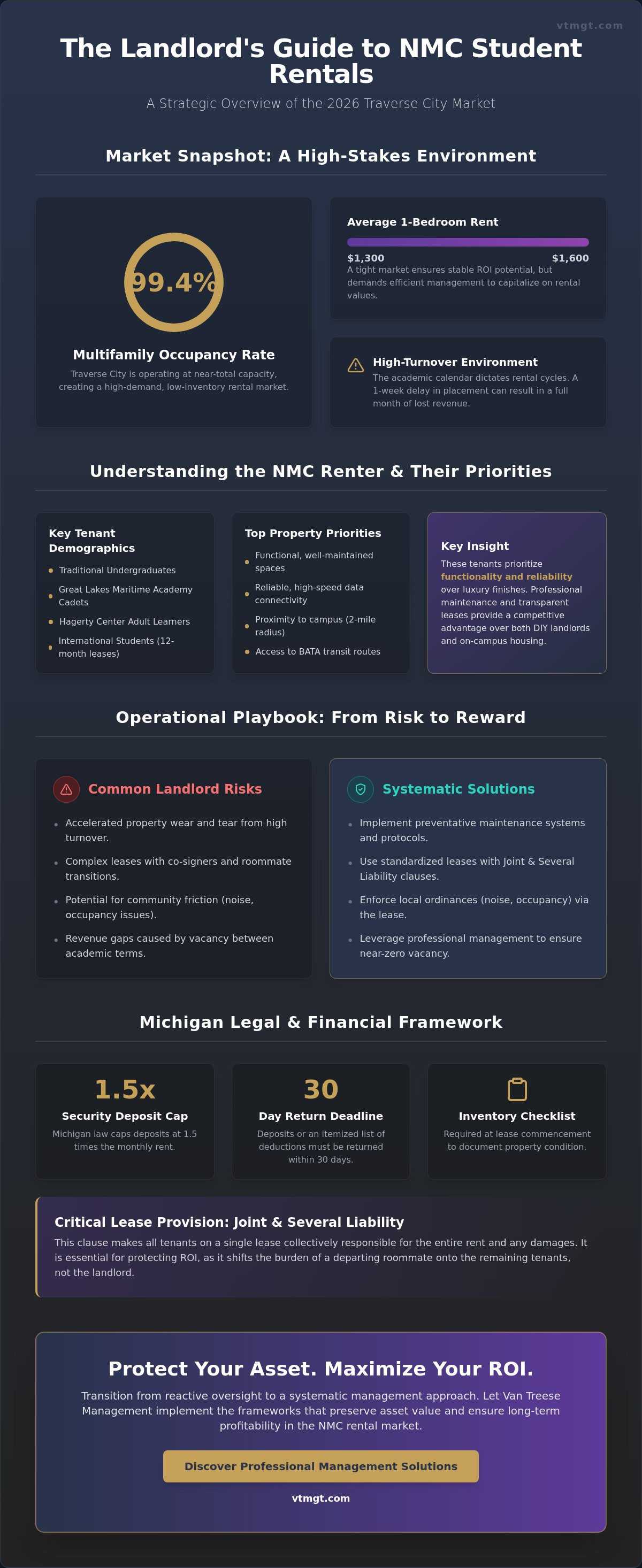
The Traverse City rental market is currently defined by a structural supply deficit. With a multifamily occupancy rate of 99.4%, landlords who specialize in the NMC student niche operate within a high-demand, low-inventory environment. Successfully managing student rentals near NMC Traverse City requires a departure from traditional residential strategies. Instead, it demands a focus on high-turnover efficiency and a deep understanding of specific tenant profiles. Precision matters here. When dealing with an academic calendar, a single week of delay in maintenance or placement can result in a month of lost revenue.
NMC serves a diverse demographic that extends beyond traditional undergraduates. The presence of the Great Lakes Maritime Academy and the Hagerty Center creates a consistent need for housing among specialized cadets and adult learners. These groups often prioritize functional, well-maintained spaces over luxury finishes. Because the market is so tight, landlords who implement standardized management systems can achieve near-zero vacancy rates while protecting their physical assets from the accelerated wear often seen in communal living. Moving from a DIY approach to professional systems ensures that the property remains a performing asset rather than a liability.
Traverse City Rental Demographics
We've observed a distinct shift toward year-round housing needs in Northern Michigan. While the academic calendar remains the primary driver, many students now seek 12-month leases to maintain their local employment or participate in summer internships. The diversification of types of student housing in the region includes traditional shared houses and more modern, high-density units. International student enrollment further stabilizes this demand, as these individuals typically require stable, off-campus arrangements for the duration of their programs. The average student rental occupancy cycle in Traverse City typically follows a 12-month rhythm that aligns with the college's fiscal and academic milestones.
Why Proximity to NMC Matters
Location is the primary variable in determining rental yields near campus. Properties located along the Front Street corridor or within a two-mile biking radius command a premium due to their "Walk Score" and ease of access. For students without personal vehicles, integration with the Bay Area Transportation Authority (BATA) bus routes is a critical marketing advantage. While NMC residence halls offer a structured environment, private off-campus rentals provide the autonomy and space that many upperclassmen and maritime cadets prefer. This competitive landscape favors landlords who offer professional maintenance coordination and transparent lease terms, providing a reliable alternative to on-campus living.
Legal and Financial Frameworks for Student Leases in Michigan
Operating within the student housing sector requires a disciplined approach to regulatory compliance. Michigan law is explicit regarding the management of security deposits; as of June 2026, these funds are capped at 1.5 times the monthly rent. Landlords are required to provide an inventory checklist at the commencement of the lease and must return the deposit, or an itemized list of deductions, within 30 days of the tenant's move-out date. These protocols are essential when managing student rentals near NMC Traverse City to prevent legal friction and maintain the asset's financial integrity. Adhering to Michigan's landlord-tenant laws ensures that your management practices remain defensible and transparent.
Joint and several liability serves as a critical structural component of a student lease. This clause ensures that every individual on the agreement is collectively responsible for the entire rent amount and any property damage. In shared housing environments near Northwestern Michigan College, this protects the landlord's revenue if one roommate exits the agreement prematurely. It shifts the burden of finding a replacement or covering the deficit onto the remaining tenants, which simplifies the owner's financial reporting and accounting processes. Without this protection, a single vacancy in a shared unit could jeopardize the property's monthly ROI.
Michigan Landlord-Tenant Law Compliance
Lease agreements must integrate specific local regulations, including Traverse City's noise ordinances and occupancy limits. These clauses aren't just boilerplate text; they're enforceable tools that mitigate the risk of community friction and municipal fines. Managing these requirements requires a deep understanding of Michigan landlord laws and local zoning nuances. Precise lease agreement preparation ensures that your documents stand up to scrutiny in Grand Traverse County courts while protecting your rights as a property owner.
Parental Guarantees and Financial Screening
Since many NMC students possess limited credit history, parental guarantees are a standard requirement for risk mitigation. In this framework, the co-signer's financial stability takes precedence over the student's personal background check. Effective management involves a high degree of human interaction with these guarantors to ensure they understand their financial obligations. Standardized systems for digital rent collection and automated late fee enforcement provide the transparency parents expect while maintaining the discipline necessary for consistent cash flow. This dual-layered screening process creates a secure financial foundation for the entire tenancy period.
Maintenance Coordination and Property Protection Strategies
High-density student housing functions much like industrial infrastructure; it requires constant monitoring and precise intervention. When you're managing student rentals near NMC Traverse City, maintenance isn't merely about fixing what breaks. It's about preserving the asset's structural integrity through standardized protocols. Minor leaks or electrical issues can escalate quickly in communal living environments where multiple tenants share utilities. A professional maintenance coordination system ensures that small issues are addressed before they require significant capital expenditure. This disciplined approach prevents the slow degradation that often plagues unmanaged student properties.
Northern Michigan’s climate adds a layer of technical complexity to property oversight. Winterization is non-negotiable. Pipes must be protected, and heating systems need precision tuning before the first frost hits Traverse City. In the spring, the focus shifts to exterior drainage and preparing for the high-intensity turnover period. Effective management relies on a network of vetted vendors who understand the tight timelines of the academic calendar. These professionals provide the 24/7 emergency response required to handle critical failures without disrupting the students' educational environment or risking damage to the building's core systems.
Mitigating Wear and Tear
Protecting the physical asset starts with material selection. We recommend standardizing high-durability flooring and scuff-resistant paint to withstand the heavy traffic typical of student housing. Quarterly inspections serve as a proactive safeguard, allowing managers to identify lease violations or maintenance needs early. This systematic approach is detailed in our guide on rental property maintenance Northern Michigan, which outlines how to balance tenant comfort with long-term asset protection. Referencing Michigan's official guide for tenants and landlords helps ensure that your inspection protocols remain legally compliant while you safeguard your investment.
Turnover Management Systems
The transition between academic semesters is a high-precision operation often called the "48-Hour Turn." During this short window, units must be inspected, cleaned, and repaired for the incoming cohort. Professional managers use standardized cleaning checklists to maintain quality control across the entire portfolio. This process relies on documented inventory checklists, which are essential in 2026 for accurately assessing damages and justifying security deposit deductions according to state law. Successfully managing student rentals near NMC Traverse City during these peak periods requires a structured framework that leaves no room for operational delays or missed details.
Marketing and Tenant Placement for Traverse City Student Housing
Maximizing the yield of a student-focused asset requires a marketing strategy that aligns with the academic recruitment cycle. In Traverse City, the peak leasing window occurs between March and May, as students secure housing for the following fall semester. Successfully managing student rentals near NMC Traverse City involves leveraging specific local channels, such as the NMC community boards and specialized digital student housing portals, rather than relying solely on generic listing sites. This targeted approach ensures that your property is visible to the most relevant demographic at the exact moment they're making housing decisions.
Conversion rates are driven by the clear communication of student-specific amenities. In 2026, high-speed fiber internet isn't an upgrade; it's a fundamental utility as critical as electricity for modern coursework. Beyond connectivity, marketing materials should emphasize quiet study zones and proximity to the Bay Area Transportation Authority (BATA) bus routes. Highlighting the property's location relative to BATA stops provides a competitive advantage, especially for students at the Great Lakes Campus or those without personal vehicles. Standardizing the showing process during the spring rush allows for high-volume viewing while maintaining the operational discipline required to secure the best tenant groups early.
Digital Marketing for Gen Z Tenants
Gen Z tenants prioritize efficiency and transparency during their housing search. Professional photography and immersive virtual tours have become mandatory requirements for high-performing listings. These tools allow prospective students, and often their parents in other regions, to evaluate the property's condition without a physical visit. We've found that using social proof and maintaining a positive community reputation significantly reduces the cost of tenant acquisition. Listing for the fall semester should begin no later than late February to capture the first wave of high-quality applicants who value stability and early planning.
Screening for Thriving Communities
Screening students requires a departure from traditional credit-centric models. Since many applicants lack a substantial credit history, we focus on behavior-based placement and rigorous reference verification. This process involves interviewing student groups to ensure compatible roommate dynamics, which directly reduces the risk of mid-lease disputes and noise complaints. Implementing early renewal incentives in January can further stabilize your portfolio by securing existing tenants for another year, effectively dropping your vacancy risk to zero well before the spring rush. For owners looking to optimize these processes, our property marketing and advertising services provide the structured framework needed to attract and retain elite student groups.
Professional Management: Scaling Your NMC Rental Portfolio
Scaling a portfolio in the student housing sector requires a transition from individual property oversight to a structured management framework. Managing student rentals near NMC Traverse City involves complex logistical cycles that can overwhelm DIY landlords, especially those managing multiple units across different neighborhoods. Professional management introduces the precision necessary to handle high-turnover schedules while maintaining the human interaction required to resolve roommate conflicts or parent inquiries. By implementing standardized systems, owners can transform a collection of properties into a high-performing, scalable investment portfolio that operates with industrial-grade efficiency.
For out-of-town investors, monthly residential management provides a critical local operational anchor in Northern Michigan. It's difficult to oversee the technical winterization protocols or the high-intensity turnover periods discussed previously from a distance. Professional oversight ensures that the asset remains protected and compliant with all local ordinances without requiring the owner's physical presence. This level of control is essential for maintaining the stability of your income, particularly in a market where Traverse City’s multifamily occupancy rate remains near total capacity at 99.4%.
ROI and Financial Reporting
Financial transparency is the foundation of a successful long-term investment. We prioritize real-time tracking of income and maintenance expenses, allowing owners to monitor their property's performance with total clarity. Our ongoing market research ensures that rent prices stay aligned with the 2026 Traverse City market, where one-bedroom units currently command between $1,300 and $1,600 per month. For a deeper analysis of regional trends and acquisition strategies, consult our comprehensive guide on investing in rental property Northern Michigan.
The Van Treese Advantage
The Van Treese advantage lies in our disciplined approach to property preservation and tenant relations. We leverage an established network of vetted contractors to reduce repair costs and ensure that every maintenance task meets our rigorous quality standards. This structured environment creates stable, thriving communities that benefit both the students and the surrounding neighborhoods. Our goal is to provide the stability and technical expertise required to manage the complexities of the academic rental cycle. If you're ready to optimize your portfolio and secure long-term ROI, contact us for a professional consultation regarding managing student rentals near NMC Traverse City.
Securing Long-Term Asset Performance in the NMC Housing Market
The Traverse City rental market is a high-precision environment where the 99.4% occupancy rate leaves no room for operational inefficiency. Successfully managing student rentals near NMC Traverse City requires a dual focus on rigorous legal compliance and proactive property preservation. By integrating joint and several liability clauses and standardized maintenance protocols, owners can mitigate the risks associated with high-turnover academic cycles. These systems don't just fill vacancies; they protect the underlying value of the physical asset while ensuring predictable financial reporting. It's about building a stable foundation that survives the churn of each semester.
We provide the structural framework necessary to scale your portfolio through standardized maintenance systems and 24/7 emergency response coordination. Our team utilizes a network of vetted local contractors to ensure that every repair meets industrial quality standards without unnecessary delays. Partner with Van Treese Management for Professional Student Rental Oversight to transition your property from a reactive liability into a disciplined, high-performing asset. Your investment deserves the precision of professional oversight to thrive in Northern Michigan’s competitive landscape.
Frequently Asked Questions
Is a student rental near NMC a good investment in 2026?
Yes, the investment potential remains high due to a regional housing shortage and a multifamily occupancy rate of 99.4%. Traverse City's household growth increased by 10.9% between 2010 and 2020, and demand continues to outpace supply. Landlords who implement structured management systems can expect stable rental income and consistent demand from both traditional students and specialized maritime cadets.
What are the specific Traverse City noise ordinances for student housing?
Traverse City enforces municipal noise ordinances that typically restrict excessive sound levels between 10:00 PM and 7:00 AM. While there isn't a separate code specifically for student housing, residential properties must comply with these community standards to avoid municipal fines. We recommend integrating these specific timeframes into your lease agreements to provide clear, enforceable boundaries for your tenants.
Can I require a co-signer for a student lease in Michigan?
Yes, requiring a co-signer or parental guarantee is a standard and legal practice in Michigan for tenants with limited credit history. This provides an additional layer of financial security by ensuring a third party is liable for rent and property damages. It's essential to verify the co-signer's financial background with the same rigor used for the primary tenant to ensure the guarantee is substantive.
How much can I charge for rent for a student apartment near NMC?
Off-campus rental rates in Traverse City for June 2026 average between $1,300 and $1,600 for one-bedroom units and $1,632 to $1,750 for two-bedroom units. These prices are significantly higher than NMC’s on-campus options, which range from $875 to $1,180. Market rates are influenced by proximity to the Front Street corridor and the specific amenities provided, such as high-speed internet and transit access.
What happens if a student tenant breaks their lease mid-semester?
If a lease includes a joint and several liability clause, the remaining roommates are legally responsible for the full rent amount. This protects your monthly revenue from being disrupted by a single tenant's departure. Professional lease agreement preparation is critical here; it ensures your contracts are compliant with the Michigan Truth in Renting Act while providing clear pathways for roommate replacements or early termination fees.
Do I need a special license for student rentals in Traverse City?
Long-term residential rentals do not require a specialized student-housing license, but they must adhere to general residential zoning and safety regulations. However, if you intend to rent your property for periods of 30 days or less, you must obtain a Vacation Home Rental license. This requires a $200 application fee and an annual renewal fee of $200, along with a total lodging tax of 11%.
How do I handle maintenance requests during the winter break?
Effective maintenance during winter break requires a 24/7 coordination system to address emergencies like frozen pipes or furnace failures while tenants are away. You should perform proactive inspections before the break to ensure all systems are functioning at peak efficiency. Utilizing a network of vetted local contractors allows for rapid response times, protecting the building's core infrastructure from Northern Michigan’s severe winter conditions.
What is the best way to screen roommates who are not on the same lease?
We strongly advise against allowing any occupant to reside in the property without being a signatory on the primary lease. The most effective strategy for managing student rentals near NMC Traverse City is to put all residents on a single, unified contract. This ensures that every individual is subject to the same rigorous background checks and behavior-based screening, reducing the risk of roommate dynamic issues and lease violations.