

What if reducing rental stress starts not with handing over the keys, but with making routine decisions repeatable? The most practical landlord burnout solutions begin by identifying which tasks and interruptions create the most pressure. If tenant messages keep cutting into personal time, or repairs and vacancies leave you feeling constantly on call, that strain is a reason to review how your rental is managed, not to make a rushed decision.
This guide will help you pinpoint patterns behind landlord burnout and compare three ways to respond: improving your self-management systems, delegating selected duties, or assigning day-to-day operations to a professional manager. You’ll also learn how consistent tenant communication and maintenance coordination can reduce recurring owner tasks. Start by identifying the sources of stress, then weigh practical options and choose manageable next steps that protect your time while keeping property operations organized.
Key Takeaways
- Use a simple task audit to identify which rental responsibilities repeatedly disrupt your time and where clearer boundaries could help.
- Build landlord burnout solutions around repeatable processes, using written procedures and templates to reduce avoidable decisions.
- Compare self-management, selective delegation, and professional management by the time, control, and coordination each requires.
- Turn your findings into a manageable plan, prioritizing rental tasks by recurrence, urgency, property impact, and available time.
- See how residential management can shift recurring work such as rent collection, tenant communication, maintenance coordination, tenant placement, and financial reporting.
Landlord Burnout: Identify the Rental Tasks Draining Your Time
Rental responsibilities can create sustained strain when interruptions, unfinished work, and constant decision-making become part of the routine. Here, landlord burnout describes that ongoing pressure; it isn’t a medical diagnosis. The term what is burnout offers broader context, but a landlord’s first practical step is to identify which parts of property management repeatedly consume time and attention.
Separate an urgent operational issue from a recurring workload pattern. A sudden repair may need prompt action. Repeated tenant messages about the same unresolved issue, however, may point to a communication or maintenance process that needs improvement. Landlord burnout solutions work better when they address the pattern, not just the latest interruption.
Which landlord responsibilities most often create ongoing pressure?
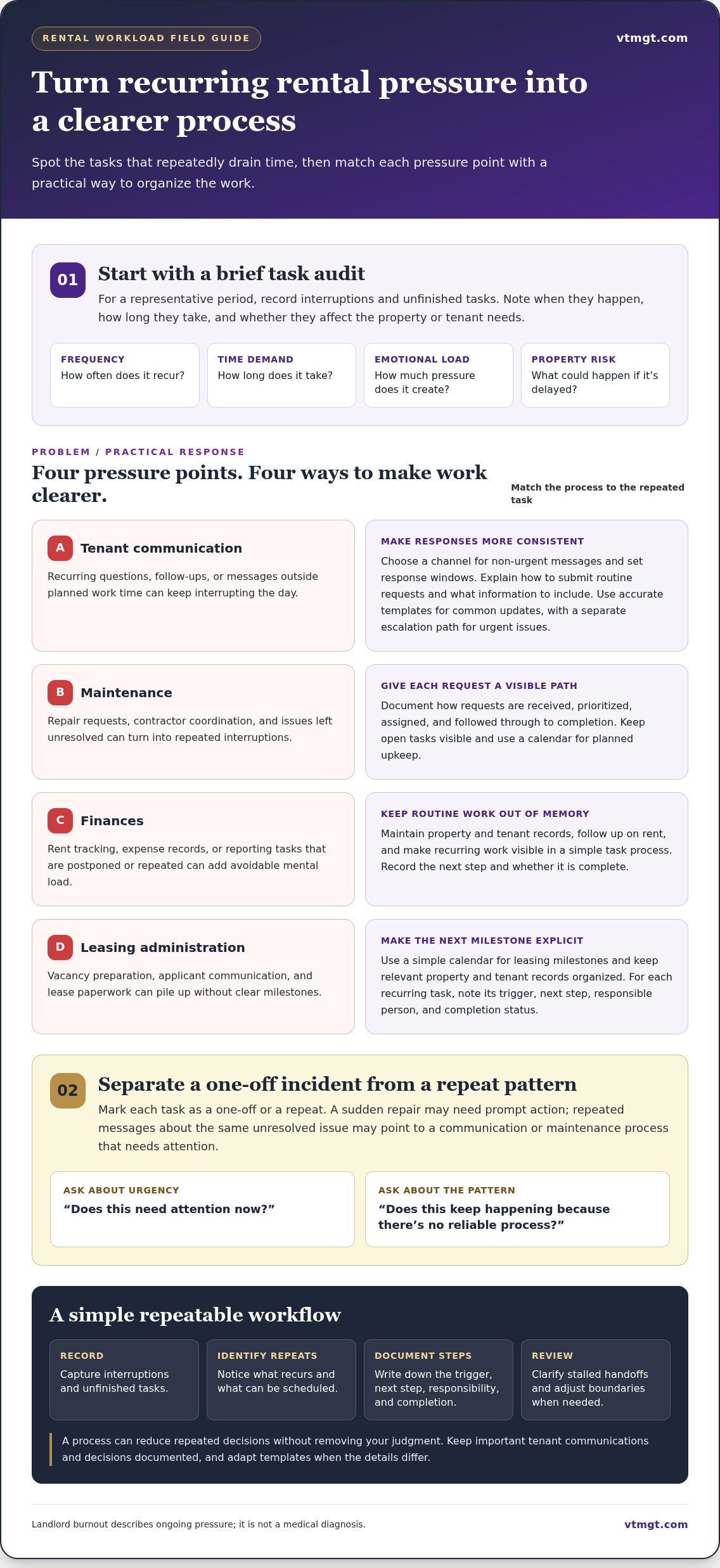
Group your rental tasks into four areas: tenant communication, maintenance, finances, and leasing administration. For a representative period, record interruptions and unfinished tasks. Note when they occur, how long they take, and whether they affect the property or tenant needs.
- Tenant communication: recurring questions, follow-ups, and messages that arrive outside your planned work time.
- Maintenance: repair requests, contractor coordination, and issues that remain unresolved.
- Finances: rent tracking, expense records, and reporting tasks you postpone or repeat.
- Leasing administration: preparing for vacancies, communicating with applicants, and organizing lease paperwork.
Mark each item as a one-off incident or a repeat. A single unexpected repair may be unavoidable. Repeated delays or the same preventable question may signal a need for a clearer procedure, template, or assignment of responsibility.
How can you tell when rental stress needs a different approach?
Look for practical changes in how you manage the property. Persistent after-hours work, routine tasks that keep slipping, or difficulty switching off from tenant concerns can indicate that your current setup isn’t sustainable. Consider whether the workload is affecting your rest, relationships, or confidence in making property decisions. These observations aren’t a diagnosis; they help identify when your management process needs attention.
Use a brief self-audit to clarify the pressure points. For each task, note its frequency, time demand, emotional load, and potential property risk if delayed. Then ask: Is this urgent now, or does it recur because there’s no reliable process? Which tasks could be scheduled, documented, delegated, or handled differently? If distress feels severe or extends beyond rental management, seek support from a qualified health professional. This assessment gives you a grounded starting point for improving systems and making workload decisions.
Landlord Burnout Solutions Start With Better Rental Management Systems
Once you’ve identified the tasks that repeatedly consume your time, turn that information into a consistent workflow. Effective landlord burnout solutions don’t require a complicated system. Track tasks, identify repeats, document the steps, set boundaries, and review what’s working. A process can reduce repeated decisions without removing your judgment: a template can handle routine updates, while you assess each situation on its facts.
Written procedures also support consistent, fair treatment. Keep records of important tenant communications and decisions, and use reliable references when setting policies. The U.S. Department of Housing and Urban Development provides an overview of federal housing laws relevant to housing providers. A clear process makes responsibilities easier to follow, but it doesn’t replace the need to understand applicable requirements.
How can landlords reduce tenant-message overload?
Choose a consistent channel for non-urgent messages and set response windows that fit your schedule and the property’s needs. Tell tenants how to submit routine requests, what information to include, and when they can expect a response. Reusable templates can cover common updates, such as confirming a request was received or explaining the next step. Keep templates accurate and adapt them when the details differ.
Set a separate escalation path for urgent issues. Explain which situations need immediate attention and how tenants should report them, while keeping ordinary questions out of that channel. The Petoskey property management guide offers related context on organizing rental operations. Boundaries work best when they’re clear, consistent, and appropriate to the property.
Which rental tasks are easiest to standardize first?
Begin with repeatable administrative work: maintaining property and tenant records, following up on rent, logging maintenance requests, and reviewing open tasks. Create a simple calendar for leasing milestones, inspections, and planned upkeep. For each recurring task, record what triggers it, the next step, who is responsible, and whether it’s complete. This keeps routine work visible and reduces reliance on memory.
For maintenance, document how requests are received, prioritized, assigned, and followed through to completion. A Northern Michigan rental maintenance guide can help inform a planned approach to property upkeep. Review your system regularly: remove steps that add no value, clarify handoffs that stall, and adjust communication boundaries if routine work starts spilling into personal time again.
If recurring tenant communication, rent collection, or maintenance coordination still takes more time than you can reasonably manage, residential property management support can organize those responsibilities through an ongoing management process.
Compare Landlord Burnout Solutions: Self-Management, Delegation, or Property Management
The right response depends on which tasks create pressure and how much direct involvement you want to retain. Improving your own workflow may be enough when the workload is manageable and the main problem is disorganization. Delegation can remove selected recurring duties, while residential property management can centralize broader day-to-day oversight. Each option changes how work is handled, not who owns the property.
Self-management improvements
- Owner time: Still required for most tasks, but templates, schedules, and set communication windows can reduce repeated effort.
- Control: Highest direct oversight. You make operational decisions and handle tenant and property matters.
- Coordination effort: Remains with you, including tracking open requests and following up.
- Operational consistency: Depends on maintaining and using your processes consistently.
Selective delegation
- Owner time: Reduced for the specific responsibilities assigned to someone else.
- Control: You retain ownership and oversight while handing off defined tasks.
- Coordination effort: You still need to communicate expectations and manage handoffs.
- Operational consistency: Improves when responsibilities and reporting steps are clearly defined.
Residential property management
- Owner time: Less day-to-day involvement in recurring management responsibilities.
- Control: You retain ownership, while routine operations are handled through management.
- Coordination effort: More recurring coordination is centralized rather than handled by you directly.
- Operational consistency: Tenant communication, rent collection, maintenance coordination, and related tasks follow an ongoing management process.
When can better self-management systems be enough?
Self-management may suit a manageable portfolio when the strain comes from identifiable gaps, such as scattered maintenance records or frequent questions that a clear procedure could address. You keep direct oversight, but remain responsible for decisions, follow-through, and maintaining the system. If interruptions or backlogs continue after workflow changes, reassess whether the problem is capacity rather than process.
When does delegated or professional management make sense?
Match support to the pressure point. If tenant messages consume your workday, assign communication; if repair follow-up is the bottleneck, assign maintenance coordination. When several responsibilities remain burdensome, residential management can centralize recurring oversight while you retain ownership. It can reduce your direct task load, but it doesn’t eliminate every decision or guarantee a particular financial result. Choose the level of support that fits your available time and desired involvement.
Build a Landlord Burnout Recovery Plan for Your Northern Michigan Rental
A useful recovery plan turns your task audit into a sequence of manageable changes. Start with one recurring pressure point, not a complete overhaul. Rank open tasks by how often they occur, how urgent they are, the effect of delay on the property, and the time you can realistically commit. This helps separate immediate operational needs from improvements that can be scheduled.
What should a practical landlord workload plan include?
Use three stages: immediate, near-term, and review. Address urgent property issues first, then choose one recurring task to simplify or hand off. Set a review date to check whether interruptions and unfinished work have changed.
- Immediate: identify time-sensitive property concerns and assign a clear next step.
- Near-term: document a process for one repeated task, or identify who will take responsibility for it.
- Review: compare the task log with your starting audit and adjust the plan if the same bottlenecks remain.
If you delegate or engage management support, prepare a handoff record. Include tenant contact details, key property information, open maintenance items, relevant records, and the decisions you want to retain or authorize someone else to make. Clear boundaries reduce ambiguity and help work move forward without requiring you to reconstruct the property’s status from memory.
How should landlords plan around seasonal rental demands?
Seasonal planning in Northern Michigan should reflect the specific property, its systems, tenant needs, and upcoming work, rather than assuming every rental follows the same schedule. Before a busier or weather-sensitive period, review planned upkeep, unresolved repairs, leasing activity, and property-specific preparations. Put recurring checks and follow-ups on a calendar, assigning an owner or responsible person to each item.
A written maintenance schedule is more reliable than waiting for a problem to prompt action. Record what needs attention, when it should be reviewed, and whether follow-up is still open. For a broader overview of relevant obligations, consult this Michigan landlord laws guide; use it alongside property-specific planning, not as a substitute for reviewing the circumstances that apply to your rental.
Keep the plan proportionate. If one documented process resolves the pressure point, continue using it. If recurring tasks still exceed your available time, consider assigning more responsibility through residential property management. Explore residential property management support to discuss a structured approach to tenant communication, rent collection, and maintenance coordination.
How Van Treese Management Can Reduce Residential Landlord Workload
After improving your own systems or delegating selected tasks, residential property management is a broader option if several recurring responsibilities still compete for your time. Van Treese Management handles core rental operations for residential owners, shifting routine work from the owner’s task list into an ongoing management process. You retain ownership while management support handles defined responsibilities.
Which recurring responsibilities can residential management handle?
Rent collection and tenant communication can create regular administrative work, particularly when questions, follow-ups, and payment tracking require repeated attention. Residential management takes on these recurring tasks, giving tenant communication and rent collection a consistent point of coordination.
Other responsibilities involve distinct workflows:
- Maintenance coordination: Van Treese coordinates repairs through a network of vetted local contractors, helping organize requests and follow-up. The firm also coordinates emergency response for managed properties.
- Tenant placement: Tenant screening, background checks, showings, and lease execution support the process of filling a vacancy.
- Financial reporting: Property financial reporting helps owners keep rental activity organized and visible.
These responsibilities can be handled as part of a broader operating arrangement. The key is to clarify who manages each recurring task and how information reaches the owner, rather than assuming every property or owner needs the same level of involvement.
What is a practical next step for an overwhelmed rental owner?
Start by outlining your property, the tasks that repeatedly interrupt your time, and the decisions you want to continue making yourself. Include open maintenance items, tenant communication needs, rent collection, and upcoming leasing work. This gives you a practical basis for deciding how management responsibilities should be organized and where you prefer to stay involved.
Van Treese Management serves residential property owners across Northern Michigan, including Petoskey, Boyne City, Indian River, Gaylord, Traverse City, and Grand Rapids. If you’re comparing landlord burnout solutions, identify which recurring duties take the most time and consider whether professional coordination fits your needs. Explore Van Treese Management to learn more about residential property management.
Take the Next Step Toward More Manageable Rental Operations
Rental stress is easier to address when you can see which tasks keep returning and choose a response that fits your time, property, and desired level of involvement. Start with one recurring pressure point, improve the process, and review whether the change reduces interruptions or unfinished work. If the workload spans several areas, delegation or residential property management can provide a more structured way to handle day-to-day responsibilities.
Van Treese Management’s residential management includes rent collection and tenant communication, along with maintenance coordination and emergency response coordination. The firm serves Northern Michigan communities including Petoskey and Boyne City. These landlord burnout solutions can help you decide how recurring tasks might be managed while you retain ownership of your rental.
Outline the responsibilities taking the most time and the level of involvement you want to keep. Then explore residential property management with Van Treese Management as a practical next step. A clear plan can help protect your time while keeping rental operations organized.
Frequently Asked Questions
What are the first signs of landlord burnout?
Early signs can include persistent after-hours work, difficulty switching off from rental concerns, and routine tasks repeatedly being delayed. You may notice that tenant messages interrupt personal time or that open maintenance items are harder to keep organized. Landlord burnout describes sustained strain connected to rental responsibilities, not a medical diagnosis. Track when the pressure occurs and which tasks are involved. If distress feels severe or extends beyond property management, consider speaking with a qualified health professional.
How can a landlord reduce stress without hiring a property manager?
Start by recording rental tasks and interruptions, then identify which ones recur and where a clearer process could help. Use a calendar for planned upkeep and leasing tasks, keep maintenance and financial records in a consistent place, and set response windows for non-urgent tenant messages. Templates can make routine communication easier while leaving room to assess unusual situations individually. Review your task log after making changes to see whether interruptions and unfinished work are decreasing.
Is hiring a property manager a good solution for landlord burnout?
It can be useful when several recurring responsibilities continue to exceed your available time. Residential management can take on rent collection and tenant communication, along with maintenance coordination and emergency response coordination. Consider which responsibilities you want handled and which decisions you prefer to retain. Management can reorganize day-to-day work, but it doesn’t remove ownership responsibilities or guarantee a particular financial result.
Can I hire help for only some rental property tasks?
Yes. You can focus support on specific pressure points rather than changing how every part of the rental is managed. For example, you might delegate maintenance coordination while continuing to handle tenant communication, or seek help with tenant placement when a vacancy arises. Define the task, what information should be recorded, who makes decisions, and how updates will be shared. A clear handoff helps prevent duplicated effort and unanswered requests.
How do landlords set boundaries with tenant communication?
Choose a consistent channel for routine messages and tell tenants when you generally review and respond to non-urgent requests. Explain what information to include so you can assess an issue efficiently. Establish a separate reporting path for urgent concerns, with clear instructions suited to the property. Keep a written record of requests and follow-up. Boundaries should make communication more predictable, not prevent tenants from reporting property problems that need timely attention.
What should Northern Michigan landlords do when maintenance becomes overwhelming?
Keep a single log of requests, urgency, next steps, and completion status, then schedule planned upkeep around the needs of the specific property rather than relying on memory. If coordination and follow-up remain a recurring burden, maintenance coordination can shift those tasks into a managed process. Van Treese Management serves owners in Petoskey, Boyne City, Indian River, Gaylord, Traverse City, and Grand Rapids, and coordinates maintenance through a network of vetted local contractors.