

What if the disagreement isn’t really about the management fee, but about how much time and responsibility each of you is prepared to take on? Trying to convince spouse to hire a property manager can turn a practical decision into a debate if one person focuses on the cost and the other on the work involved in running a rental.
Both concerns deserve a fair hearing. Self-management may avoid a management fee, but it also means handling recurring tasks such as tenant communication, rent collection, maintenance coordination, and financial records. Professional support has a cost, too. The useful comparison is how each approach fits your finances, available time, and priorities as property owners.
This article offers a practical way to discuss the options. You’ll map the responsibilities involved, identify which tasks could be delegated, and agree on a next step without pressure. For Northern Michigan owners, that may mean comparing tenant placement, ongoing communication, maintenance coordination, rent collection, and reporting with the work you currently handle.
Key Takeaways
- Start with shared goals for the rental property so the discussion focuses on its needs, not on who is right.
- Track recurring tasks, occasional work, and interruptions to get a clearer picture of the time self-management requires.
- Compare both approaches using the same criteria, including availability, tenant communication, leasing, maintenance coordination, and reporting.
- Use a calm, five-step conversation to convince spouse to hire a property manager, or to agree on another informed next step.
- See how Van Treese Management’s tenant placement, rent collection, communication, reporting, and local contractor coordination fit into the comparison.
How to discuss hiring a property manager without turning it into an argument
One spouse may value direct control over tenant decisions and expenses. The other may feel that calls, repairs, and routine administration have become a second job. Both perspectives can be reasonable. The discussion is more productive when you treat them as different priorities to balance, rather than positions one person must win.
Choose a calm time to talk, not the middle of a repair or a tense tenant exchange. Start with what the property needs and what you both want ownership to look like over the next few years. Separate a recent frustration, such as a maintenance issue, from long-term goals like consistent income, time for other commitments, a positive tenant experience, and the property’s condition. A neutral overview of Property Management can help clarify the range of responsibilities without making the conversation a sales pitch.
Start with shared goals for the rental property
Ask each other: “What do we want this property to provide over the next few years?” One partner may prioritize income consistency, while the other values more personal time or close oversight. Write down each priority, then note where you agree. Shared goals give you a basis for comparing options. For example, you might both want reliable rent collection and good tenant communication, even if you differ on who should handle them.
Name the concerns behind resistance
If one spouse objects to hiring a manager, clarify whether the concern is the fee, losing control, communication, or confidence in service quality. Then identify which responsibilities each of you would prefer to keep, such as approving larger expenses or staying involved in leasing decisions. If you want to convince spouse to hire a property manager, understanding the real objection matters more than repeating the benefits. Management can shift defined tasks, but it doesn’t remove every decision or property expense.
Keep the possible outcomes open. You could continue self-managing, delegate selected tasks, or use full management. The aim is not to secure an immediate yes. It’s to agree on a fair way to assess what the property requires and what level of involvement works for both of you. That shared starting point makes the next comparison more practical and less personal.
Build a clear picture of the work involved in self-managing a rental
Before comparing management options, document what running the rental involves. A task that takes only a few minutes may still require attention during a workday, a trip, or an evening at home. A written record helps replace assumptions with a fuller view of the time, coordination, and decisions each spouse contributes.
Map recurring landlord responsibilities
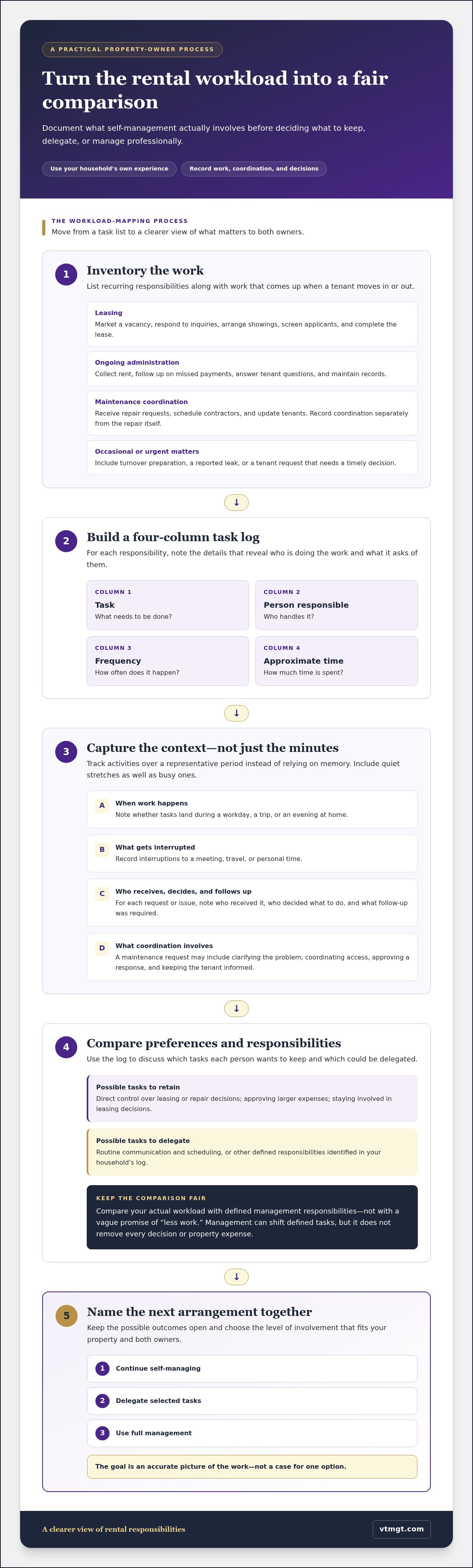
Create a simple log with four columns: task, person responsible, frequency, and approximate time spent. Include routine work as well as tasks that arise when a tenant moves in or out. For context on the broad range of duties involved, see this overview at wikipedia.org. Your household log should reflect your own property, not a generic estimate.
- Leasing: Marketing a vacancy, responding to inquiries, arranging showings, screening applicants, and completing the lease.
- Ongoing administration: Collecting rent, following up on missed payments, answering tenant questions, and maintaining records.
- Maintenance coordination: Receiving a repair request, scheduling a contractor, and updating the tenant. Record coordination separately from the repair work itself.
- Occasional or urgent matters: Turnover preparation, a reported leak, or a tenant request that needs a timely decision.
Track these activities over a representative period instead of relying on memory. Note when work happens and whether it interrupts a planned activity, such as a meeting, travel, or personal time. Include quiet stretches too. The purpose is an accurate picture, not a case for one option.
Identify the interruptions and decisions that matter most
For each request or issue, record who received it, who decided what to do, and what follow-up was required. A maintenance request may involve more than arranging the repair. Someone may need to clarify the problem, coordinate access, approve a response, and keep the tenant informed. These steps show where the workload lies without assuming that every issue is frequent or disruptive.
Then compare preferences. One spouse may want to retain direct control over leasing or repair decisions, while the other may prefer delegated coordination of routine communication and scheduling. This distinction helps you convince spouse to hire a property manager with evidence about the actual workload, while also identifying tasks you may both want to keep. For a reference point, review Van Treese Management residential management responsibilities alongside your log.
Compare self-management with professional property management fairly
Use the same criteria to assess both approaches. Your task log shows what you handle now. Compare those responsibilities with the defined services in a management arrangement, rather than with a vague promise of “less work.” A general overview at wikipedia.org can provide background on property management responsibilities, while the table helps you focus on your household’s needs.
| Criteria | Self-management | Professional support |
|---|---|---|
| Time and availability | Owners handle tasks and respond according to their own schedules. | Defined recurring tasks may be delegated, reducing owners’ direct involvement in those activities. |
| Tenant communication | Owners receive and respond to tenant questions and requests. | A manager can handle tenant communication within the agreed scope. |
| Leasing | Owners coordinate marketing, inquiries, showings, screening, and lease execution. | Leasing tasks can be handled as part of the management arrangement. |
| Maintenance | Owners coordinate requests, contractors, scheduling, and tenant updates themselves. | A manager can coordinate maintenance, while owners may retain approval over specified decisions. |
| Reporting and oversight | Owners maintain records and review property finances directly. | Financial reporting can provide organized information while owners retain oversight. |
Compare responsibilities, oversight, and communication
Use your task log to mark which duties you would delegate and which you want to retain. Then agree on how often you’d like updates and what decisions require your approval, such as a leasing choice or a repair expense. Professional management assigns and coordinates defined work. It does not transfer every owner decision or responsibility. The arrangement should make the division of tasks clear to both spouses.
Assess the financial tradeoff without assuming the answer
Compare the management fee with the time you currently spend and the specific services included in the proposed scope. Keep that fee distinct from other ownership expenses, such as repairs or vacancy-related costs. Don’t assume management will increase rental income or eliminate expenses. Use your property records to assess what the service would cost and which tasks it would cover. For local context, review this guide to property management in Petoskey, MI.
Control also has value, and spouses may weigh it differently from time savings or consistent reporting. To convince spouse to hire a property manager, let the comparison clarify the tradeoffs instead of predetermining the outcome. Self-management, selective delegation, and broader professional support can each be reasonable choices depending on your priorities.
Use a five-step conversation to reach a decision together
Set aside a calm time and agree on a short agenda before discussing management. Avoid starting during a repair, tenant dispute, or other moment when frustration may shape the decision. The goal isn’t to persuade one spouse at any cost. It’s to reach a shared next step based on your property’s needs and both partners’ priorities.
- Agree on goals. Identify what you want the rental to provide, such as dependable income, a well-maintained property, a good tenant experience, or less owner time spent on routine tasks.
- Review the work. Use your responsibility log to see who handles each task, how often it comes up, and whether it interrupts work or personal plans.
- Define concerns. Give each spouse time to explain specific worries, whether they involve fees, oversight, tenant communication, maintenance, or service quality.
- Compare options. Consider self-management, delegating selected tasks, and broader professional support against the same agreed criteria.
- Choose a next action. Decide what information would help you move forward, such as reviewing a management scope or gathering local rental information.
Use questions that keep the discussion practical
Ask, “Which tasks feel manageable, and which repeatedly disrupt our plans?” Then clarify what each of you would expect from a manager: How often would you want updates? Which decisions would you want to approve yourselves? What level of direct involvement would feel appropriate? Agree on criteria that could make either self-management or professional support acceptable. If you’re trying to convince spouse to hire a property manager, these questions help ensure the conversation addresses concerns instead of becoming a debate over who is right.
Turn unresolved concerns into specific information needs
Replace broad doubts with questions you can answer. For example, “We’d lose control” can become “Which decisions would remain ours?” A concern about communication can become “How would tenant updates and owner reporting work?” If repair coordination is central to the discussion, review this guide to Northern Michigan rental property maintenance.
Separate information from assumptions. A management fee doesn’t establish that the service will increase income, and hiring a manager doesn’t mean owners stop making decisions. A practical next step, such as reviewing a proposed scope or gathering rental information, can help you assess the fit before making a change. To explore residential property management support, visit Van Treese Management’s website.
Explore local property management support with Van Treese Management
After comparing your task log with the responsibilities you might delegate, consider how local support would fit your rental. Van Treese Management provides residential property management in Northern Michigan, organizing responsibilities such as tenant placement, tenant communication, rent collection, maintenance coordination, and financial reporting. Looking at these tasks as a defined scope helps both spouses compare handling each step themselves with delegating selected operations.
Show how management responsibilities can be organized
Tenant placement can include marketing the vacancy, conducting showings, completing background checks, and executing the lease. Ongoing management includes rent collection and tenant communication, while maintenance coordination connects repair needs with a network of vetted local contractors. Residential management also includes emergency response coordination. Together, these services give you a concrete basis for discussing which recurring responsibilities could move off your household’s task list.
Delegation doesn’t mean owners lose all oversight. As you evaluate management, discuss what information you want reported, how you prefer tenant communication to be handled, and which decisions you want to remain involved in. If you’re considering how to convince spouse to hire a property manager, a clear description of the work and the oversight owners retain is more useful than a broad promise of convenience.
Agree on a practical next step in Northern Michigan
Review your task log together and identify the responsibilities that take the most coordination or attention. Van Treese Management serves residential owners in Petoskey, Boyne City, Indian River, Gaylord, Traverse City, and Grand Rapids. Owners in Emmet and Charlevoix counties can also use property valuations and rental market research as context when assessing their property’s needs.
You don’t have to make a final decision during the first discussion. A practical next step is for both partners to review the management scope and compare it with the tasks, reporting, and decision authority they want for the property. If you’re ready to explore that comparison, review residential property management with Van Treese Management.
Make your next step a shared decision
A productive conversation starts with shared goals, not a sales pitch. List the responsibilities you currently handle, compare self-management with professional support using the same criteria, and separate concerns about cost from questions about control, communication, and service scope. You don’t have to decide everything at once. Agreeing to gather information or consider delegating selected tasks can be a useful first step.
If you’re trying to convince spouse to hire a property manager, focus on whether the proposed support fits your household’s priorities and the property’s needs. Van Treese Management’s residential management includes rent collection, tenant communication, and emergency response coordination, with maintenance coordinated through a network of vetted local contractors.
Both partners can review the responsibilities and oversight involved before deciding whether professional support makes sense. Explore residential property management with Van Treese Management as a practical next step. A clear, respectful discussion can help you choose an approach that works for both of you.
Frequently Asked Questions
How do I convince my spouse to hire a property manager?
Start with shared goals for the rental, then document the tasks and time involved in managing it yourselves. Compare that workload with the specific services a manager would provide, such as leasing, tenant communication, rent collection, and maintenance coordination. To convince spouse to hire a property manager, address concerns about cost and control directly rather than pressing for an immediate yes. Agree on a practical next step, such as reviewing a management scope together.
What if my spouse thinks a property manager is too expensive?
Compare the fee with the services included, your actual responsibilities, and the time you spend managing the property. Use your own rental records and the proposed service terms rather than relying on general claims about savings. Consider whether tenant communication, leasing, rent collection, or maintenance coordination would meaningfully support your priorities. Professional management doesn’t guarantee higher income or remove every property expense, so assess the tradeoff based on your circumstances.
Will hiring a property manager mean losing control of our rental property?
No, hiring a property manager means delegating defined operating tasks, not giving up all owner oversight. Before deciding, list which responsibilities you want handled and which decisions you’d prefer to remain involved in. Discuss how tenant matters, leasing, maintenance coordination, reporting, and owner updates would be organized. Reviewing the management scope together helps both spouses understand the division of responsibilities and set expectations for communication.
How can we compare self-managing with hiring a property manager?
Use the same criteria for both options: time, tenant communication, leasing, rent collection, maintenance coordination, financial reporting, and owner involvement. Record who currently handles each responsibility and how often it arises, then compare that workload with the services and fees in a management proposal. This approach keeps the decision grounded in your property’s actual needs instead of generic claims about savings or results.
What does a residential property manager do for landlords?
A residential property manager can coordinate key rental operations, with responsibilities defined by the management agreement. Van Treese Management provides tenant placement and leasing, rent collection, tenant communication, maintenance coordination, and financial reporting. Tenant placement includes marketing, showings, background checks, and lease execution. Residential management also includes emergency response coordination. Review the service scope and reporting approach together to understand how responsibilities would be organized for your property.
Is hiring a property manager worth it for a rental property?
It depends on the property’s needs, your available time, and the value you place on professional coordination. Compare the management fee and included services with the tasks you currently handle, the level of involvement you want, and your operating priorities. A manager doesn’t guarantee higher returns or eliminate every expense. Use your property’s records and the proposed service terms to decide whether the arrangement makes sense for your household.
How should couples choose a property manager in Northern Michigan?
First agree on the service and oversight priorities that matter to both of you, such as tenant placement, communication, maintenance coordination, rent collection, and financial reporting. Van Treese Management serves Northern Michigan communities including Petoskey, Boyne City, Indian River, Gaylord, Traverse City, and Grand Rapids. Review the management responsibilities together and identify the updates and decisions you’d want to stay involved in before deciding whether the arrangement fits.