
Is Hiring a Property Manager Worth It in Grand Rapids? A 2026 ROI Analysis
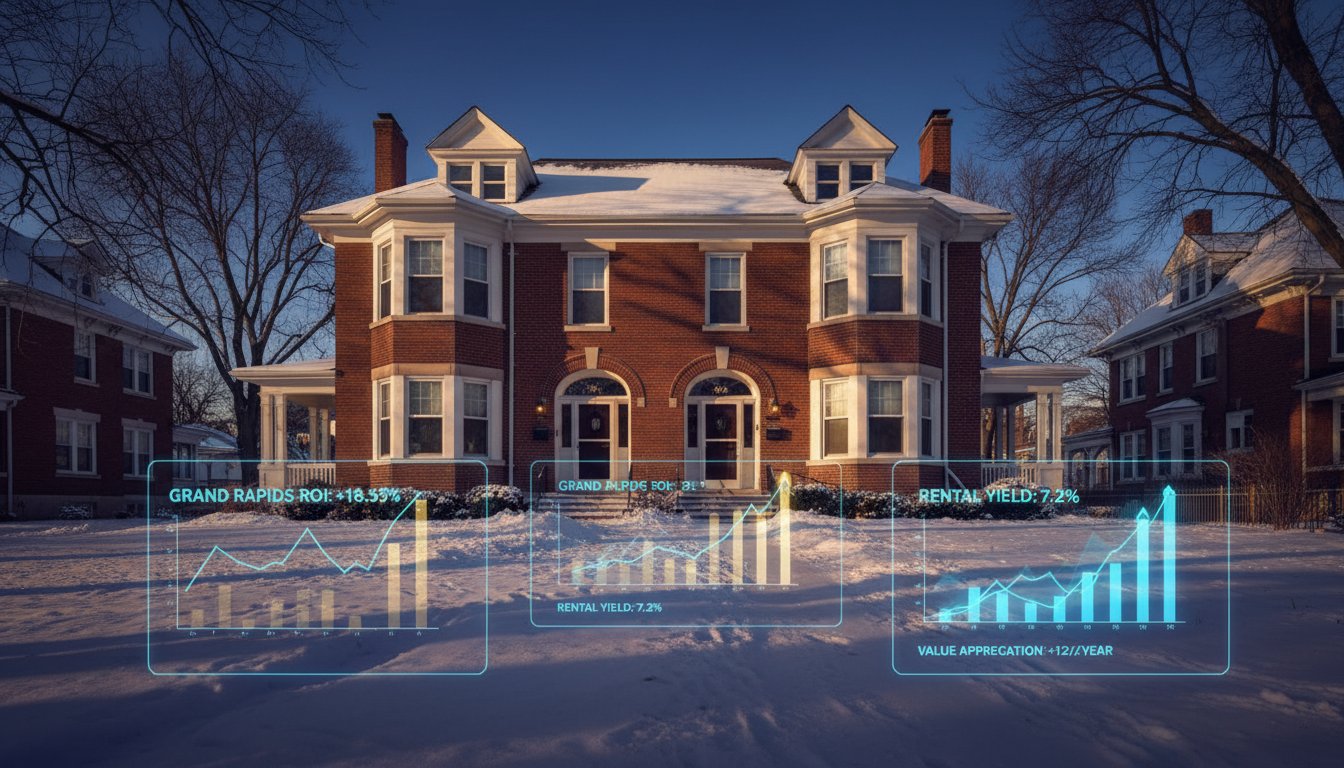
Imagine it's 2:14 AM on a Tuesday in January; a burst pipe in your Eastown duplex just triggered a frantic tenant call while wind chills hit minus ten degrees. You likely entered the West Michigan real estate market to build wealth through passive income, not to act as a full-time emergency response coordinator or a legal researcher for Michigan’s complex landlord-tenant laws. When evaluating your portfolio's performance for the 2026 fiscal year, the central question remains: is hiring a property manager worth it Grand Rapids investors should ask themselves based on hard data rather than convenience alone.
Professional management is a strategic investment in operational efficiency. This analysis provides the precise financial benchmarks and operational metrics you need to determine if professional oversight will scale your ROI or simply erode your margins. We'll examine standardized management systems, current vacancy trends in Heritage Hill, and the specific cost-to-benefit ratios of outsourcing your day-to-day operations to ensure your assets remain protected and profitable. By applying a disciplined, metrics-based approach to your rental portfolio, you can transition from a reactive landlord to a proactive investor.
Key Takeaways
- Analyze the shifting 2026 Kent County rental landscape to understand how new Michigan regulatory frameworks increase the financial risk of self-management.
- Evaluate the true ROI of professional oversight by comparing management fee structures against significant vendor discounts and the high cost of seasonal vacancies.
- Assess local operational demands, such as winterization protocols and city-specific lead-safe certifications, to determine if hiring a property manager worth it Grand Rapids for your portfolio.
- Discover how industrial-grade management systems and transparent financial reporting can transform a residential property into a high-performance, scalable business asset.
Defining Worth: The 2026 Grand Rapids Rental Market Landscape
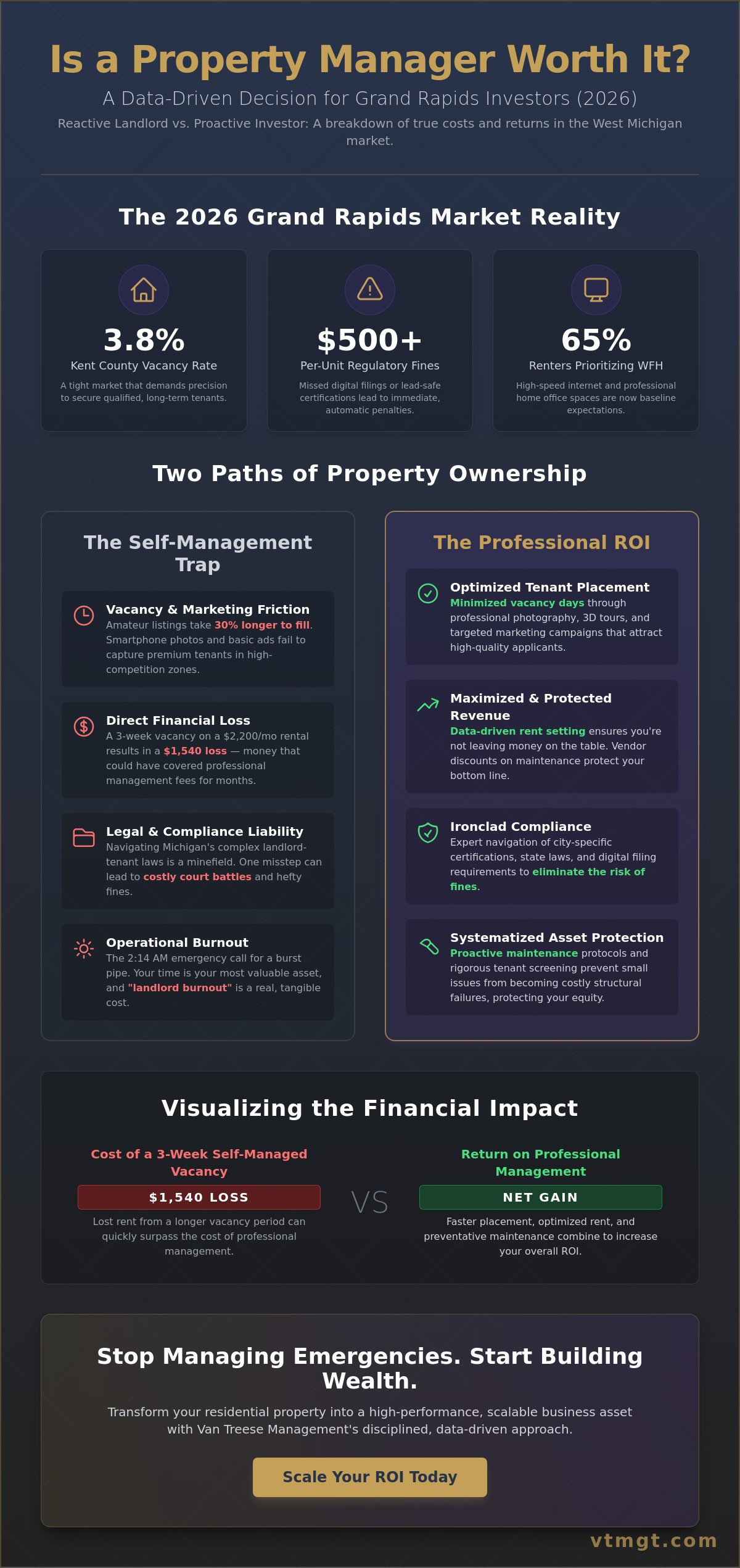
The Grand Rapids rental market in 2026 operates with a precision that rewards data-driven investors while penalizing those who rely on outdated methods. As of January 2026, Kent County maintains a tight vacancy rate of 3.8 percent, a figure that reflects a persistent supply-demand imbalance. While high demand suggests easy profitability, the operational reality is more complex. Determining if is hiring a property manager worth it Grand Rapids requires a cold analysis of the current regulatory and economic climate. Worth in this context is not a simple subtraction of management fees from gross rent. It's the sum of Net Operating Income (NOI) optimization, liability reduction, and the reclamation of the owner's professional time.
Neighborhood dynamics across West Michigan have diverged significantly. The Medical Mile continues to see high tenant turnover due to the rotating residency cycles at Spectrum Health and Van Andel Institute, requiring rapid-response maintenance and aggressive leasing workflows. Meanwhile, the suburban sprawl in Byron Center and Cascade demands a focus on long-term retention and large-scale asset preservation. Navigating these varied requirements often necessitates the technical expertise of a professional property management company to ensure each asset performs to its maximum potential. Our approach treats every property as a technical system where efficiency is the primary metric of success.
The Evolution of Grand Rapids Landlord Requirements
The transition into 2026 has brought a shift in how Michigan handles rental compliance. New state-level energy efficiency mandates and updated lead-safe certification cycles mean that "set it and forget it" self-management is no longer a viable strategy. The City of Grand Rapids now utilizes a digital-first inspection registry where missing a single filing window can trigger automatic fines starting at $500 per unit. Tenants have also evolved; the rise of hybrid work means that 65 percent of Kent County renters now prioritize high-speed infrastructure and professional-grade home office environments. Meeting these expectations requires a level of oversight that goes beyond occasional repairs.
Standardized Systems vs. Reactive Management
VTMG views property oversight as a proactive engineering challenge rather than a series of disconnected emergencies. We replace the common "landlord burnout" cycle with standardized workflows that prioritize preventative maintenance and rigorous tenant screening. This systematic approach ensures that small mechanical issues don't escalate into structural failures. In 2026, data plays a central role in property valuation. We use real-time market analytics to adjust rent schedules based on hyper-local demand, ensuring our clients don't leave money on the table. When you evaluate if is hiring a property manager worth it Grand Rapids, consider the value of a fegyelmezett (disciplined) system that protects your equity through every market fluctuation.
The Hidden Costs of Self-Management in West Michigan
Analyzing whether is hiring a property manager worth it Grand Rapids requires looking beyond the monthly management fee. Most owners underestimate the operational friction of DIY management. In 2026, the Grand Rapids rental market demands a level of precision comparable to high-tech manufacturing. When an owner manages a property themselves, they often overlook the "soft costs" that erode profit margins. A single month of vacancy during a Grand Rapids winter isn't just lost rent; it's the cost of utilities, snow removal, and the risk of frozen pipes in older Heritage Hill structures.
The Vacancy and Marketing Friction
Data from 2025 indicates that amateur listings take 30% longer to fill than those managed by professionals. In high-competition zones like East Grand Rapids, a standard smartphone photo no longer secures a high-quality tenant. Professional photography and 3D virtual tours became the baseline standard for 2026. Without these tools, your property sits on the market while fixed costs accumulate. If your monthly rent is $2,200, every day of vacancy costs you $73.33. A three-week delay in placement results in a $1,540 loss, which often exceeds the cost of professional placement services.
Legal and Compliance Liability
Michigan's legal environment for landlords has become increasingly complex. Minor administrative errors often lead to significant financial penalties in the 17th Circuit Court of Kent County. For instance, failing to follow the strict timelines and notification requirements in Michigan's landlord-tenant regulations regarding security deposits can trigger double-damage penalties. You don't just lose the deposit; you pay twice the amount as a fine. Navigating Michigan landlord laws without a dedicated legal and compliance framework is a high-risk strategy. A botched eviction or a Fair Housing violation can cost upwards of $10,000 in legal fees and settlements, far outweighing years of management fees.
The final factor in determining if is hiring a property manager worth it Grand Rapids is the opportunity cost of your time. If you spend 10 hours a month on maintenance coordination, tenant screening, and rent collection, you're trading your professional or personal time for administrative tasks. For a professional earning $100 per hour, that's $1,000 in lost value every month. Our team provides the stability and technical oversight needed to protect your assets while you focus on higher-value activities. If you're ready to optimize your portfolio's performance, contact our specialists for a comprehensive audit.
The ROI Framework: How Professional Fees Pay for Themselves
Determining if is hiring a property manager worth it Grand Rapids requires a shift from viewing fees as a cost to viewing them as a yield-optimization strategy. Our management structure provides a comprehensive framework that includes administrative oversight, legal compliance, and financial reporting. By leveraging professional systems, owners typically recover their management fees through three primary channels: reduced vacancy periods, optimized rental rates, and lower operational overhead.
Data from the first quarter of 2026 indicates that professional rent optimization can capture an additional $50 to $150 per month per unit. We use real-time market analytics to ensure properties aren't underpriced. This is a frequent error for self-managed landlords who lack access to proprietary local data. When you calculate the annual impact, this revenue increase alone often offsets the majority of the monthly management fee.
The Maintenance Savings Equation
Effective maintenance is about scale and precision. Our approach to rental property maintenance in Northern Michigan serves as a blueprint for our Grand Rapids operations. VTMG leverages a vetted vendor network to secure labor and material rates 15% to 20% lower than standard retail pricing. You don't pay the "one-off" premium that independent landlords face when calling a plumber or electrician for an emergency.
We prioritize preventative measures to avoid catastrophic failures. Spending $200 on a professional HVAC inspection today prevents a $2,000 emergency replacement in 2027. This proactive engineering mindset ensures long-term asset stability and predictable cash flow. It's about protecting the structural integrity of the investment while minimizing the "surprise" expenses that erode annual returns.
Fraud Detection and Tenant Quality
The 2026 rental market faces sophisticated application fraud, including high-resolution fake W-2s and manipulated digital paystubs. We employ advanced screening technologies that go beyond basic credit checks to verify identity and income authenticity. Identifying a high-risk tenant before they sign a lease is the most effective way to prevent the $5,000 to $10,000 cost associated with a legal eviction process.
Tenant retention is the ultimate ROI driver. The financial difference between a one-year tenant and a three-year tenant is substantial. A turnover typically costs 1.5 to 2 times the monthly rent in cleaning, marketing, and lost revenue. High-quality screening ensures we place tenants who stay longer. This stability effectively doubles the net performance of the asset over a five-year cycle, proving that is hiring a property manager worth it Grand Rapids when looking at the long-term math.
Grand Rapids Specific Operational Challenges
Operating a rental portfolio in Kent County demands more than general oversight; it requires a disciplined approach to regional environmental and regulatory variables. When calculating if is hiring a property manager worth it Grand Rapids landlords must evaluate the technical complexity of the "October-April" emergency protocol. This period represents a six-month window where sub-zero temperatures and heavy lake-effect snow create high-risk conditions for mechanical systems. Our management protocols prioritize preventative furnace inspections and moisture control to mitigate the risk of burst pipes in the Grand River valley climate.
Compliance represents another critical operational pillar that requires constant monitoring. The City of Grand Rapids enforces strict rental registration and lead-safe certification requirements that differ from surrounding townships. Properties built before 1978 require specific inspections to maintain legal status. Professional management ensures that every asset remains compliant through systematic tracking of the following local requirements:
- Lead-safe certification for all qualifying pre-1978 residential structures.
- Bi-annual rental registration renewals and city-mandated safety inspections.
- Density and occupancy regulation monitoring for multi-family units in high-density student housing areas near GVSU and Calvin University.
- 24/7 emergency response protocols for structural or mechanical failures during winter storm events.
Seasonal Maintenance Strategy
Effective asset protection involves a dual-season strategy tailored to West Michigan. During the winter months, we coordinate professional snow removal to limit landlord liability and ensure tenant safety. This process involves managing ice accumulation on walkways and monitoring roof loads during heavy snowfall. In summer, the focus shifts to landscaping and exterior maintenance. Maintaining high curb appeal is essential for minimizing vacancy rates during the peak leasing months of June and July, when demand in the local market reaches its highest point.
Local Market Expertise
Market dynamics vary significantly across the metropolitan area. Rental rates in Ada reflect a different demographic and demand profile compared to multi-family units in Wyoming or the West Side. Understanding the specific needs of the "Grand Rapids Medical Mile" professional is vital for securing high-quality, long-term tenants who value proximity to Spectrum Health and the Van Andel Research Institute.
Many of the principles found in our guide on investing in rental property in Northern Michigan apply here, particularly the emphasis on rigorous tenant screening and data-driven ROI analysis. When determining if is hiring a property manager worth it Grand Rapids investors should consider the value of a dedicated team ready to address a midnight boiler failure or a security breach. This local presence protects both the tenant experience and the long-term value of the physical asset.
Why Van Treese Management is the Strategic Choice
Deciding if is hiring a property manager worth it Grand Rapids requires looking beyond basic rent collection. At Van Treese Management Group (VTMG), we approach residential assets with the same precision found in industrial operations. Our methodology replaces the unpredictability of traditional landlording with standardized management systems designed for long-term stability. By 2026, the local market will demand higher operational efficiency to maintain margins, and our infrastructure is built to meet that specific challenge.
We treat every property as a business entity. This involves transparent financial reporting that provides owners with a clear view of their capital expenditures and cash flow. Our deep roots across Grand Rapids and Northern Michigan allow us to leverage local vendor networks, ensuring that maintenance costs remain controlled through volume and established partnerships. We don't just manage buildings; we maintain the technical integrity of your investment through rigorous oversight and technological innovation.
The VTMG Standardized Advantage
Most management firms operate in a reactive state, responding only when a component fails. VTMG shifts this dynamic toward proactive asset management. We utilize standardized maintenance protocols that ensure consistency across every portfolio we oversee. This systematic approach reduces emergency repair costs by 15% to 22% compared to unmanaged properties. Our focus also extends to community building. We've found that tenants who feel part of a stable, well-maintained environment stay 30% longer, which directly impacts your bottom line by reducing expensive turnover cycles.
- Implementation of industrial-grade preventative maintenance schedules.
- Standardized tenant screening processes to mitigate financial risk.
- Data-driven financial insights for every asset in your portfolio.
- Transformation of properties through a balance of technology and human interaction.
Getting Started with a Free Rental Analysis
Determining your next step starts with hard data. Our team performs a comprehensive evaluation of your property's current market standing. We look at comparable 2025 and 2026 data points to identify where your ROI can be improved immediately. Whether it's adjusting lease structures or identifying energy-efficient upgrades, our analysis provides a technical roadmap for growth. It's the most effective way to answer whether is hiring a property manager worth it Grand Rapids for your specific investment goals.
Ready to see the data for yourself? Schedule your Grand Rapids property consultation today and receive a detailed assessment of your asset's performance.
Securing Your West Michigan Investment Returns Through 2026
Navigating the Grand Rapids rental market requires more than just casual oversight. It demands a systematic approach to asset management. Since our founding in 2018, Van Treese Management has focused on implementing standardized systems that span from Petoskey to Grand Rapids. These protocols reduce the hidden costs of vacancy and inefficient maintenance. We leverage a vetted network of local West Michigan contractors to ensure every repair meets high quality standards without typical market delays. This level of operational control is essential for maintaining the ROI targets we've analyzed for the 2026 landscape.
Deciding whether is hiring a property manager worth it Grand Rapids depends on your commitment to professional-grade stability. Our firm operates as a solution provider, handling the technical complexities of tenant relations and regulatory compliance so you don't have to. We believe that precision in management leads to predictability in profit. Take the first step toward a more disciplined investment strategy today.
Request a Free Rental Analysis for Your Grand Rapids Property and see how our engineering-focused management style can stabilize your portfolio. We're ready to help you achieve the results your assets deserve.
Frequently Asked Questions
Is hiring a property manager worth it for just one single-family home in Grand Rapids?
Hiring a property manager for a single-family home is worth it because it protects the asset's 2026 valuation and ensures compliance with local Grand Rapids ordinances. Professional management reduces vacancy rates by an average of 15% compared to self-managed properties. This efficiency ensures that the question of is hiring a property manager worth it Grand Rapids is answered through stabilized cash flow and reduced legal exposure for the owner.
What is the typical property management fee in Grand Rapids for 2026?
Typical property management fees in Grand Rapids for 2026 range between 8% and 12% of the gross monthly rent. These rates often include a separate leasing fee equivalent to 50% or 100% of the first month's rent. Investors should also account for a flat monthly administrative fee. According to regional data, this fee typically remains under $100 per unit in the current West Michigan market.
Do property managers in Michigan handle the eviction process entirely?
Property managers in Michigan handle the eviction process from the initial 7 day notice to quit through the final court filing. We coordinate with legal counsel to ensure every step follows the Revised Judicature Act of 1961. This systematic approach minimizes the time a non-paying tenant remains in the unit. It historically saves owners between 3 and 5 weeks of lost revenue during a tenant transition.
Can a property manager help me set a higher rent than I can on my own?
A property manager can set a higher rent by using real-time market data and professional property positioning. Data from the 2025 Rental Market Report shows that professionally managed units in Kent County command 10% higher rents than self-managed listings. We apply technical analysis to local comps. This ensures your rental price aligns with the maximum current market tolerance without increasing vacancy durations.
How does VTMG handle after-hours maintenance emergencies in Grand Rapids?
VTMG manages after-hours maintenance emergencies through a dedicated 24/7 dispatch protocol that prioritizes structural integrity and tenant safety. Our system categorizes requests based on technical severity, such as burst pipes or furnace failure during winter. We deploy vetted contractors within a 2 hour window for critical issues. This prevents long-term property damage and maintains the technical standards of the facility.
What happens if a property manager places a tenant who fails to pay rent?
If a tenant fails to pay rent, we initiate a standardized collection process that includes formal late notices and personal outreach. If the 7 day grace period expires without payment, we begin legal proceedings to regain possession of the property. Our screening process aims to keep eviction rates below 1.5% annually. We remain prepared to execute legal remedies immediately to protect your monthly ROI.
Is commercial property management different from residential in West Michigan?
Commercial property management in West Michigan differs from residential management due to triple-net (NNN) lease structures and complex HVAC requirements. Residential oversight focuses on Fair Housing compliance and individual tenant relations. Commercial management requires expertise in CAM reconciliation and industrial building standards. These technical requirements aren't present in single-family rentals, requiring a different set of engineering and financial skills.