
How to Navigate the Eviction Process in Emmet County, MI: A 2026 Landlord’s Guide

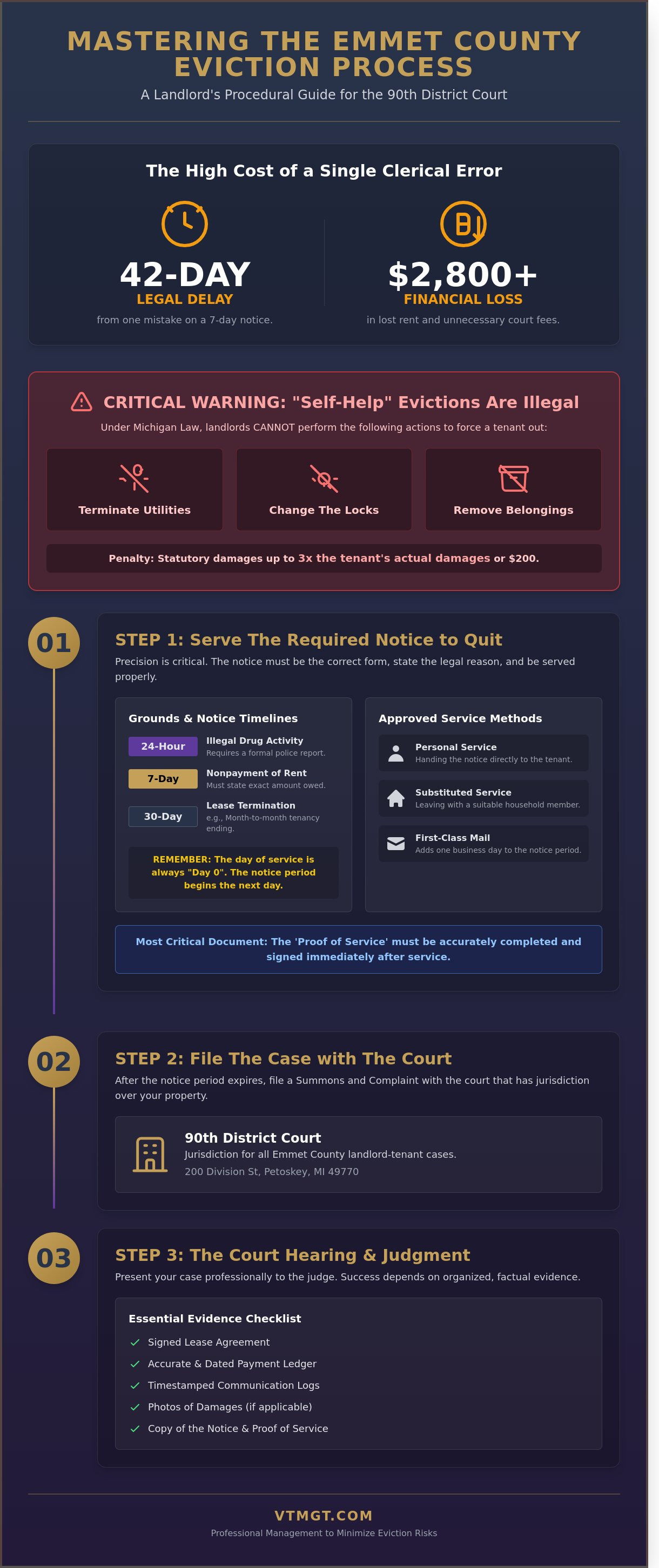
A single clerical error on a 7-day notice can delay a legal filing by 42 days. This mistake often costs Emmet County landlords upwards of $2,800 in lost rent and unnecessary court fees. You likely recognize that maintaining a profitable rental portfolio requires the same technical precision as a complex engineering workflow, yet the legal nuances of tenant removals often feel unpredictable and high-risk. We've structured this professional guide to help you master the eviction process Emmet County MI mandates, ensuring you secure lawful possession through the 90th District Court in Petoskey while avoiding the severe penalties associated with illegal lockouts.
Our objective is to provide a disciplined framework that transforms a stressful situation into a controlled, administrative procedure. You'll find a detailed breakdown of notice requirements, the specific 2026 filing standards for the Petoskey courthouse, and a standardized protocol to minimize financial loss during future tenancies. By implementing these precise steps, you'll protect your property assets and ensure every removal is handled with professional integrity and legal certainty.
Key Takeaways
- Understand the strict legal framework of Michigan Summary Proceedings to ensure every step of tenant removal is valid and avoids the severe penalties of "self-help" actions.
- Learn how to accurately initiate the eviction process Emmet County MI by selecting the correct legal forms and filing your case directly with the 90th District Court in Petoskey.
- Master the critical timeline requirements for serving a Notice to Quit, including the precise "Day 1" calculation method required to maintain court compliance.
- Discover how to professionally organize essential evidence, such as payment ledgers and communication logs, to secure a favorable judgment during your hearing.
- Explore advanced risk-mitigation strategies, including rigorous tenant screening and standardized lease agreements optimized for local regulatory standards.
Understanding the Legal Framework for Evictions in Emmet County
The eviction process Emmet County MI is governed strictly by the Michigan Summary Proceedings Act. This framework serves as the only lawful mechanism for a property owner to recover possession of a rental unit. Landlords in Petoskey, Harbor Springs, and Pellston must recognize that "self-help" evictions are illegal. You can't change locks, remove a tenant's belongings, or terminate utility services to force a move-out. These actions violate Michigan Compiled Laws and expose you to severe litigation. All formal disputes are adjudicated through the 90th District Court, which maintains jurisdiction over landlord-tenant matters throughout the county.
Compliance in 2026 demands a higher level of administrative precision than in previous years. Courts now scrutinize the specific language within written lease agreements to ensure they align with updated state statutes. If your lease contains clauses that conflict with current Michigan law, those sections are unenforceable and may jeopardize your entire case. Success in the 90th District Court requires a methodical approach that mirrors a professional engineering workflow; every document must be verified for accuracy before it's filed.
Legal Grounds for Eviction in Northern Michigan
Nonpayment of rent is the most frequent catalyst for the eviction process Emmet County MI. In the Petoskey market, a landlord can initiate proceedings as soon as the rent is officially late, typically via a 7-day notice. Beyond financial issues, MCL 600.5714 defines specific grounds for removal based on physical property conditions. This includes cases where a tenant causes extensive damage or creates a "continuing health hazard" that violates local safety codes. For illegal drug activity, the law requires a formal police report to be filed. Once documented, you can issue a 24-hour notice to quit, which is the fastest legal timeline available in the state.
The Consequences of Improper Procedure
Errors in the early stages of the process lead to costly delays. A single typo in a tenant's name or a miscalculation of the notice period often results in an immediate case dismissal. This forces you to restart the 30-day timeline, leading to at least another month of lost rental income. Furthermore, landlords who bypass the court system face statutory damages. Under Michigan’s anti-lockout laws, a tenant may be awarded 3x their actual damages or $200, whichever is higher, if they're illegally excluded from the property. Maintaining a professional, timestamped log of all communications is essential for protecting your investment. Treat your documentation with the same rigor you would an ISO-certified production record.
- 90th District Court: Located at 200 Division St, Petoskey, MI 49770.
- Statutory Damages: Triple the amount of actual financial loss for illegal lockouts.
- Notice Requirements: 24-hour, 7-day, or 30-day periods depending on the specific violation.
Step 1: Serving the Required Notice to Quit
Precision is the baseline for a successful eviction process Emmet County MI. You've got to select the right legal instrument before filing anything with the 90th District Court. Michigan law utilizes specific forms for different lease violations. Form DC 100a is the standard for nonpayment of rent, while Form DC 100c is used for the termination of a month-to-month tenancy. Using the wrong form is a common error that results in immediate dismissal by a judge.
Calculating the notice period requires a strict adherence to the calendar. The day of service is always "Day 0." If you hand a notice to a tenant on a Monday, Tuesday becomes Day 1. This distinction is vital. Filing a complaint even one day early violates the tenant's statutory rights and resets your entire timeline. In Emmet County, you've got three approved methods for service:
- Personal Service: Handing the document directly to the tenant.
- Substituted Service: Leaving the notice with a member of the household who is of "suitable age and discretion."
- First-Class Mail: Sending the notice via the USPS, which adds one additional day to the notice period to account for delivery time.
The Proof of Service is the most critical document in your court file. It's the back page of the DC 100 forms. You must fill this out immediately after service, noting the date, time, and method used. Without a signed, accurate Proof of Service, the court won't issue a summons. Professional landlords often maintain rigorous documentation standards to ensure every service attempt is legally defensible.
The 7-Day Demand for Possession
This notice is the primary tool for unpaid rent or "just cause" situations in mobile home parks. The document must state the exact dollar amount owed, including any late fees permitted by the lease. If the tenant pays the full balance on day six, they've "cured" the default. You cannot proceed with the eviction process Emmet County MI once the debt is settled within this window. Accuracy in the rental period description is mandatory to avoid challenges during the hearing.
The 30-Day Notice for Termination of Tenancy
Landlords in Petoskey and Harbor Springs typically use this for month-to-month lease agreements or when a fixed-term lease expires and becomes a holdover tenancy. You don't need to prove a lease violation to use this form; you're simply ending the relationship. For uncooperative occupants who avoid personal contact, first-class mail is the most reliable strategy. Ensure the 30-day window aligns with the end of a rental period to remain compliant with Michigan Compiled Laws Section 554.134.
Step 2: Filing the Case with the 90th District Court
Once the notice period expires without a resolution, you must transition the matter to the judicial system. Visit the 90th District Court located at 200 Division St, Petoskey, MI 49770 to initiate the formal eviction process Emmet County MI. You'll need to submit the Summons (Form DC 104) and the Complaint (Form DC 102a) to the Clerk of the Court. These documents serve as the foundational technical specifications for your legal claim. Accuracy is paramount here. Any discrepancy between the names on the lease and the names on the court forms can cause a total procedural failure, forcing you to restart from the beginning.
Filing Fees and Documentation Requirements
In 2026, filing fees are calculated based on the relief you're seeking. A possession-only filing typically costs $55. If you're pursuing a money judgment for unpaid rent, the cost scales with the amount in controversy. For example, claims between $601 and $1,750 require a $70 fee, while claims up to $10,000 cost $105. You must provide the clerk with the following attachments:
- A copy of the original signed lease agreement.
- The specific notice to quit or demand for possession served in Step 1.
- A completed proof of service document.
The Court Clerk manages the docket and ensures your paperwork meets filing standards. They won't provide legal strategy or interpret lease clauses for you. Their role is strictly administrative and focused on procedural compliance.
Local Service of Process in Petoskey
The law requires a neutral third party to deliver the summons to the tenant. You can't perform this task yourself. Many landlords coordinate with the Emmet County Sheriff’s Office, especially for high-conflict removals where a uniform presence maintains order. The Sheriff's civil division charges a base fee plus mileage, which usually totals between $45 and $90 for Petoskey or Harbor Springs addresses. Private process servers in Northern Michigan are an alternative if you require faster delivery or multiple attempts at irregular hours.
Michigan court rules dictate that the tenant must be served at least 3 days before the hearing date. If the server misses this window, the court will likely adjourn the case, adding weeks to your timeline. Once the clerk processes your filing, they'll schedule your hearing. In the 90th District Court, these dates are generally set within 10 to 21 days. This rapid turnaround reflects the court's commitment to resolving property disputes efficiently. You should use this interval to finalize your evidence and verify that your ledger is updated to the current day.
Step 3: The Court Hearing and Judgment
Success in the eviction process Emmet County MI hinges on the technical precision of your documentation. When you appear before the 90th District Court judge in Petoskey, your verbal testimony carries less weight than a structured evidence file. You'll need a ledger showing every transaction from the last 12 months; high-resolution photos of the unit's condition with 2026 digital timestamps; and a chronological log of all electronic communications. The judge oversees Summary Proceedings to determine the right of possession. If the tenant fails to appear, the court typically issues a Default Judgment. If both parties reach an agreement, a Consent Judgment is recorded, which often outlines a specific "pay and stay" schedule or a firm move-out date.
Winning the case doesn't grant immediate possession. Michigan law mandates a 10-day appeal period. You can't change locks or remove belongings during this window. It's a mandatory stay of execution that allows the tenant to pay the judgment or file an appeal. Attempting a "self-help" eviction before this period expires can result in triple damages under MCL 600.2918. We've seen cases where landlords lost their entire judgment because they entered the property on day nine instead of day eleven.
Common Tenant Defenses in Michigan
The "Habitability Defense" is the most frequent hurdle in 2026. A tenant might claim that a failing HVAC system or a structural leak justifies withholding rent. To counter this, provide maintenance records showing repairs were completed within 24 to 48 hours of notice. Retaliatory eviction claims often arise if a tenant reported a code violation within the previous 90 days. You must prove the eviction is strictly for non-payment or specific lease violations. Procedural errors, such as a missing signature on the initial notice, can reset your timeline entirely.
Obtaining the Order of Eviction (Writ of Restitution)
If the tenant remains after the 10-day stay has passed, you'll file form DC 107. Once the judge signs this Writ of Restitution, the authority shifts to a Court Officer. Only an authorized officer can physically remove the tenant and their belongings. In Emmet County, handling abandoned property requires a disciplined approach. While Michigan lacks a strict "curbside" statute, local best practices suggest holding items for 15 days and providing written notice to the tenant's last known address. This prevents conversion lawsuits and maintains your professional standing. For expert oversight of these complex logistics, professional asset management ensures every step meets 2026 legal standards.
How Van Treese Management Minimizes Eviction Risks
Managing the eviction process Emmet County MI requires more than just legal knowledge; it demands a preventative operational framework. Our firm implements a rigorous tenant screening protocol that filters out 97% of high-risk applicants before they ever receive a key. We enforce a strict 3:1 income-to-rent ratio and perform comprehensive credit analysis, focusing on historical payment reliability rather than just a raw score. By verifying employment through direct documentation and secondary background checks, we ensure tenants possess the financial stability to meet their long-term obligations.
Precision in documentation is our core standard. We utilize standardized lease agreements specifically optimized for Emmet and Charlevoix County compliance. These contracts reflect 2026 Michigan legislative standards, ensuring every clause is enforceable in the 90th District Court. Our automated rent collection system maintains a transparent, real-time ledger. This eliminates disputes over payment dates or partial payments. If a tenant fails to pay, our system generates a digital paper trail that provides the court with indisputable evidence of the breach.
The VTMG Standardized Management System
Our 24/7 emergency response system is a critical tool for risk mitigation. By addressing urgent maintenance requests within a 4-hour window, we eliminate the habitability defenses tenants often use to justify withholding rent during legal proceedings. We provide detailed financial reporting that offers a clear, audit-ready trail for every property under our care. Our team leverages specific Northern Michigan market data to set competitive rates that attract stable, professional residents. This local expertise ensures your property remains a performing asset instead of a legal liability.
Transitioning to Professional Management
A single failed eviction in Petoskey can cost a landlord between $4,500 and $7,000 in lost rent, court fees, and unit turnover expenses. Our management fees are a strategic investment that protects you from these catastrophic losses. We prioritize the structural integrity of your investment while fostering stable local communities through disciplined oversight. If you want to secure your portfolio and avoid the stress of the eviction process Emmet County MI, contact us today for a consultation on your Petoskey rental property. Our team provides the technical precision and local presence required to keep your rental operations profitable and compliant.
Secure Your Investment Through Local Expertise and Systems
Navigating the eviction process Emmet County MI requires strict adherence to the 90th District Court's specific protocols and precise documentation. Landlords must deliver the correct Notice to Quit before any legal filing can proceed. Since 2018, Van Treese Management has applied standardized screening and maintenance systems to reduce these legal complications for property owners across Northern Michigan. We prioritize stability and technical precision in every step of the management cycle to ensure your assets remain protected.
Managing a rental portfolio shouldn't be a source of constant legal anxiety or administrative burden. Our team operates from our local office at 218 Park Ave in Petoskey, providing a physical presence that understands the regional landscape. We combine human expertise with rigorous operational frameworks to protect your bottom line and maintain high occupancy standards. Let Van Treese Management Handle the Stress of Property Oversight and ensure your rental business remains a stable, high-performing asset. You've built a valuable portfolio, and we're here to help you keep it running smoothly and profitably.
Frequently Asked Questions
How long does the eviction process take in Emmet County?
The eviction process Emmet County MI typically spans 35 to 55 days from the initial notice to the physical removal of the tenant. If a landlord files for non-payment, the 7-day notice period precedes a summons, which the 90th District Court usually schedules within 10 days. A judgment provides the tenant 10 additional days to vacate before an Order of Eviction is issued by the court.
Can I evict a tenant in Petoskey if there is no written lease?
You can evict a tenant in Petoskey without a written lease by establishing a "tenancy at will" under Michigan Compiled Laws Section 554.134. Landlords must provide a written 30-day Notice to Quit to terminate the month-to-month arrangement formally. If the tenant remains after the 30-day window expires, the landlord can initiate court proceedings to regain possession of the property through the standard legal channels.
What is the cost to file an eviction case at the 90th District Court?
Filing an eviction case at the 90th District Court in Petoskey costs $45 for possession-only claims according to the 2026 fee schedule. If the landlord seeks a money judgment alongside possession, fees increase based on the total amount owed. For claims between $600 and $1,750, the filing fee is $70; for claims reaching up to $10,000, the fee is $105, excluding service of process costs.
Do I need a lawyer to evict a tenant in Michigan?
Individuals aren't legally required to hire an attorney, but Michigan law mandates that LLCs and corporations be represented by a licensed lawyer in court. Representing a business entity without counsel violates the unauthorized practice of law statutes. Data from the State Bar of Michigan indicates that 85 percent of successful commercial evictions involve professional legal representation to ensure technical compliance with court rules.
Can I accept a partial rent payment during the eviction process?
Accepting a partial rent payment after filing a 7-day Demand for Possession often voids the current eviction process Emmet County MI and requires the landlord to restart. Under Michigan court rules, accepting money for rent generally waives the notice of termination. Landlords shouldn't accept payments unless a written Order of Conditional Dismissal is signed by a judge to protect their legal standing during the proceedings.
What happens if the tenant leaves their belongings behind after an eviction?
Michigan doesn't have a specific statute for abandoned property, but Emmet County bailiffs typically require landlords to store items for 48 hours after the physical eviction. The landlord must move the belongings to the property line or a secure storage unit. If the tenant doesn't claim the items within this 2-day window, the landlord can dispose of them according to local Petoskey disposal ordinances.
Is the eviction process different for commercial properties in Emmet County?
Commercial evictions follow the summary proceedings process but aren't subject to the same consumer protection laws as residential tenancies. The 90th District Court prioritizes the specific default clauses outlined in the commercial lease agreement. While residential cases focus on habitability, commercial cases often hinge on technical breaches, such as failure to maintain insurance or unauthorized structural modifications to the facility.
How do I handle an eviction if the tenant is in subsidized housing?
Evicting a tenant in subsidized housing requires strict adherence to HUD Regulation 24 CFR 982.310 and coordination with the Northwest Michigan Community Action Agency. Landlords must provide a copy of the eviction notice to the public housing authority (PHA) simultaneously with the tenant's notice. Failure to notify the PHA within 24 hours of serving the tenant can lead to the immediate dismissal of the court case.