
Fair Housing Act Michigan: A 2026 Guide for Northern Michigan Landlords
In January 2025, a landlord in Petoskey faced a formal civil rights investigation because they didn't realize that "source of income" now includes Housing Choice Vouchers under expanded state protections. It's a sobering reminder that even well-intentioned property owners can find themselves in legal jeopardy if they aren't tracking the latest shifts in the fair housing act Michigan. You've likely felt the growing complexity of managing rentals in small Northern Michigan communities where a single oversight can damage your reputation and your portfolio. We recognize that your priority is to provide quality housing through a disciplined, professional business model that eliminates unnecessary risk.
This 2026 guide provides the technical precision you need to master federal and state regulations, ensuring your leasing process remains both ethical and legally compliant. You'll learn how to implement a standardized screening framework that removes bias and addresses the 2025 legislative updates with expert accuracy. We'll examine the specific requirements for Boyne City and Harbor Springs landlords, offering a clear roadmap to full compliance and the peace of mind that comes from a controlled, high-quality operation.
Key Takeaways
- Identify the critical differences between federal protections and the additional classes, such as age and marital status, mandated by Michigan’s Elliott-Larsen Civil Rights Act.
- Prepare for the April 2025 Source of Income mandate to ensure your screening process correctly handles Section 8 vouchers and disability benefits.
- Master the art of writing "Fair Housing Friendly" rental advertisements for Northern Michigan markets by avoiding subtle, non-compliant language that suggests demographic preferences.
- Learn how to apply standardized management systems to navigate the complexities of the fair housing act Michigan and mitigate legal risks across Emmet and Charlevoix counties.
- Discover how integrating technical precision with professional oversight creates an ethical leasing environment that protects your long-term property investments.
Understanding the Fair Housing Framework in Michigan
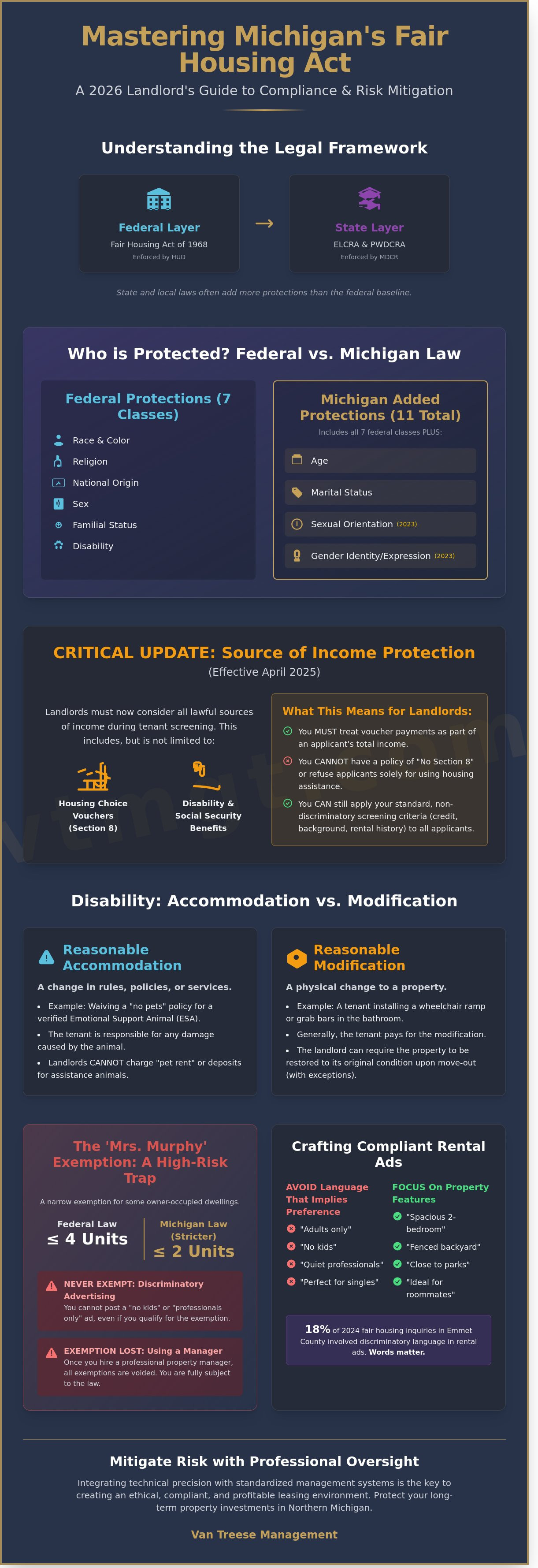
The fair housing act Michigan framework operates through a tiered system of legal protections. It begins with the Federal Fair Housing Act of 1968. This legislation prohibits discrimination based on race, color, religion, sex, familial status, national origin, and disability. Michigan landlords must integrate these federal rules with the Elliott-Larsen Civil Rights Act (ELCRA) of 1976. This state law provides broader protections than the federal baseline. ELCRA was expanded in March 2023 to include sexual orientation and gender identity as protected classes. Landlords in Northern Michigan must also navigate the Persons with Disabilities Civil Rights Act (PWDCRA). This 1976 act mandates that housing providers accommodate residents with physical or mental limitations. In 2026, compliance requires monitoring local shifts. Cities like Petoskey maintain specific non-discrimination ordinances that can exceed state requirements. Property owners should treat these laws as a technical manual for operational risk management.
Federal vs. State Jurisdiction
The U.S. Department of Housing and Urban Development (HUD) enforces federal statutes. The Michigan Department of Civil Rights (MDCR) manages state-level complaints. They often collaborate, but the MDCR frequently applies stricter scrutiny. By January 2026, Michigan regulatory bodies have intensified their focus on algorithmic bias in tenant screening. Landlords can't claim ignorance of these automated processes. If a third-party software creates a disparate impact, the property owner remains liable. This dual oversight ensures that equal housing opportunity remains a measurable requirement rather than a vague goal.
The 'Mrs. Murphy' Exemption and Its Limits
Michigan law recognizes a narrow exemption for owner-occupied dwellings with no more than two families living independently. This is commonly known as the 'Mrs. Murphy' exemption. It's a high-risk area for private owners. Federal law allows up to four units, but Michigan's stricter two-unit limit takes precedence. There's a critical trap here. No dwelling is exempt from Section 804(c) of the Fair Housing Act. This section prohibits discriminatory advertising. You can't post a "no kids" flyer even if you live in the building. Professional property management firms lose these exemptions entirely. Once you hire a manager, you operate under the full weight of the fair housing act Michigan standards.
Protected Classes: Who is Covered Under Michigan Law?
The fair housing act Michigan operates as a dual-layer framework. It combines the seven federal protected classes with additional state-level mandates. Under the federal Civil Rights Act of 1968, landlords can't discriminate based on race, color, religion, sex, national origin, familial status, or disability. Michigan's Elliott-Larsen Civil Rights Act (ELCRA) expands this list. On March 16, 2023, Michigan codified protections for sexual orientation and gender identity or expression. This brings the total number of protected categories to 11 when including the state's long-standing additions of age and marital status.
Our team observes that in Petoskey, the transition from short-term vacation rentals to long-term leases often leads to familial status violations. Owners frequently try to target "quiet professionals" or "adults only" to protect their assets. This is a direct violation of the fair housing act Michigan. Data from 2024 indicates that roughly 18% of fair housing inquiries in Emmet County involved discriminatory language in rental advertisements regarding children under the age of 18. Ensuring your lease agreements reflect these 2023 updates is a critical step in professional property management and risk mitigation.
Disability and Reasonable Accommodations
Landlords must distinguish between a reasonable accommodation and a reasonable modification. An accommodation is a change in rules, such as waiving a "no pets" policy for a verified Emotional Support Animal (ESA). A modification is a physical change, like installing a ramp. In 2026, landlords maintain the right to request reliable documentation from a healthcare professional if the disability isn't apparent. You can't charge "pet rent" or security deposits for these animals. Precise documentation management is essential to avoid litigation.
Age and Marital Status Nuances
Michigan law prohibits denying a lease based on age or marital status. In Boyne City, you can't refuse a 19-year-old applicant simply because of their age if they meet your standard financial criteria. Similarly, asking if a couple is married during the screening process creates immediate legal liability. The only exception applies to housing specifically designed for seniors. These communities must meet the Housing for Older Persons Act (HOPA) requirement, where at least 80% of units are occupied by one person aged 55 or older.
- Federal Classes: Race, Color, Religion, Sex, National Origin, Familial Status, Disability.
- Michigan Additions: Age, Marital Status, Sexual Orientation, Gender Identity.
- Key Date: March 16, 2023 (ELCRA Expansion).
The 2025 Source of Income Law: What Landlords Need to Know Now
Michigan's legislative landscape shifted on April 1, 2025, when the state formally added "source of income" (SOI) as a protected category. This update ensures that the fair housing act Michigan standards align with modern subsidy structures. Landlords in Northern Michigan must now treat government assistance with the same validity as traditional employment wages. This isn't just a suggestion; it's a mandatory operational standard for the 2026 rental market.
Defining 'Source of Income' in 2026
The 2025 mandate defines income as any lawful source of funds used to pay for housing. This includes:
- Housing Choice Vouchers (Section 8)
- Social Security Disability Insurance (SSDI)
- Veterans Affairs Supportive Housing (VASH)
- Short-term emergency rental assistance from community action agencies
You can't use phrases like "No Section 8" or "No programs" in your Petoskey or Charlevoix marketing materials. Such language constitutes a direct violation of state law. Standardizing your intake process ensures every applicant is evaluated on their total financial capacity rather than the origin of their check. If a tenant receives $1,200 in monthly disability benefits, that amount carries the same weight as $1,200 in gross wages from a local employer.
Operational Changes for Property Owners
Precision in financial screening is critical for compliance. When evaluating a voucher holder, you must adjust your income-to-rent ratio. You only apply your multiplier, such as a 3x rent requirement, to the tenant's individual portion of the rent. If the total rent is $1,600 and the voucher covers $1,300, the applicant only needs to prove they earn $900 per month to meet a 3x requirement for their $300 share. Ignoring this specific calculation method is a frequent source of litigation in 2026.
The law includes a narrow "4 or fewer units" exception for owner-occupied buildings. If you reside in one unit of a small multi-family property in Petoskey, certain SOI protections might not apply to you. However, most commercial landlords and professional managers fall outside this carve-out and must comply fully. Non-compliance carries heavy costs. The fair housing act Michigan allows for civil penalties starting at approximately $11,000 for initial offenses. Training your staff to use neutral, fact-based language regarding vouchers is the most effective way to mitigate this financial risk.
Practical Compliance for Northern Michigan Rental Advertising
Precision in communication is the primary defense against litigation. Writing rental descriptions for properties in Traverse City or Gaylord requires a technical approach to language. Every adjective acts as a parameter that either opens or restricts the market. Compliance with the fair housing act Michigan requires a shift from subjective intuition to objective data. Landlords must remove words like "quiet" or "vibrant" if they target specific age groups or family structures. It's safer to list the exact square footage and insulation ratings than to use vague demographic descriptors.
Steering is a high-risk area. It occurs when a landlord influences a prospect's choice based on a protected characteristic. Telling a family with children that a second-floor unit in a downtown Gaylord building "isn't ideal" because of the stairs is a direct violation. The choice belongs to the tenant. Landlords should maintain a "first-come, first-served" application system. This mechanical approach ensures that the first qualified applicant gets the lease, removing subjective bias from the process. It's a binary system: the applicant either meets the 3.0x income requirement or they don't.
Digital Marketing and Fair Housing
Facebook and Google implemented strict housing ad protocols in 2023 to eliminate discriminatory targeting. You can't filter audiences by zip code or interest. Your digital presence must reflect a broad demographic. If your website only features photos of one specific ethnic group, you risk a disparate impact claim. Additionally, avoid landmarks that signal religious or social preferences. Don't say "walking distance to the church"; instead, state "located 0.4 miles from the city center." This ensures the fair housing act Michigan standards are met through objective geography.
Standardized Tenant Screening Processes
A systematic screening framework is essential for risk management. Every applicant must face the same 72-point evaluation, including income verification and credit checks. HUD's 2026 guidance emphasizes that blanket criminal record bans are discriminatory. Landlords must evaluate the specific nature and recency of convictions using an individualized assessment. Documenting every denial with specific data points is the only way to mitigate legal challenges. If you reject an applicant, keep the file for 36 months to ensure you have a clear audit trail.
How Van Treese Management Mitigates Fair Housing Risk
Van Treese Management (VTMG) approaches property compliance with the same rigor found in high-precision engineering. We've established a management infrastructure that prioritizes operational stability and technical proficiency. By applying standardized systems to property oversight in Emmet and Charlevoix counties, we eliminate the inconsistencies that often trigger legal disputes. Our commitment to innovation means we use data-driven protocols to ensure every landlord-tenant interaction aligns perfectly with the fair housing act Michigan. We treat compliance as a mission-critical process where the margin for error is non-existent.
- Implementation of standardized screening rubrics to ensure objective evaluation.
- Digital audit trails for all applicant communications and decisions.
- Rigorous oversight of local ordinances in Petoskey and surrounding municipalities.
- Proactive maintenance scheduling to ensure equal housing quality for all residents.
Professional Tenant Placement in Petoskey
In Petoskey, our One-time Tenant Placement service functions with CAD/CAM-level precision. We don't leave candidate selection to chance or subjective intuition. Instead, we utilize a rigid set of objective parameters to evaluate every applicant. This methodical approach creates a verifiable, digitized audit trail for every decision made. In 2026, having this level of technical documentation is essential for protecting your community reputation. We ensure that every lease is executed within strict ethical boundaries, removing the human bias that often leads to liability.
The VTMG Advantage: Local Expertise, Global Standards
Our reach extends across Petoskey, Boyne City, and Indian River; bringing global management standards to the Northern Michigan market. We've replaced traditional, reactive landlording with a proactive, system-based model that treats your investment like a professional enterprise. VTMG team members complete a minimum of 40 hours of specialized legal education annually. This keeps our staff updated on the evolving nuances of the fair housing act Michigan. This professional insulation is the most effective tool for protecting your assets from the financial risks of non-compliance. Our systems are designed to outperform "gut-feeling" management by providing a logical, repeatable framework for every property.
Contact Van Treese Management for a Compliance Audit to secure your rental portfolio today.
Future-Proof Your Portfolio for 2026 and Beyond
Navigating the evolving regulatory landscape in 2026 demands a rigorous, technical approach to property operations. The introduction of the 2025 source of income law mandates that landlords treat vouchers and subsidies as valid income, requiring an immediate overhaul of traditional screening metrics. Compliance with the fair housing act Michigan isn't a suggestion; it's a fundamental requirement for long-term asset stability. Our data indicates that standardized workflows reduce the risk of litigation by providing a clear, auditable trail for every tenant interaction across Northern Michigan. We prioritize the integration of these legal updates into your daily operations to prevent costly oversights.
We leverage industrial-grade precision to manage your real estate investments. Our firm utilizes standardized management systems and deep local Northern Michigan expertise to ensure your properties meet every legal and operational benchmark. We provide 24/7 emergency response coordination to handle technical issues the moment they arise, protecting both your tenants and your physical assets. You don't need to shoulder the burden of complex legal shifts when you have a disciplined partner dedicated to your success. Secure Your Rental Investment with Professional Management. We're here to help you achieve a high-performance rental portfolio that stands the test of time.
Frequently Asked Questions
Is it illegal to refuse Section 8 in Michigan in 2026?
It's illegal to refuse Section 8 vouchers in Michigan as of 2026. The state legislature expanded the Elliott-Larsen Civil Rights Act through 2024 amendments that added "source of income" as a protected category. We ensure our screening protocols treat voucher holders exactly like any other applicant. Landlords who reject tenants solely for using housing assistance face significant legal exposure under the current fair housing act Michigan standards.
Can I charge a higher security deposit for tenants with pets if they claim it's an ESA?
You can't charge a higher security deposit or any pet related fees for a verified Emotional Support Animal (ESA). Federal HUD guidelines specify that these animals aren't pets; they're assistive tools for individuals with disabilities. Charging a $250 pet fee or an extra $500 deposit for an ESA constitutes a violation of federal law. We recommend verifying the tenant's documentation from a licensed healthcare professional before waiving these standard costs.
Does the Michigan Fair Housing Act apply to single-family homes in Petoskey?
The Michigan Fair Housing Act applies to nearly all single-family homes in Petoskey, even those rented without a real estate broker. Michigan's state laws are more restrictive than federal exemptions, often covering owner-occupied dwellings with as few as 2 units. If you own more than 3 single-family houses, you're subject to every provision of the law. Our management systems apply these regulations to every Northern Michigan property to maintain 100% legal compliance.
What are the penalties for violating the Elliott-Larsen Civil Rights Act?
Violating the Elliott-Larsen Civil Rights Act leads to severe financial penalties and mandatory corrective actions. Courts frequently award actual damages for emotional distress, which can exceed $10,000 per incident. You'll also face civil fines that start at $11,000 for a first offense and climb to $50,000 for subsequent violations within a 7 year period. We prioritize detailed documentation to protect our partners from these costly litigation risks.
Can I say 'perfect for a single professional' in my Gaylord rental ad?
You shouldn't use the phrase "perfect for a single professional" in any Gaylord rental advertisement. This language indicates a preference based on familial or marital status, which is a direct violation of the fair housing act Michigan. Instead, describe the property's physical attributes like its 1,100 square foot floor plan or the 2 car attached garage. Objective descriptions of the building's features prevent claims of discriminatory intent from prospective tenants.
How do I legally deny a tenant in Northern Michigan without risking a lawsuit?
To legally deny a tenant, you must use a written set of objective qualification criteria applied consistently to every single applicant. If the denial is based on a credit report, you're required by the Fair Credit Reporting Act to provide a formal adverse action notice. We keep digital records of every application for 7 years to prove our decisions are based on data like a 3 to 1 income-to-rent ratio rather than protected characteristics.
Are there local fair housing ordinances specific to Traverse City or Grand Rapids?
Traverse City and Grand Rapids both have local human rights ordinances that provide protections beyond basic state requirements. Grand Rapids City Code Chapter 160 prohibits discrimination based on gender identity, a standard the state officially adopted in 2023. Traverse City's Ordinance 614 offers local enforcement mechanisms for housing complaints. We track these municipal variations closely to ensure our regional operations remain compliant with both city and state levels of government.
What should I do if a tenant requests a ramp be built at my Charlevoix property?
You must allow the tenant to install a ramp at their own expense as it's considered a reasonable modification. While the tenant pays for the 12 foot ramp and its installation, you can't unreasonably deny the request if it doesn't compromise the building's structural integrity. You're permitted to require that the property be restored to its original condition when the lease ends. We suggest requiring a professional contractor's plan before any construction begins on your Charlevoix investment.