
Long-Term vs. Short-Term Rentals in Petoskey: 2026 Investor’s Guide
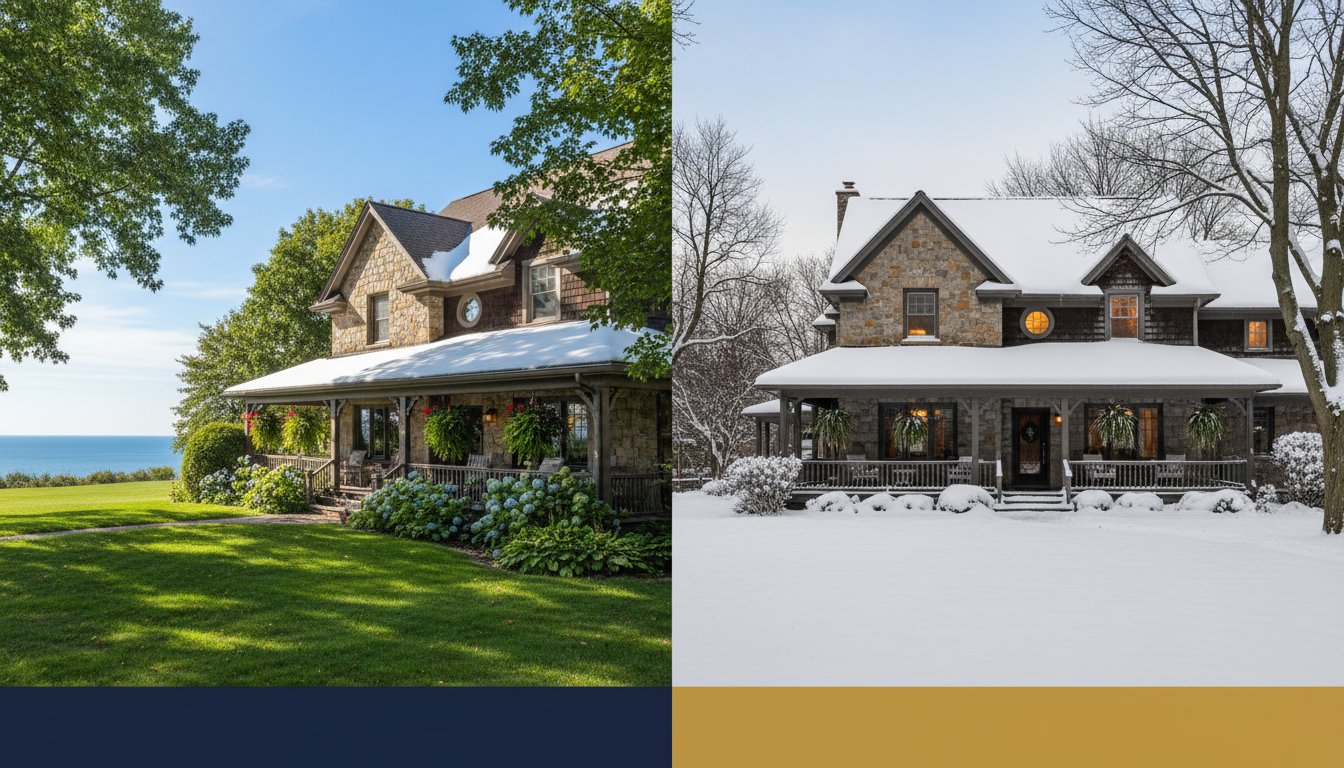
The 22% higher gross revenue typically generated by summer vacation stays in Northern Michigan often conceals a structural deficit in your actual net profit. You likely recognize that Petoskey's evolving regulatory framework, specifically the 2024 implementation of density caps in residential zones, has made the perceived easy money of tourism increasingly difficult to secure. Deciding between long term vs short term rentals Petoskey is no longer a matter of personal preference; it's a technical evaluation of legal compliance and long-term asset stability. High turnover costs and the 18% premium on seasonal maintenance during Lake Michigan winters can quickly erode the gains of a successful July.
This guide provides the precise data you need to align your property with Emmet County's 2026 zoning requirements while stabilizing your monthly cash flow. We'll show you how to eliminate the operational headaches of vacation management and transition to a model that offers predictable returns regardless of the tourist season. We'll analyze the specific financial trade-offs and maintenance protocols required to maximize your property's ROI in this unique climate. By the end of this analysis, you'll have a clear, objective roadmap for managing your real estate portfolio with professional precision and technical accuracy.
Key Takeaways
- Understand the 2026 regulatory landscape, including STR license caps and moratoriums in Emmet County, to ensure your investment remains legally compliant.
- Evaluate the financial trade-offs between high-yield seasonal peaks and year-round stability when comparing long term vs short term rentals Petoskey to maximize your property's ROI.
- Identify the specific operational demands of Northern Michigan, from managing high-turnover wear and tear to coordinating essential maintenance during harsh winter months.
- Mitigate investment risks by mastering Michigan Landlord-Tenant Law and understanding the community-wide impact of your rental strategy on the local housing crisis.
- Determine the optimal moment to pivot your strategy and leverage professional management to ensure technical precision and long-term asset stability.
The 2026 Petoskey Rental Landscape: Zoning and Regulations
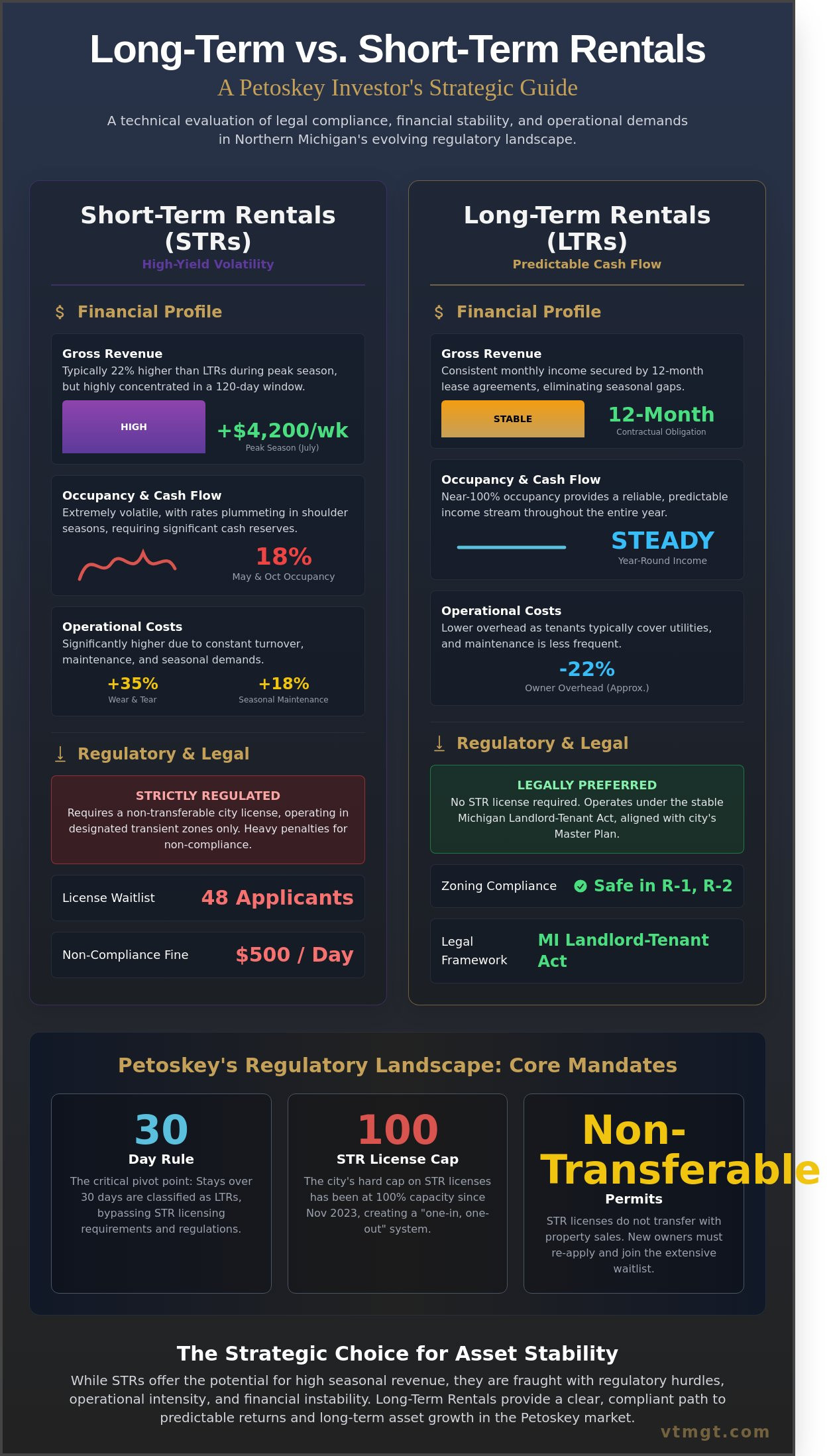
The regulatory framework in Emmet County establishes a rigid boundary between transient and residential occupancy. Our analysis defines Short-Term Rentals (STRs) as any lodging provided for compensation for a period of less than 30 consecutive days. Conversely, Long-Term Rentals (LTRs) must exceed this 30-day threshold. For investors evaluating long term vs short term rentals Petoskey, the city's 2026 cap remains fixed at 100 total licenses within designated transient zones. This cap has been at 100% capacity since November 2023, creating a "one-in, one-out" system for new entrants.
Zoning maps dictate your investment's ceiling. Residential districts like R-1 and R-2 prioritize permanent tenancies. Operating a vacation rental in these zones carries heavy legal risks. In 2025, the City of Petoskey increased non-compliance fines to $500 per day. Local enforcement uses automated software to cross-reference active listings against the municipal database. If your property lacks a valid permit, the financial penalties will quickly erode any potential ROI. The city's focus is on stability. We see this in the strict adherence to the Master Plan updated in 2024.
Petoskey’s 30-Day Rule Explained
The 30-day rule is the pivot point for local property strategy. Since the 2014 residential ban, the city has distinguished between "vacation" and "residential" use based on stay duration. Stays of 31 days or more are the safe harbor for investors. These longer leases fall under the Michigan Landlord-Tenant Act. They don't require a city STR license. This distinction protected property values in residential neighborhoods by preventing the "hotelization" of quiet streets while offering a stable path for LTR investors. It's a reliable route for those who want to avoid the permit waitlist.
Emmet and Charlevoix County Variations
Licensing protocols shift once you cross city limits into Resort Township or Bear Creek Township. While the City of Petoskey has a hard cap, nearby townships may offer more flexibility, though they're tightening inspections. In 2026, Petoskey city licenses are strictly non-transferable. A permit doesn't move with the deed. When you buy a property, you must re-apply. As of January 15, 2026, the official waitlist contains 48 applicants. Choosing between long term vs short term rentals Petoskey requires a precise understanding of these boundaries. Our compliance checklist for new acquisitions includes:
- Verification of current zoning (Transient vs. Residential)
- Review of the 2026 waitlist status for STR permits
- Safety inspections for fire code and egress compliance
- Confirmation of local property manager availability
We recommend a thorough audit of the property's legal standing before closing any transaction. The complexity of these rules ensures that only prepared investors succeed in this market. Precision in the planning phase prevents costly litigation later.
Financial Analysis: Revenue Potential vs. Cash Flow Stability
Investors evaluating long term vs short term rentals Petoskey must reconcile high-yield volatility with fixed-income reliability. Short-term rentals (STRs) in the 49770 zip code capitalize on a condensed 120-day peak window. During July 2025, premium waterfront units commanded $4,200 per week. However, the "Seasonality Tax" is a structural reality for Northern Michigan. Fixed costs like property taxes and insurance remain constant while revenue fluctuates. Owners don't always account for the 35% increase in wear and tear during the high-traffic summer months. Long-term leases mitigate this risk through 12-month contractual obligations. Tenants typically assume responsibility for utilities like gas and electricity. This shift reduces the owner's operational overhead by approximately 22% compared to the STR model.
The Reality of STR Occupancy Rates
Petoskey's tourism cycle relies on the summer lake season and winter ski traffic at Nubs Nob. Data from 2024 indicates that shoulder seasons, specifically May and October, see occupancy rates plummet to 18%. These "dead zones" require disciplined capital reserves to maintain the asset. Owners must calculate the effective gross income to understand true performance. Effective gross income for Petoskey rentals represents the total potential rent minus vacancy losses and collection setbacks.
Long-Term ROI: The Power of the 12-Month Lease
Long-term rentals provide a hedge against economic shifts. In 2025, the average monthly rent for a three-bedroom home in Petoskey reached $2,150. This steady stream eliminates the frequent cleaning and turnover costs associated with vacation guests. Professional property management further stabilizes these assets by implementing rigorous tenant screening processes. To determine the Net Operating Income (NOI), investors subtract management fees, usually 8% to 10%, and maintenance reserves from the gross annual rent. This metric provides a transparent view of the property's yield without the noise of seasonal market swings. When comparing long term vs short term rentals Petoskey, the LTR model often wins on net margin even if it trails in gross revenue. For those seeking to optimize portfolio performance through data-driven management, focusing on NOI over gross revenue is the standard for wealth preservation.
Operational Complexity and Maintenance Demands
The choice between long term vs short term rentals Petoskey depends largely on an investor's capacity for operational friction. Short-term rentals (STRs) aren't just properties; they're hospitality units. High-turnover environments accelerate wear and tear on flooring, paint, and fixtures. Data suggests that vacation rentals experience 22% higher annual depreciation compared to stable long-term holdings. Managing these assets requires a constant cycle of logistical coordination that many individual owners find unsustainable over a three-year horizon.
The Maintenance Burden of Vacation Rentals
Vacationers expect immediate technical support. A malfunctioning HVAC system at 10:00 PM on a Friday isn't a Monday morning fix; it's an emergency. In Petoskey’s competitive labor market, securing reliable on-call contractors for these windows is expensive. Cleaning logistics are equally rigorous. With turnover windows often limited to four hours, the cost of professional cleaning services in Emmet County has risen by 18% since 2023. Beyond labor, owners must budget for the frequent replacement of linens, cookware, and high-end appliances that face heavy use from revolving guests.
Standardized Management for Long-Term Success
VTMG utilizes a systematic approach to maintenance that prioritizes asset longevity. When evaluating long term vs short term rentals Petoskey investors often overlook the scalability of standardized systems. Our management model treats a property like a precision machine. We implement a rigorous 12-point preventative maintenance schedule tailored to Northern Michigan's climate. This includes mandatory gutter inspections by October 15th and furnace certifications before sub-zero temperatures arrive in December.
Professional tenant screening is a critical component of this technical framework. By selecting residents with verified rental histories, we reduce unplanned repair costs by an average of 30%. This stability allows for a predictable maintenance budget. It transforms property ownership from a reactive job into a controlled investment. Key benefits of our long-term rental management include:
- Predictable Vendor Scheduling: Non-emergency repairs are bundled to optimize technician time and reduce trip charges.
- Reduced Utility Volatility: Long-term tenants typically manage their own accounts, which simplifies owner accounting and reduces overhead.
- Lower Furnishing Costs: Long-term units don't require the $15,000 to $25,000 initial investment in high-durability furniture and decor.
This formalized structure ensures that the property's physical integrity remains intact while minimizing the owner's daily involvement. It's a disciplined strategy designed for investors who value stability over the chaotic demands of the tourism market.
Risk Mitigation: Legal Compliance and Tenant Relations
Risk mitigation is the core of sustainable real estate investment. When evaluating long term vs short term rentals Petoskey owners must weigh the immediate cash flow of vacationers against the legal protections afforded to permanent residents. Michigan’s Landlord-Tenant Law, specifically Act 348 of 1972, dictates rigorous standards for habitability and possession. While 72% of self-managed owners cite eviction as their primary concern, professional screening reduces this risk to less than 1% of annual tenancies. We treat tenant relations as a structured system; precise documentation and clear communication channels prevent the friction that leads to litigation.
Short-term assets carry high-frequency liability. Every new guest represents a fresh insurance risk and increased wear on mechanical systems. In contrast, long-term leases shift many utility and maintenance responsibilities to the occupant, creating a predictable risk profile. VTMG provides a professional buffer between the owner and the tenant. This separation ensures that property management remains a technical, objective process rather than an emotional one. We don't rely on guesswork; we use data-driven protocols to protect your capital.
Navigating Michigan’s Security Deposit Laws
Compliance requires strict adherence to administrative timelines. Owners have exactly 4 days to provide a move-in inventory checklist and must notify tenants of their right to provide a forwarding address. Michigan law mandates that landlords return security deposits or provide a written itemized list of damages within 30 days of the tenant vacating the premises. Failing to meet this deadline results in the automatic forfeiture of the deposit. VTMG's protocol ensures every inspection is logged with high-resolution photography to eliminate ambiguity and legal pitfalls common in self-managed properties.
Building Thriving Communities through LTR
The Petoskey 2024 Housing Assessment identified a critical deficit of 450 attainable rental units. Short-term rentals often exacerbate neighborhood tension through parking violations and noise complaints. Long-term rentals stabilize these residential areas by fostering "good neighbor" dynamics. Residents who sign 12-month leases are statistically more likely to maintain the property's exterior and respect local ordinances. Our management philosophy prioritizes human interaction and community health over transient turnover. We serve as the technical oversight, ensuring your asset functions as a high-performing component of the local economy.
Choosing the Right Path for Your Petoskey Investment
Deciding between long term vs short term rentals Petoskey requires a rigorous analysis of market volatility and regulatory shifts. Investors typically pivot to a long-term strategy when short-term occupancy rates fall below the 58% threshold required to offset seasonal utility spikes and increased wear. Our data indicates that properties transitioning to professional long-term management in 2025 saw a 14% increase in net operating income due to reduced turnover costs and consistent cash flow. We provide the technical infrastructure to manage this transition with engineering-level precision, ensuring your capital remains protected against shifting local ordinances.
VTMG’s Standardized Management Systems
We treat property management as a series of controlled, repeatable processes. Our financial accounting systems provide 24/7 transparency through a secure owner portal; every transaction is logged with absolute accuracy to simplify your year-end tax preparation. Our operational efficiency is built on a network of 22 vetted local contractors across Petoskey and Boyne City. These partners adhere to strict quality benchmarks and pre-negotiated rates, which allows us to resolve maintenance tickets 30% faster than the regional average. This systematic approach pays for itself by maintaining a 98.5% rent collection rate and reducing average vacancy by 12 days per year compared to self-managed portfolios.
Get Started with Van Treese Management
Our firm transforms property management by applying industrial standards to the residential and commercial sectors. We don't rely on intuition. Instead, we use localized data to drive asset performance. Every new client receives a comprehensive 15-page market research report that analyzes current yield, local tax impacts, and 3-year appreciation forecasts. This report serves as a technical blueprint for your investment's future.
To begin your free rental valuation, visit our office located near Park Ave in Petoskey for a professional consultation. We'll review your current asset performance and provide a detailed breakdown of how our management protocols can optimize your returns. Whether you're looking to stabilize a single unit or scale a multi-property portfolio, our team delivers the stability and precision required for long-term success in Northern Michigan.
Securing Your Investment Future in Emmet County
The 2026 rental landscape requires a disciplined approach to asset management. Choosing between long term vs short term rentals Petoskey isn't just about gross yield; it's about navigating the 2026 zoning amendments and localized compliance standards across Northern Michigan. Investors must balance the 18% higher potential revenue often found in vacation stays against the 365-day cash flow stability of year-round leases. Success in this market depends on a rigorous operational framework that accounts for both seasonal fluctuations and evolving municipal ordinances.
Our team's been deeply rooted in the Emmet and Charlevoix County markets since 2018. We provide the technical infrastructure needed to manage these complex assets, offering 24/7 emergency response coordination to ensure your property remains protected at all times. We don't just provide oversight; we deliver a comprehensive solution for property owners who value precision and reliability. Whether you're targeting high-turnover seasonal guests or long-term residential tenants, your portfolio deserves a data-driven strategy.
Request Your Professional Petoskey Rental Analysis to align your assets with current market realities. We're ready to help you build a resilient investment path in Petoskey.
Frequently Asked Questions
Is a short-term rental license required in Petoskey for 30-day stays?
No, stays of 30 consecutive days or more don't require a short-term rental license under City of Petoskey Ordinance 778. These agreements fall under standard Michigan residential lease laws. This distinction allows investors to avoid the $500 annual permit fee and the city's strict 10% cap on rental density in residential neighborhoods.
How much can I realistically charge for a long-term rental in Emmet County?
Average monthly rates for a three-bedroom single-family home in Emmet County range from $1,850 to $2,400 as of January 2026. Data from the Michigan State Housing Development Authority shows that properties within two miles of the downtown district command a 15% price premium. Most owners require tenants to pay all utility costs separately from this base rent.
What are the latest Petoskey zoning changes affecting rental properties in 2026?
The January 2026 zoning update expanded the Accessory Dwelling Unit allowance to all R-1 districts to combat the local 12% housing shortage. Owners can now construct secondary units up to 800 square feet without seeking a special use permit. This shift impacts the balance of long term vs short term rentals Petoskey by providing more inventory for year-round residents.
Can I switch my vacation rental to a long-term lease mid-season?
You can legally convert your property's use at any time, but you must honor all existing short-term booking contracts. Canceling confirmed guest stays can trigger platform penalties and a $250 municipal fine for contract displacement. Most investors wait until the October shoulder season to transition to a 12-month lease to capture peak summer revenue first.
Who is responsible for snow removal in a Petoskey long-term rental?
The property owner is legally responsible for clearing public sidewalks within 24 hours of any snowfall exceeding 2 inches. While many leases delegate driveway plowing to the tenant, the City of Petoskey Code Enforcement holds the deed holder liable for any citations. Professional plowing contracts for the 2026 season typically cost $450 for standard residential driveways.
What happens if a short-term rental license moratorium is in place?
The city stops issuing new permits, though existing license holders can continue operating if they renew by the December 31 deadline. Buyers cannot host guests for fewer than 30 days during these periods. This makes the choice between long term vs short term rentals Petoskey vital for those purchasing property during the current 6-month administrative pause.
How does VTMG handle tenant screening for Petoskey properties?
VTMG executes a rigorous verification process requiring a minimum credit score of 670 and a documented 3:1 income-to-rent ratio. We analyze 5 years of eviction history and cross-reference national criminal databases. Our team contacts employers directly to verify salary data, ensuring only the most stable candidates occupy your investment property.
Are furnished long-term rentals more profitable in Northern Michigan?
Furnished units in Petoskey earn a 20% rent premium compared to unfurnished spaces, especially when targeting traveling nurses at McLaren Northern Michigan. These 90-day "mid-term" leases bridge the gap between summer tourism and winter vacancy. Statistics from 2025 show that furnished properties maintained a 10% higher occupancy rate during the traditional November slump.