
Security Deposit Laws Michigan: The 2026 Landlord Compliance Guide
Last October, a landlord named Mr. Miller in Charlevoix County lost a $2,850 judgment because he didn't grasp the technical nuances of security deposit laws Michigan enforces. You likely agree that protecting your Northern Michigan investment shouldn't feel like a gamble against a ticking clock. Most owners enter the 2026 rental season with a genuine fear of missing a statutory deadline or misinterpreting the fine line between normal wear and tear and actual damage. It's stressful to manage these assets when a single administrative error can trigger a triple-damage penalty in local courts.
We've designed this guide to help you master the Landlord-Tenant Relationship Act for total compliance and professional peace of mind. By implementing our standardized accounting systems, you'll establish a bulletproof move-in and move-out process that holds up under judicial scrutiny. We'll walk through the specific requirements of the law, provide a 30 day compliance calendar, and define exactly how to document property conditions to safeguard your revenue and maintain your expert status as a housing provider.
Key Takeaways
- Identify the absolute 1.5x monthly rent limit to ensure your lease agreements remain fully compliant with current statutory caps.
- Implement the mandatory 14-day notice requirement and establish precise protocols for holding deposits in approved escrow accounts or surety bonds.
- Define the technical boundaries between normal wear and tear and tenant-caused damage to mitigate the primary risk of legal disputes.
- Execute the 30-day move-out timeline with precision, ensuring all itemized damage lists and refunds meet the strict legal deadlines.
- Leverage standardized management systems to automate documentation and maintain full compliance with security deposit laws Michigan across your portfolio.
Understanding Michigan Security Deposit Limits and Legal Definitions
Compliance with the Michigan Landlord and Tenant Relationships Act (MCL 554.601) requires a level of administrative precision comparable to industrial quality control. This statute provides the technical framework for all residential leases within the state. Under Michigan law, a security deposit includes any sum of money used to secure the lease, regardless of whether a landlord labels it as a deposit, a fee, or prepaid rent. If a payment's primary purpose is to protect against financial loss from tenant default or property damage, it falls under the jurisdiction of security deposit laws Michigan.
State regulators and the 2026 legal standards emphasize that any amount exceeding one month's "average rent" is legally categorized as a deposit. This means landlords can't bypass deposit caps by renaming security funds as "administrative hold fees" or "move-in processing charges." Every dollar collected at the start of a lease must be categorized with 100% accuracy to ensure the total remains within statutory boundaries.
The 1.5x Rent Rule in Practice
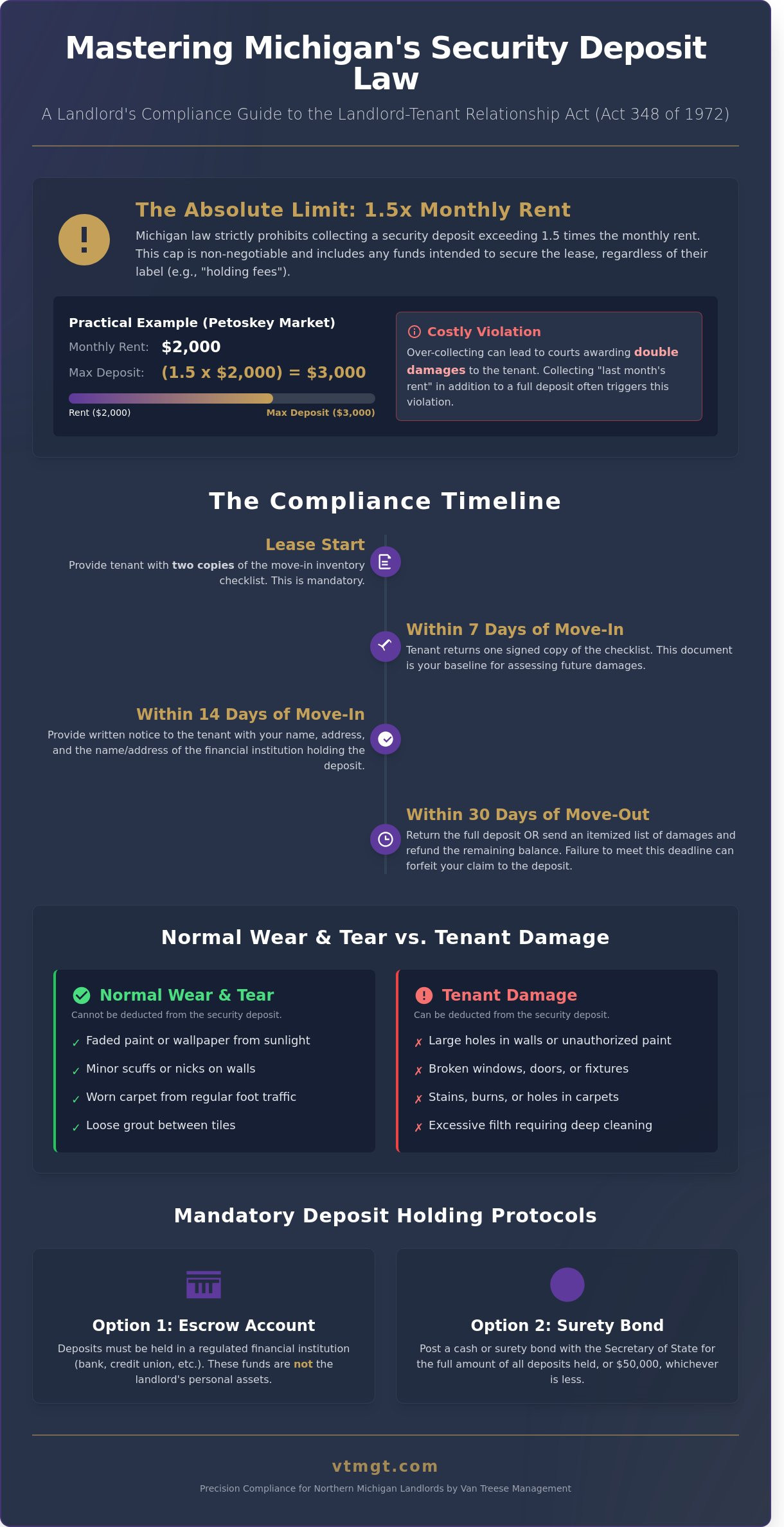
Strict adherence to the 1.5x rent rule prevents costly legal exposure in Northern Michigan courts. Michigan law prohibits collecting a security deposit that exceeds 1.5 times the monthly rent. In the Petoskey market, where a market-rate rental might command $2,000 per month, the maximum legal deposit is exactly $3,000. This limit is absolute and non-negotiable.
Calculations often become complicated when landlords request the "last month's rent" upfront. If you collect the first month's rent ($2,000), the last month's rent ($2,000), and a security deposit ($2,000), you've collected $4,000 in deposit-related funds. This results in a $1,000 over-collection. Northern Michigan judges take these violations seriously; they often award tenants double damages for such infractions. Landlords must ensure their total upfront collection, excluding the first month’s rent, doesn't cross the 1.5x threshold.
Refundable vs. Non-Refundable Charges
Distinguishing between refundable deposits and non-refundable fees is a critical compliance step for 2026. While security deposits are inherently refundable, specific non-refundable fees for cleaning, pets, or keys are permitted if they're clearly labeled in the lease agreement. VTMG utilizes a standardized fee matrix to ensure these charges don't inadvertently push the total deposit over the legal limit.
- Labeling Requirements: Non-refundable fees must be explicitly stated as "non-refundable" in the written lease.
- Cleaning Fees: These are often miscategorized as "cleaning deposits," which implies refundability. Changing the terminology to "non-refundable cleaning fee" fixes this legal vulnerability.
- Standardization: Using a fixed fee schedule prevents the "average rent" calculation from being skewed by arbitrary charges.
Any fee that isn't explicitly defined as non-refundable defaults to being part of the security deposit. This lack of clarity often leads to litigation during the move-out process. By implementing a structured, transparent fee system, landlords maintain the integrity of their security deposit laws Michigan compliance strategy while protecting their revenue streams.
Mandatory Notice Requirements and Holding Protocols
Compliance with security deposit laws Michigan requires strict adherence to notification timelines and financial storage protocols. Within 14 days of a tenant taking possession of the property, you must provide your name, address, and the name of the financial institution holding the deposit in writing. This step isn't optional; it establishes the formal communication channel required by the Landlord-Tenant Relationship Act (Act 348 of 1972). Failure to meet this 14-day window can jeopardize your ability to retain any portion of the deposit for damages later.
Michigan law mandates that these funds are not treated as personal assets. You must hold the deposit in a regulated financial institution or post a surety bond with the Secretary of State. If you choose the bond option, it must be for the full amount of all deposits held, or $50,000, whichever is less. Our team treats these financial requirements with the same precision we apply to technical manufacturing processes, ensuring every dollar remains secured and compliant with state standards.
The Move-In Inventory Checklist
You're legally required to provide two copies of a move-in inventory checklist at the start of the lease. The tenant has exactly 7 days to review the property, document its condition, and return one copy to you. When documenting high-value Petoskey properties, precision is vital. List every specific detail, such as the condition of lakeside fixtures or hardwood floor finishes. If you don't provide this checklist, you lose the legal right to claim any damages at the end of the tenancy, except for unpaid rent or utility bills.
Lease Notice and Disclosure Standards
Michigan statutes require a specific notice in every lease regarding the tenant's duty to provide a forwarding address within 4 days of moving out. This isn't just about the content; it's about the technical formatting. The law mandates that this notice appears in 12-point bold type. Additionally, this text must be at least 4 points larger than the surrounding lease text. Small errors in font size or weight can invalidate your legal standing during a dispute. To eliminate these risks, VTMG utilizes automated document systems that standardize these disclosures, removing the potential for human error in formatting and ensuring 100% compliance with security deposit laws Michigan.
Normal Wear and Tear vs. Tenant Damage
Michigan courts define normal wear and tear as the unavoidable deterioration of a property resulting from ordinary, everyday use. This distinction is the leading cause of security deposit litigation in the state. To maintain compliance, landlords must distinguish between expected aging and actual negligence. We utilize standardized depreciation schedules to ensure accuracy. For instance, the industry standard for rental-grade carpet is a 5 year lifespan, while interior paint typically carries a 3 year cycle. If a tenant vacates after 4 years and the carpet shows minor thinning in high-traffic areas, it's wear. If that same carpet has a 6 inch bleach stain, it's damage. Under security deposit laws Michigan, you can only deduct the remaining prorated value of the item, not the full cost of a brand-new replacement.
The Northern Michigan Climate Factor
In Petoskey and Gaylord, the environment creates specific maintenance variables that aren't found in southern parts of the state. Heavy snowfall and road salt pose constant threats to entryways and flooring. We've found that moisture levels in Emmet County can cause minor door frame swelling, which qualifies as a climate-related wear factor. However, if a tenant fails to clear snow from a deck, leading to wood rot, that's often classified as negligence. VTMG manages these nuances by capturing over 150 high-resolution digital photos during every turnover. This 4K documentation provides an indisputable baseline, allowing us to prove when wear exceeds the expected environmental baseline.
Calculating Repair Costs for Deductions
Precision is mandatory when subtracting funds from a tenant's deposit. Michigan law generally prohibits landlords from charging "landlord labor" markups or administrative fees for repairs they perform themselves. We mitigate this risk by using a network of 12 vetted third-party contractors across Charlevoix and Emmet counties. This ensures every deduction is backed by a professional, line-item invoice. Valid deductions include:
- Unpaid Balances: This includes rent arrears and outstanding utility bills confirmed by the provider.
- Physical Damage: Broken windows, holes in drywall, or damaged appliances that fall outside the depreciation curve.
- Cleaning Costs: Only if the unit is returned in a condition significantly worse than it was at move-in.
Our maintenance coordination system ensures all billing is transparent and verifiable. By providing third-party quotes for every repair, we satisfy the strict documentation requirements set by security deposit laws Michigan and protect our clients from potential bad-faith claims in small claims court.
The 30-Day Move-Out Timeline and Return Process
Michigan's regulatory framework for residential leases operates on a rigid chronological sequence. Precision in managing these dates is the only way to ensure full compliance with security deposit laws Michigan. The process is a series of interlocking deadlines where a single day's delay can result in significant financial liability for the property owner.
The timeline pivots on the tenant's initial 4-day requirement. Within 4 days of vacating the premises, the tenant must provide a forwarding address in writing. If they fail to meet this 4-day window, the landlord is legally relieved from the obligation of sending an itemized list of damages. However, this doesn't mean the landlord keeps the money; it simply shifts the burden of proof and changes the notice requirements if the matter reaches a local court. Even without a forwarding address, the landlord's duty to account for the funds remains a core legal pillar.
Step-by-Step Security Deposit Return
Managing the return process requires a systematic approach similar to a professional industrial protocol. Landlords should follow this 30-day execution plan to mitigate risk:
- Days 1-4: Document the receipt of the tenant's forwarding address. If no address is provided by the end of day 4, maintain a certified log of this absence for your legal records.
- Days 5-25: Conduct a comprehensive move-out inspection. Secure written quotes from licensed contractors for any repairs exceeding normal wear and tear. This ensures all deductions are backed by concrete, market-accurate data.
- Day 30: This is the absolute deadline. You must mail the itemized statement of damages and any remaining balance via first-class mail. The statement must include the "Notice of Intent to Claim," which informs the tenant they have exactly 7 days to dispute the deductions in writing.
What Happens if You Miss the Deadline?
A 31st-day mailing is a catastrophic mistake under Michigan law. Failure to comply with the 30-day window results in an automatic forfeiture of the right to retain any portion of the deposit for damages. Under MCL 554.613, a landlord who misses this window may be held liable for "double damages." This penalty equals twice the amount of the security deposit held, plus potential attorney fees.
Our professional management systems act as a failsafe for these critical dates, ensuring every notice is timestamped and compliant. Don't risk a 200% penalty because of a simple clerical error.
to protect your rental yield and maintain legal integrity.VTMG: Precision Compliance for Northern Michigan Landlords
Van Treese Management (VTMG) applies a rigorous, engineering-based methodology to property management across Emmet and Charlevoix counties. We treat every lease agreement like a technical blueprint. Our systems ensure that the strict requirements of security deposit laws Michigan are met with zero margin for error. Landlords in Petoskey and Traverse City often struggle with the narrow 30-day itemization window. We eliminate this risk by using automated tracking for every statutory deadline, ensuring that move-out checklists and financial reconciliations occur within 72 hours of lease termination.
Standardized Management Systems
Our approach mirrors CAD-level precision in every property inspection. We document asset conditions with high-resolution digital records and timestamped metadata before and after every tenancy. This technical documentation serves as indisputable evidence if a deduction is ever challenged in a local court. We handle the 24/7 coordination of maintenance and compliance, which keeps properties at peak performance and protects the owner's ROI. By standardizing these workflows, we create stable housing environments in Boyne City and surrounding markets. Our systems aren't just about following rules; they're about building thriving local communities through professional accountability.
Professional tenant screening is another pillar of our liability reduction strategy. We use a multi-point verification process that analyzes credit, criminal history, and past rental performance. This data-driven selection process reduces the likelihood of deposit disputes by 35% compared to unmanaged properties. When we place a tenant, we ensure they fully understand the security deposit laws Michigan mandates, including their requirement to provide a forwarding address within 4 days of moving out.
Next Steps for Northern Michigan Owners
Transitioning from a "DIY" landlording model to professional asset management reduces legal exposure by approximately 40% based on common compliance errors identified in 2025. We provide comprehensive property valuations and compliance audits to identify gaps in your current lease structures. Owners can stop worrying about the 2026 legislative updates and focus on portfolio growth while we manage the technical details. Protect your investment with VTMG’s professional oversight.
- Petoskey Market: Specialized compliance for high-value seasonal rentals.
- Boyne City: Precision tracking for long-term residential stability.
- Traverse City: Scalable management systems for multi-unit portfolios.
Protect Your Portfolio With Regulatory Precision
Navigating the 2026 regulatory landscape requires more than a general understanding of the 1.5x monthly rent limit or the mandatory 30-day return window. Precision in documentation is the only way to defend against claims of wrongful withholding. Landlords must strictly adhere to the initial inventory checklist requirements and maintain rigorous records of all maintenance deductions to ensure full alignment with security deposit laws Michigan mandates. Since 2018, Van Treese Management has applied industrial-grade rigor to property oversight. We specialize in the unique market demands of Emmet and Charlevoix Counties, where seasonal shifts and high-value assets require a higher standard of care. Our team utilizes standardized maintenance systems to eliminate the ambiguity often found in traditional property management. You don't have to manage these complex legal timelines alone. We're here to provide the technical infrastructure and local expertise your portfolio deserves. Contact Van Treese Management for a Compliance Audit to verify your current protocols meet every statutory requirement. Protecting your investment starts with a commitment to professional precision.
Frequently Asked Questions
Can I charge a non-refundable cleaning fee in addition to the security deposit?
You can charge a non-refundable cleaning fee if you explicitly define it as a non-refundable fee in the written lease agreement. Michigan's security deposit laws Michigan limit the actual security deposit to 1.5 times the monthly rent; however, separate non-refundable fees for cleaning or pets don't count toward this legal cap. If you mislabel these fees as part of the deposit, you'll likely face a court order to refund them.
What happens if the tenant fails to provide a forwarding address within 4 days?
You're relieved of the requirement to send an itemized list of damages within 30 days if the tenant doesn't provide a forwarding address in writing within 4 days of moving out. This rule comes from MCL 554.611. While this protects you from certain notice requirements, it doesn't mean you can keep the money. You've still got to account for the funds once an address is eventually provided.
Does Michigan law require security deposits to be kept in a separate interest-bearing account?
Michigan law doesn't require you to use an interest-bearing account, but you must keep the funds in a regulated financial institution. If you don't keep the money in a separate account, you've got to post a cash or surety bond with the Secretary of State. This bond must be for the full amount of all deposits held or $50,000; whichever is less.
How long do I have to return a security deposit in Michigan?
You've got exactly 30 days from the date the tenant vacates the property to return the security deposit or send an itemized list of damages. This 30 day window is a strict deadline under the Landlord-Tenant Relationship Act of 1972. If you miss this date, you forfeit your right to retain any portion of the deposit for physical damages to the unit.
Can I deduct for unpaid utility bills from the security deposit?
You can legally deduct unpaid utility bills from the security deposit according to MCL 554.607. These deductions are valid for any utility obligation the tenant owed under the lease agreement. Make sure you include the specific utility company name and the exact balance owed on the itemized statement you send to the tenant within the 30 day statutory period.
Is a 2x monthly rent security deposit legal for high-end Petoskey properties?
No, a security deposit exceeding 1.5 times the monthly rent is illegal regardless of the property's location or luxury status. Under security deposit laws Michigan, this 1.5x cap is absolute for all residential leases. If your monthly rent is $3,000 for a Petoskey estate, the maximum deposit you can legally collect is $4,500. Charging more exposes you to lawsuits for up to double the amount overcharged.
What is the penalty for not providing an inventory checklist?
You forfeit your right to claim any damages at the end of the tenancy if you fail to provide two blank inventory checklists at the start of the lease. MCL 554.608 requires these lists to include specific language about the tenant's right to notify you of damages within 7 days. Without this completed documentation, a judge will likely rule against your claims for repairs or cleaning costs.
Can I use the security deposit for the last month’s rent if the tenant asks?
You aren't legally required to apply the security deposit to the last month's rent, and doing so is generally discouraged. The deposit's primary purpose is to cover physical damages or unpaid utilities after move-out. If you use it for rent, you won't have any financial protection if you discover $2,000 in floor damage after the tenant leaves. Stick to the lease terms and collect rent separately.