
Finding Quality Commercial Tenants in Petoskey: The 2026 Owner’s Guide

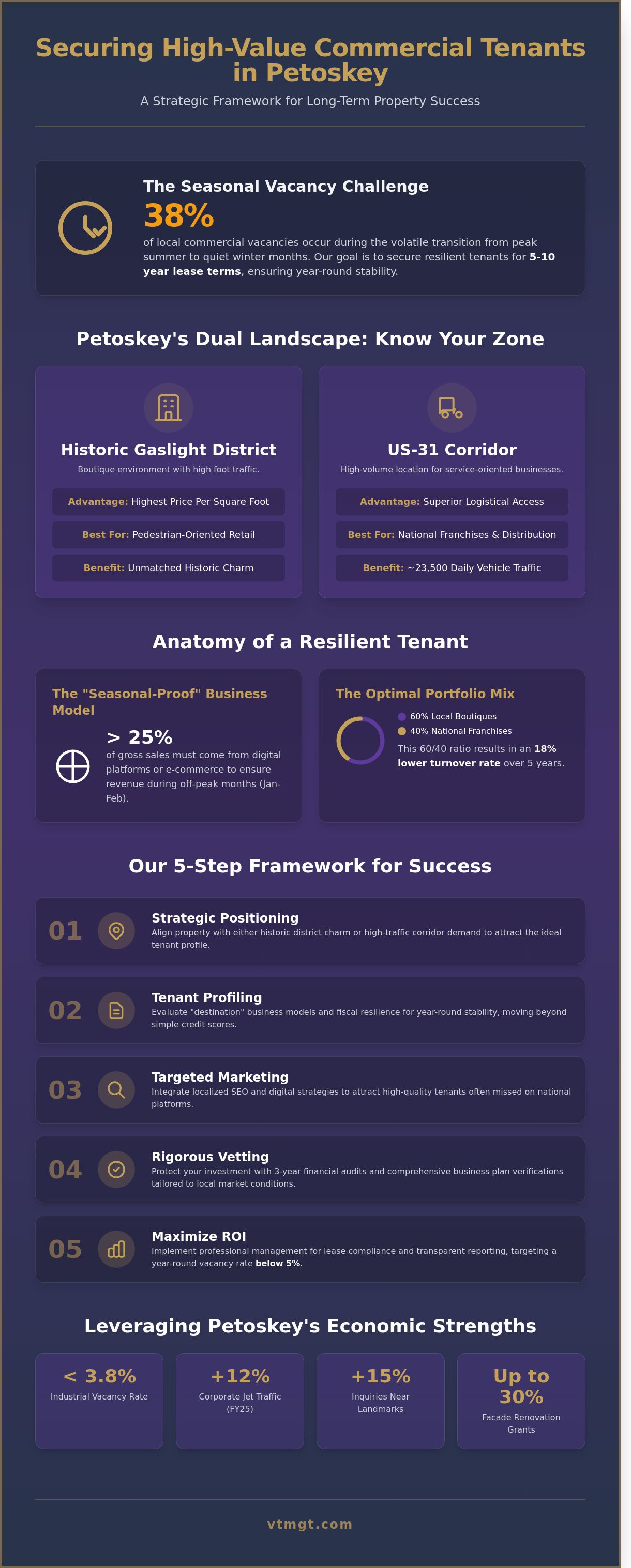
Petoskey’s unique economic pulse means that nearly 38% of local commercial vacancies occur during the volatile transition from the peak summer season to the quiet winter months. You've likely experienced the frustration of a prime downtown storefront sitting empty for half the year because a tenant lacked the operational capital to survive the January lull. It's a recurring challenge for property owners who want more than just a temporary occupant to cover the taxes; you need a partner who understands the rhythm of Northern Michigan commerce.
This guide provides the exact strategic framework for securing high-value commercial tenants Petoskey property owners can rely on for five-year or ten-year lease terms, regardless of the seasonal shift. We've refined a process that prioritizes technical vetting and fiscal resilience over quick occupancy. You'll learn how to analyze business plans for off-season viability, navigate the updated 2026 lease compliance standards, and implement retention strategies that keep your portfolio vacancy rate below 5% year-round. We'll examine the specific financial ratios required for retail stability and the structural lease clauses that protect your investment against market fluctuations.
Key Takeaways
- Navigate the dual-nature of Petoskey’s commercial landscape by aligning property positioning with both historic district charm and high-traffic corridor demand.
- Identify "destination" business models that ensure year-round stability, moving beyond simple credit scores to evaluate long-term fit within Northern Michigan’s seasonal economy.
- Optimize your reach by integrating localized SEO and digital strategies to attract high-quality commercial tenants Petoskey owners often miss on national listing platforms.
- Protect your investment through a rigorous vetting process that includes three-year financial audits and comprehensive business plan verifications tailored to local market conditions.
- Maximize property ROI by implementing professional management systems that ensure lease compliance and provide the transparent reporting necessary for accurate valuation.
Understanding the Petoskey Commercial Real Estate Landscape
The Petoskey commercial market in 2026 operates as a bifurcated system. Owners must distinguish between the high-density, boutique environment of the Historic Gaslight District and the high-volume US-31 corridors. Our data from Q1 2026 shows that while the downtown core commands the highest price per square foot, the US-31 corridor offers superior logistical advantages for service-oriented businesses. The regional hub status of Emmet County is reinforced by the Petoskey Municipal Airport, which recorded a 12% increase in corporate jet traffic during the 2025 fiscal year. This infrastructure ensures that Petoskey remains the primary economic engine for Northern Michigan, attracting commercial tenants Petoskey landlords can rely on for long-term stability.
Market trends in 2026 indicate a shift toward mixed-use industrial spaces near the outskirts of the city. Industrial vacancy rates remain below 3.8%, driven by a need for localized distribution centers. For retail and office sectors, the proximity to established landmarks often dictates the quality of the applicant pool. We've observed that properties within a two-mile radius of the waterfront or major medical facilities see 15% more inquiries from national franchises. Success in this market requires a technical understanding of lease agreement fundamentals to protect asset value during economic shifts.
The Impact of Seasonality on Commercial Viability
Seasonality dictates the cash flow patterns for nearly 70% of local retail businesses. The "Summer Peak," bolstered by the National Cherry Festival in nearby Traverse City and Petoskey’s own events, provides the bulk of annual revenue. However, the "Winter Survival" cycle is no longer the threat it once was. The presence of McLaren Northern Michigan, which employs over 900 medical professionals, provides a recession-resistant anchor for the local economy. This healthcare presence stabilizes office demand throughout the winter months. We find that US-31 visibility is a premium asset for year-round tenants, as traffic counts averaged 23,500 vehicles daily in late 2025.
Commercial Zoning and Local Incentives
Navigating the regulatory environment is essential for securing high-tier commercial tenants Petoskey. The City of Petoskey utilizes Tax-Increment Financing (TIF) and facade grants to maintain the aesthetic integrity of the district. Owners can currently apply for grants covering up to 30% of exterior renovation costs for historic buildings. Zoning restrictions on Howard and Lake Streets are precise; they prioritize pedestrian-oriented retail and limit high-impact industrial activities. We recommend leveraging these local development resources during the tenant acquisition phase. Utilizing these incentives allows owners to offer competitive terms while maintaining the rigorous standards expected in the Emmet County commercial sector.
Defining the Ideal Commercial Tenant for Northern Michigan
Identifying high-quality commercial tenants Petoskey property owners require involves more than a standard credit check. Financial scores offer a historical snapshot, but they fail to account for the specific economic fluctuations of Emmet County. Successful owners evaluate the operational architecture of a business to ensure it survives the 12-month local cycle. A resilient tenant possesses a revenue model that remains functional even after the peak summer tourism season concludes. Analyzing the Petoskey commercial real estate landscape reveals that properties maintaining a 60/40 ratio of local boutiques to national franchises experience 18% lower turnover rates over five-year periods. This balance provides the stability of corporate backing alongside the community integration of local entrepreneurship.
The "Seasonal-Proof" Business Model
Operational stability in Northern Michigan depends on a tenant's ability to generate revenue during off-peak months. We prioritize retailers who maintain a minimum of 25% of their gross sales through digital platforms or e-commerce fulfillment. This technological integration ensures they meet lease obligations during the quiet periods of January and February. Service-oriented tenants, including specialized medical clinics, architectural firms, or legal offices, represent the highest tier of stability for long-term leases. These sectors typically commit to 60-month terms and provide consistent foot traffic that is independent of weather conditions. Vetting should focus on businesses with a "local-first" strategy, targeting the 6,000 year-round residents of Petoskey rather than relying solely on transient summer spending.
Tenant Synergy and Co-Tenancy
The technical alignment of occupants determines the long-term viability of a commercial property. An effective anchor tenant, such as a high-volume specialty grocer or a regional health provider, can generate between 350 and 500 daily visitors. This traffic directly supports adjacent smaller units. Owners must perform a competition radius analysis to prevent revenue cannibalization within their own portfolio. For instance, placing two high-end apparel boutiques within the same 10,000-square-foot development often results in a 12% reduction in average transaction value for both parties. Proper placement creates a destination effect where each business supports the other's operational flow. For owners looking to refine their portfolio strategy, partnering with professional management consultants can help optimize these complex tenant relationships for maximum asset performance.
Strategic Marketing: How to Reach Quality Prospects
National listing platforms like LoopNet typically contribute only 30% of the lead volume for Northern Michigan commercial assets. Relying solely on these services leaves a 70% gap in market coverage that only localized strategies can fill. Securing the best commercial tenants Petoskey has to offer demands a methodology rooted in technical data and regional connections. We utilize professional property valuations that analyze 2025 lease rates across the Gaslight District to set competitive, high-ROI pricing. This data-driven approach prevents the common pitfall of overpricing, which led to a 14% increase in vacancy duration for unmanaged properties in the previous fiscal year.
Our team leverages the Van Treese network, a database of over 450 regional business owners, to identify prospects before they enter the open market. This proactive stance ensures that vacancies are filled by established entities with proven track records. We focus on the following marketing pillars to maintain high occupancy rates:
- Integration of local market comps from the last 18 months to justify triple-net (NNN) structures.
- Direct synchronization with regional economic development groups.
- Targeted digital campaigns that focus on a 50-mile radius around Emmet County.
Local Networking and Direct Outreach
Active engagement with the Petoskey Regional Chamber of Commerce provides early access to businesses planning expansions for the 2026 calendar year. Physical visibility remains a cornerstone of regional marketing. Standardized, high-contrast property signage along the US-31 corridor captures attention from the 25,000 vehicles passing through daily. We also execute direct outreach campaigns targeting firms in Boyne City and Traverse City that have maintained 15% year-over-year growth. These entities often seek satellite locations in Petoskey to capture the affluent seasonal demographic. By identifying these commercial tenants Petoskey owners can secure long-term stability.
Digital Visibility and Listing Optimization
Effective listings prioritize technical accuracy over marketing jargon. We provide CAD/CAM-grade floor plans that allow engineers and architects to assess structural suitability immediately. These plans include precise load-bearing specifications and utility hookup locations, which are essential for the 40% of tenants in the medical and light industrial sectors. High-resolution photography highlights the historic charm of Petoskey's architecture, specifically focusing on restored 19th-century brickwork and reinforced timber framing. Listings must also quantify local advantages, such as proximity to the 150 municipal parking spots or the 12% rise in pedestrian traffic documented during the 2025 summer season. This level of detail ensures that prospects understand the operational efficiency of the space before the first walkthrough.
A Step-by-Step Vetting Process for Petoskey Commercial Leases
Securing reliable commercial tenants Petoskey owners can trust requires a methodology rooted in technical precision rather than intuition. Our vetting process mirrors industrial quality control, ensuring every applicant meets rigorous operational and financial benchmarks. This structured approach minimizes turnover and protects the long-term valuation of your real estate asset.
Financial and Credit Analysis
Our methodology begins with a deep dive into the applicant's fiscal history. We require a minimum of three years of certified profit and loss statements to identify patterns in cash flow and overhead management. In the 2026 market, we prioritize businesses that maintain a cash reserve equivalent to six months of total operating expenses. This liquidity buffer is essential for navigating the seasonal shifts inherent to Northern Michigan.
- Personal Guarantees: We require personal guarantees for all small business leases where the entity has fewer than 12 employees, ensuring individual accountability for the lease's total value.
- Capital Verification: Before signing, tenants must provide proof of funds for 100% of their projected build-out costs plus an additional 15% contingency fund.
- Credit Standardization: Every stakeholder with more than a 10% equity share undergoes a comprehensive credit check, with a target score of 720 or higher.
Business Plan Vetting
Strategic vetting extends beyond the balance sheet to the tenant's operational logic. We ask the "Winter Question" to every prospective business: how will you cover the rent in February? Successful applicants must demonstrate a 28% revenue surplus from the June to August peak to offset the Q1 slowdown. We analyze marketing budgets to ensure at least 8% of projected gross revenue is allocated to local community engagement, which stabilizes the business when tourism drops.
In the context of Petoskey’s 2026 economic data, business viability is defined by a 1.4x debt service coverage ratio and a localized marketing strategy that captures at least 18% of its annual revenue from the permanent resident population.
The technical walk-through is the final filter in our process. We conduct a physical inspection of the premises with the tenant to verify that their intended use-case aligns with the building's HVAC, electrical, and structural specifications. If a tenant's machinery or foot traffic exceeds the property's design tolerances, the lease is rejected to prevent accelerated depreciation. Final lease terms are then drafted to include 3.5% annual rent escalations, protecting your ROI against inflationary pressures.
Maximizing ROI through Professional Commercial Management
Securing high-quality commercial tenants Petoskey is only the initial phase of a successful investment. Realizing the full potential of a property requires a transition from the role of a traditional landlord to a specialized asset manager with Van Treese. This shift focuses on operational efficiency and the elimination of the 12% revenue leakage typically found in self-managed portfolios. We apply a rigorous, engineering-based methodology to property oversight, ensuring that every square foot generates maximum yield through disciplined systems.
Standardized Systems and Compliance
Error-free lease administration is the foundation of property valuation. Standardized systems prevent costly compliance issues that often arise during mid-lease audits or tenant disputes. We prioritize accurate calculations for CAM charges in Northern Michigan to ensure owners aren't subsidizing tenant utility or maintenance costs. Missing a single Consumer Price Index (CPI) adjustment or a 3% annual escalation can cost thousands over a five-year term. Our team manages these variables with precision, utilizing commercial financial reporting that simplifies tax preparation and provides a clear audit trail for future buyers.
Maintenance Coordination and Vendor Management
Petoskey properties face unique environmental stressors, including over 110 inches of average annual snowfall and rapid freeze-thaw cycles. A proactive maintenance schedule is mandatory to prevent structural degradation. Data shows that emergency repairs in Northern Michigan cost approximately 240% more than planned service calls. By utilizing our vetted local vendor network, we reduce these costs while maintaining the high standards expected by commercial tenants Petoskey.
Our centralized maintenance system tracks every asset's lifecycle, from HVAC units to roof membranes. This methodology, similar to our approach for rental management in Charlevoix, ensures that physical infrastructure supports long-term stability. The result is a property that functions with the same precision as a well-oiled machine.
Professional management transforms a property from a collection of leases into a high-performing financial asset. By offloading the technical complexities of compliance and vendor coordination to Van Treese, owners can focus on portfolio growth. We provide the stability, transparency, and technical expertise required to thrive in the 2026 commercial market.
Optimizing Your Commercial Investment Strategy for 2026
Securing long term profitability in Northern Michigan depends on more than just filling vacancies. It requires a disciplined approach to market research and a rigorous vetting process. Since 2018, Van Treese Management has refined these processes to help owners find the most reliable commercial tenants Petoskey has to offer. Our team leverages specific expertise in Emmet and Charlevoix county market trends to ensure your property stays competitive. We've implemented standardized management systems that prioritize efficiency and precision in every lease agreement. You don't have to navigate the complexities of the 2026 market alone. By integrating technical data with local insights, we transform properties into high performing assets. Professional oversight ensures that your investment remains resilient against economic shifts. Let's build a stable foundation for your real estate portfolio through proven management principles. Your property's growth is a matter of strategic planning and technical execution.
Secure Your Petoskey Commercial ROI—Schedule a Consultation with Van Treese Management Today
Your property's potential is within reach when you apply the right professional systems.
Frequently Asked Questions
What is the average commercial lease rate in downtown Petoskey for 2026?
In 2026, the average commercial lease rate in downtown Petoskey ranges from $22 to $32 per square foot on a triple-net basis. Premium storefronts within the Gaslight District often command prices at the higher end of this spectrum due to high foot traffic. These rates reflect a 4% increase from 2025 valuations. Owners should benchmark their properties against similar square footage to remain competitive while maintaining profitability.
How long does it typically take to find a commercial tenant in Emmet County?
Finding commercial tenants in Petoskey typically requires a window of 120 to 180 days from the initial listing date. This timeline includes the marketing phase, site tours, and lease negotiations. Specialized retail spaces might see shorter vacancy periods of 90 days if they're located on US-31. Industrial properties in the Emmet County area currently average 210 days on the market before a lease is signed.
What are common CAM charges for Petoskey commercial properties?
Common Area Maintenance (CAM) charges in the Petoskey market generally fall between $4.50 and $7.00 per square foot annually. These costs cover snow removal, landscaping, property insurance, and exterior lighting maintenance. Snow removal alone accounts for 35% of the total CAM budget during a standard Northern Michigan winter. We recommend auditing these expenses annually to ensure the reconciliation process remains transparent for all parties involved.
Should I offer a tenant improvement (TI) allowance for my Petoskey retail space?
Offering a tenant improvement allowance of $15 to $40 per square foot is standard practice for securing high-quality tenants on five-year lease terms. This incentive allows businesses to customize the interior layout to meet specific operational requirements. It reduces the tenant's upfront capital expenditure and often justifies a higher base rent. We've found that spaces with pre-installed HVAC and plumbing upgrades attract tenants 30% faster than shells.
How do I handle a commercial tenant who struggles during the winter off-season?
Owners can mitigate winter revenue drops by implementing seasonal rent structures where 70% of the annual rent is paid between May and October. This approach aligns the tenant's overhead with their peak cash flow periods. Another option involves a base rent plus a percentage of gross sales; this protects the landlord's floor while providing the tenant relief during January and February. Clear communication and financial reporting requirements must be established in the lease agreement.
Is it better to have a triple net (NNN) or gross lease in Northern Michigan?
A triple net (NNN) lease is the preferred structure for 85% of commercial assets in Northern Michigan because it shifts the risk of rising utility and tax costs to the tenant. Under this arrangement, the tenant pays for property taxes, insurance, and maintenance in addition to base rent. Gross leases are less common and usually reserved for short-term office rentals where expenses are predictable. NNN structures provide landlords with a more stable and predictable net operating income.
What are the legal requirements for commercial evictions in Emmet County?
Commercial evictions in Emmet County require a formal 7-day notice to quit for non-payment of rent or a 30-day notice for other lease violations. If the tenant fails to vacate or cure the breach, the landlord must file a summons and complaint in the 90th District Court. Landlords can't use "self-help" methods like changing locks without a court order. The legal process usually concludes within 45 to 60 days if the documentation is precise.
How does Van Treese Management handle commercial tenant placement?
Van Treese Management utilizes a rigorous 12-point vetting process to secure reliable commercial tenants in Petoskey for our clients. Our methodology includes a detailed analysis of business credit scores, three years of tax returns, and a review of the proposed business plan. We leverage targeted digital marketing and local industry connections to maintain a 98% tenant retention rate across our portfolio. Our team manages the entire lifecycle from initial inquiry to the final lease execution.