
Fair Credit Reporting Act: 2026 Landlord Compliance Guide

A tenant-screening report can turn a routine rental decision into a documented compliance process, especially when its findings affect an approval, a co-signer requirement, or a higher deposit. The fair credit reporting act for landlords applies when consumer reports are used to evaluate rental applicants. Identifying which reports qualify is an important first step.
It’s easy to focus on the screening result itself. Landlords also need a consistent process for obtaining and using reports, then communicating decisions that rely on them. If a report contributes to a denial or conditional approval, federal notice requirements may apply, even if the report wasn’t the only reason for the decision.
This guide explains when tenant-screening information falls under the FCRA, what to address before requesting or using a report, and how to handle adverse action notices. It also covers practical ways to document decisions and apply screening criteria consistently. For rental owners, these steps make screening a structured part of tenant placement and property management, not a checkbox completed after an application arrives.
Key Takeaways
- The fair credit reporting act for landlords applies when consumer reports are used in rental decisions, including reports with credit, rental, eviction, or background information.
- Request a report only for a legitimate rental purpose, such as evaluating an application or renewal, not out of curiosity.
- A denial or certain less favorable rental terms may trigger adverse action notice duties when a consumer report influenced the decision.
- Use written screening criteria and a repeatable process for reviewing reports, documenting decisions, communicating outcomes, and securely disposing of records.
- Property management can help coordinate screening, applicant communication, documentation, and tenant placement, but it doesn’t replace legal advice or guarantee compliance.
What the Fair Credit Reporting Act Means for Landlords
The Fair Credit Reporting Act (FCRA) is a federal law that regulates consumer reporting and the use of consumer reports. Its requirements can apply when a report prepared by a consumer reporting agency is used to assess a rental applicant. The Fair Credit Reporting Act overview describes the law’s background and purpose. The Federal Trade Commission’s landlord guidance offers practical information about how consumer-report rules apply to rental decisions.
For rental screening, a consumer report is information prepared by a consumer reporting agency about an applicant that may be used to evaluate their eligibility for housing. This is a plain-language description, not a quotation of the statute. The report’s source and intended use matter. A screening report can be covered even when it contains more than a credit score, which is central to the fair credit reporting act for landlords.
Which tenant screening records may count as consumer reports?
A consumer reporting agency may gather or evaluate information from different sources and provide it to a landlord for a rental decision. Depending on the report and provider, it may include:
- Credit history or payment information
- Rental history, including reported lease payment or housing records
- Eviction-related court or public-record information
- Criminal-history information
These are examples, not a rule that every record in these categories automatically has FCRA status. A report obtained from a screening company to evaluate an applicant is different from an informal conversation with a prior landlord. A direct reference check isn’t automatically a consumer report just because it discusses rental history. Consider who gathered and supplied the information, how it was prepared, and whether it was provided to assess eligibility.
How does federal FCRA coverage relate to Michigan rentals?
The FCRA applies under federal law, while the Fair Housing Act and Michigan landlord-tenant requirements address separate legal questions. The FCRA concerns consumer reporting and how reports are used. Fair housing rules govern discriminatory treatment in housing, while state and local landlord-tenant rules may cover other parts of renting. One set of requirements doesn’t replace the others, so a screening process may need to account for more than report access and handling.
For landlords in Petoskey, Boyne City, Indian River, Gaylord, Traverse City, and Grand Rapids, the federal FCRA framework doesn’t change from one city to another. Other applicable requirements may depend on the rental location and the decision at issue. For a separate overview of state-level topics, see Michigan landlord laws. Treat report classification as the starting point, then consider the other rules relevant to the rental decision.
When Landlords May Request and Use a Consumer Report
Before requesting a tenant-screening report, identify the rental decision it will support. Under the Fair Credit Reporting Act, a landlord generally needs a permissible purpose to obtain a consumer report. The request should connect to a legitimate rental-related decision, not general interest in someone’s personal finances. The Federal Trade Commission’s landlord guidance describes report use in evaluating prospective tenants; the specific basis for a request can depend on the circumstances.
Documenting the rental decision helps show why a report was requested and keeps access tied to an actual housing decision. For example, evaluating an application for a vacant unit is different from ordering a current tenant’s report simply to see whether their finances have changed. A renewal review may raise its own questions about purpose and applicable requirements, so don’t assume an earlier application automatically justifies every later report request.
What is a permissible purpose in rental screening?
In plain language, permissible purpose means there’s a legally recognized reason to obtain a consumer report. For landlords, the request should connect to a rental transaction or decision, such as assessing an application. The Fair Credit Reporting Act’s permissible-purpose categories are defined by law, so this explanation isn’t an exhaustive list, and not every tenancy-related inquiry necessarily qualifies.
A screening company’s services don’t establish the landlord’s purpose. A provider may offer different report types or bundled screening products, but those features don’t make every search appropriate for every applicant or tenancy. The landlord remains responsible for connecting the requested information to the decision being evaluated.
What should landlords establish before ordering a report?
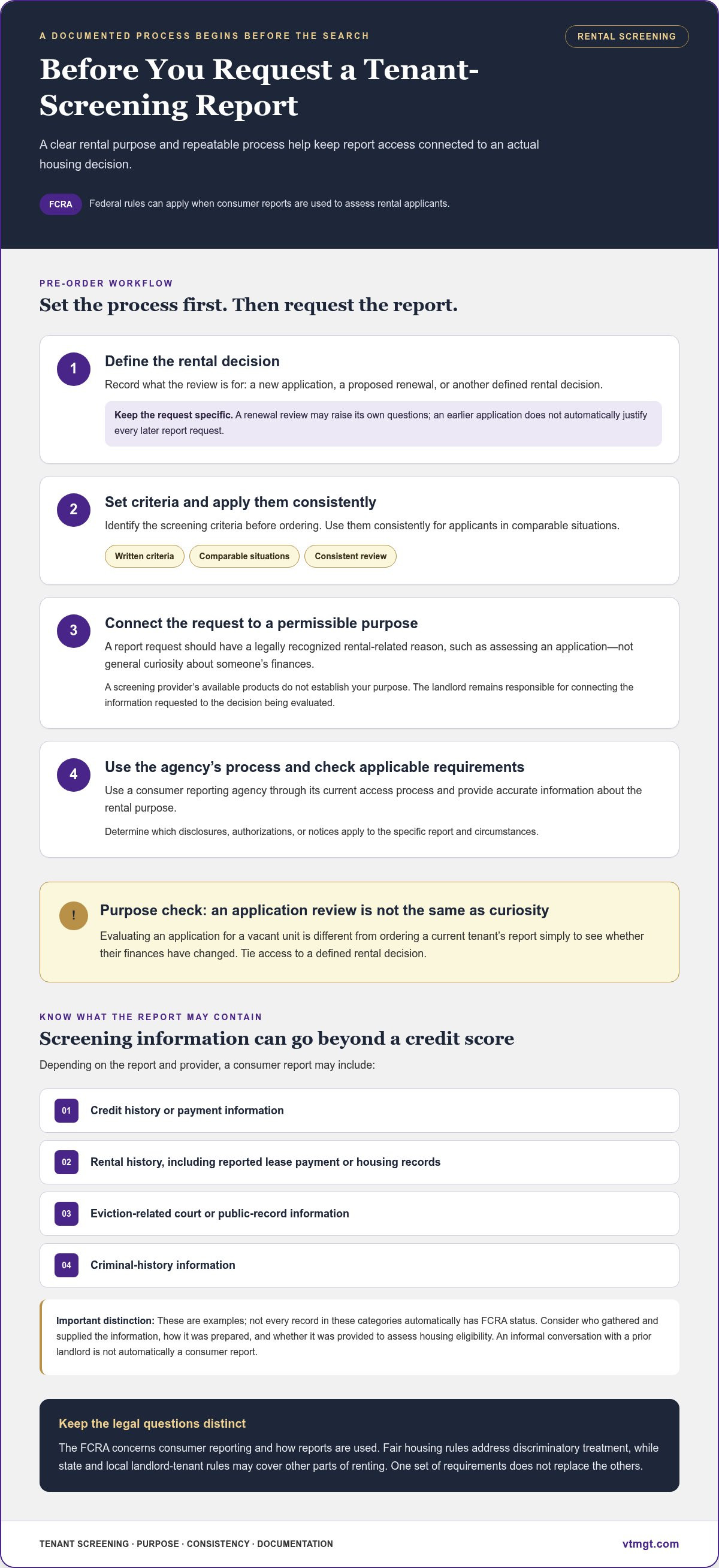
Set the decision and process first. The fair credit reporting act for landlords is easier to apply when report access follows a defined workflow, rather than an informal request made after concerns arise. Before ordering a report:
- Record whether the review concerns a new application, a proposed renewal, or another defined rental decision.
- Identify the screening criteria that apply, and use them consistently for applicants in comparable situations.
- Use a consumer reporting agency through its current access process, providing accurate information about the rental purpose.
- Determine which disclosures, authorizations, or notices apply to the specific report and screening arrangement.
Keep documentation proportionate and useful. Note the decision being considered, the criteria applied, and who requested the report. This creates a clearer record if a decision is later reviewed and helps distinguish a defined screening step from a search without a clear rental purpose. It also clarifies where a provider’s process ends and the landlord’s responsibilities continue.
Property owners who want screening and placement handled as part of an organized rental process can use tenant screening and placement to connect applicant evaluation with the broader work of placing a tenant.
When a Screening Report Leads to Adverse Action
A consumer report can affect more than an approval or denial. Under the Fair Credit Reporting Act (FCRA), adverse action in a housing decision may include rejecting an application or approving it only with less favorable terms, such as requiring a co-signer or charging a higher deposit. The specific facts and applicable rules matter, so don’t assume every unfavorable decision triggers identical notice duties. If information in a consumer report influenced the outcome, assess FCRA notice requirements even when it wasn’t the only reason for the decision.
The screening company supplies information; it doesn’t make the landlord’s final rental decision. The landlord evaluates the report alongside the application and applicable criteria, then determines whether the decision amounts to adverse action and what notices are required. A credit score alone doesn’t establish whether the FCRA process was followed. Consider whether a consumer report influenced the decision and whether the required notice was provided.
Which rental decisions may qualify as adverse action?
Consider the practical effect on the applicant. A denial is a clear example. Requiring a co-signer or imposing a higher deposit after reviewing a report may also qualify. A change to rent or another rental term may require careful analysis under the FCRA and other applicable rules. The label used in an email or application system doesn’t determine the legal result. Focus on what changed, why it changed, and whether report information contributed.
For example, if an applicant would otherwise qualify but the landlord requires a co-signer because of information in a screening report, that conditional approval may involve adverse action. If the decision is based on a different factor, the FCRA analysis may differ, though other legal obligations can still apply.
What information belongs in an adverse action notice?
When the FCRA applies, the notice generally identifies the consumer reporting agency that supplied the report, including its name, address, and telephone number. It must explain that the agency didn’t make the rental decision and can’t explain the specific reasons for it. The notice must also explain the applicant’s right to request a free copy of the report from the agency within 60 days and the right to dispute inaccurate or incomplete information with that agency.
Use a defined review sequence whenever a screening result contributes to a less favorable outcome:
- Identify whether the report influenced the decision, even in part.
- Determine whether the outcome qualifies as adverse action and which notice requirements apply.
- Provide the required information promptly as part of communicating the decision.
- Retain the decision record and a copy of the notice under the property’s recordkeeping process.
Before sending a notice, verify current federal requirements and any additional rules that apply to the specific decision. Record the report’s role, the outcome, and the notice provided. That documentation helps show how the decision was reached and whether the applicant received information needed to review or dispute the report.
A Repeatable FCRA Workflow for Landlords and Property Managers
Define a reliable screening process before applications arrive, then follow and document it at each decision point. For the fair credit reporting act for landlords, the practical objective is to connect report access to a legitimate rental purpose, apply established criteria consistently, respond appropriately when information is unclear, and protect the records created along the way. A written workflow also makes clear who handles each step.
How can landlords standardize report-based decisions?
Set screening criteria before reviewing individual reports, and apply them consistently to applicants in comparable circumstances. Define who may request reports, who reviews results, and when a question must be escalated. If a report is incomplete, disputed, or ambiguous, staff should know where to route it rather than making an improvised decision. Consistency doesn’t mean ignoring relevant differences; document the reason for any exception.
Use a decision log for each application or other rental review. Record the decision being evaluated, the criteria applied, who accessed and reviewed the report, whether the report influenced the outcome, the decision rationale, and any notice sent with its completion date. This helps show how information moved from report to decision without treating a screening score as the decision itself.
A practical sequence is:
- Approve written screening criteria and assign responsibility for access and review.
- Record the rental purpose before requesting a report, then follow the reporting agency’s access procedures.
- Evaluate the information against the criteria, recording questions, exceptions, and the report’s role in the outcome.
- Determine whether the result requires an adverse action notice, provide applicable information, and log when it was sent.
- Securely retain decision records and report information only as long as justified under applicable requirements and the organization’s retention process.
This structure is useful throughout Northern Michigan, including Petoskey, where rental operations benefit from clear roles and consistent applicant communication. Tenant screening in Petoskey works best as part of an organized local property-management process, rather than as an isolated report request.
How should landlords protect and dispose of reports?
Limit report access to people who need the information to carry out the rental decision. Store electronic and paper records securely, and define how staff handle, retain, and dispose of them. The FTC’s Disposal Rule requires reasonable measures to protect against unauthorized access to or use of consumer-report information during disposal. Verify current requirements and document the organization’s approved disposal process. Deleting a file or discarding paper without safeguards may not be sufficient.
Screening administration can be part of a repeatable rental workflow through professional property management and tenant placement.
How Professional Property Management Supports Consistent FCRA Practices
Consistent screening takes more than requesting a report. Applications, background checks, applicant communication, rental decisions, notices, and placement need to connect through a clear administrative process. A property manager can coordinate these operational steps, helping owners keep organized records and apply established screening criteria consistently across applicants.
For landlords considering the fair credit reporting act for landlords, distinguish workflow support from legal interpretation. A property manager can help administer screening and document the process, but that support doesn’t replace legal advice or guarantee compliance. Owners remain responsible for ensuring their policies and decisions meet applicable requirements.
What can a property manager handle in the screening process?
Property management can bring application review, background checks, applicant communication, and leasing together in a coordinated tenant-placement process. Van Treese Management’s tenant placement includes background checks and lease execution, while its standardized management systems support consistent administration and communication. Clear records can help show which steps were completed and how an application moved toward a placement decision, without promising a particular screening result.
Operational coordination is especially useful when several people participate in reviewing applications or communicating decisions. Defined responsibilities can reduce missed handoffs and help keep applicant records together. A manager can organize and administer the process, but interpreting a disputed report or determining a complex legal obligation may require qualified counsel.
When should a landlord seek legal guidance?
Consult qualified legal counsel when a report is disputed, information appears incomplete or inaccurate, an adverse-action decision is difficult to assess, or you’re unsure which requirements apply. Screening can involve federal FCRA duties alongside fair housing protections and Michigan landlord-tenant requirements. Legal review can help explain how those obligations relate to the facts of a particular rental decision.
Keep the roles clear: property management supports the practical administration of tenant screening and placement, while legal counsel advises on legal interpretation. Neither a screening provider nor a property manager’s administrative process, on its own, guarantees compliance. Landlords should maintain documented criteria and decision records, and seek current legal guidance when the facts raise uncertainty.
For owners in Northern Michigan, including Petoskey, consistent screening administration is one part of a broader rental management system. The property management in Petoskey guide provides local context on organizing rental operations and tenant placement.
For support coordinating tenant screening and placement as part of residential property management, explore Van Treese Management’s property management services.
Build a Screening Process You Can Put Into Practice
Before the next application arrives, decide who owns each step in your screening workflow and how the handoff from application review to final rental decision will be recorded. The process should be clear enough for staff to follow consistently and flexible enough to flag questions for further review. Treat the fair credit reporting act for landlords as one part of that operating framework, alongside other requirements relevant to your properties.
Professional management can make that framework part of daily rental operations. Van Treese Management’s tenant placement includes background checks and lease execution, while residential management includes tenant communication and standardized management systems. These operational elements can support a more organized applicant experience, but they don’t replace legal advice or guarantee compliance.
To bring more structure to rental operations in Petoskey, explore professional property management in Petoskey. A clear process is a practical foundation for confident, consistent decisions.
Frequently Asked Questions
Does the Fair Credit Reporting Act apply to small landlords?
Yes. The fair credit reporting act for landlords can apply to a small owner just as it can to a larger operator when a consumer reporting agency’s report is obtained or used for a rental decision. Owning one unit doesn’t, by itself, remove the issue. A call to a former landlord may be an informal reference rather than a consumer report, so consider who compiled the information and how it will be used.
Can a landlord use a credit report from a previous rental application?
Don’t assume an old report can be reused for a new applicant review or later rental decision. The original report request and the new use each need an appropriate purpose, and the report may no longer reflect the applicant’s current circumstances. Follow the reporting agency’s current procedures and document why the information is relevant to the decision. If the permissible purpose or reuse conditions are unclear, seek qualified legal guidance.
How long does negative information stay on a tenant screening report?
There isn’t one universal reporting period for every type of negative information. Time limits and exceptions can depend on the record category and applicable law, so don’t assume a credit item, court record, or bankruptcy is treated identically. For a rental decision, also consider whether the information is accurate, complete, and relevant. If a record’s age or status is unclear, verify it with the reporting agency before relying on it.
Can an applicant dispute information in a tenant screening report?
Yes. Applicants generally can request information in their consumer file and dispute information they believe is inaccurate or incomplete with the reporting agency. If an applicant raises a dispute, don’t treat the challenged item as unquestionably correct. Follow a consistent review and communication process while the issue is addressed. The agency’s notice and dispute materials can help explain the applicable rights and steps. Check current FTC or CFPB guidance for details.
Does a landlord have to give an applicant a copy of the screening report?
Not necessarily as a routine step in every application. An adverse action notice is distinct from handing over the full report: it identifies the reporting agency and explains the applicant’s rights to request a copy and dispute information. The applicant can generally request a free report from the agency within 60 days after receiving an adverse action notice. Confirm current notice requirements for the specific screening arrangement and decision.
Can landlords charge applicants for tenant screening?
The FCRA doesn’t answer every question about an applicant screening fee. It regulates consumer-report practices, while fee limits, disclosures, and handling may be governed by state or local requirements. Michigan landlords should verify current rules that apply to their rental and avoid assuming a fee is permitted simply because a reporting agency charges for a report. The applicant fee and the agency’s separate consumer-report process are related but distinct matters.
What should an applicant do if a tenant screening report contains an error?
Contact the consumer reporting agency identified in the screening paperwork or adverse action notice and dispute the specific information believed to be inaccurate or incomplete. Keep copies of the notice, report, and supporting records, such as proof that a balance was paid or a court record was resolved. Applicants in Petoskey, Boyne City, Indian River, Gaylord, Traverse City, and Grand Rapids can use the same federal dispute process while following the agency’s current instructions.