
Commercial Property Maintenance Contracts in Traverse City: A 2026 Buying Guide

What happens when a maintenance request arrives, but no one knows who approves the work, contacts the contractor, or tracks the result? That uncertainty can delay repairs and disrupt operations. When comparing commercial property maintenance contracts Traverse City owners should check whether the provider coordinates vendors or performs repair work, and how each request moves from report to resolution.
A maintenance arrangement should help protect building operations, but the proposed price alone won’t show whether its scope, escalation process, and reporting fit your property. Before choosing a provider, define what’s included, who can authorize costs, how urgent issues are handled, and what documentation you’ll receive.
This guide explains how to compare scope, response procedures, vendor oversight, and reporting, including what to verify for seasonal needs and property-specific coverage. Van Treese Management provides commercial property management that includes maintenance coordination through local contractors, common-area maintenance oversight, and financial reporting. Confirm the specific services and procedures proposed for your property.
Key Takeaways
- Separate maintenance coordination from repair work, preventive scheduling, and emergency dispatch so each responsibility is clear.
- Compare commercial property maintenance contracts in Traverse City using equivalent scopes, approval rules, and documentation, not headline service descriptions.
- Ask how vendors are sourced, granted site access, and monitored, and whether work records and invoices are reviewed.
- Review exclusions, authorization limits, reporting expectations, and termination language before signing.
- Confirm property-specific coverage, coordinated tasks, response procedures, and seasonal arrangements directly with each provider.
What a Commercial Property Maintenance Contract Should Cover in Traverse City
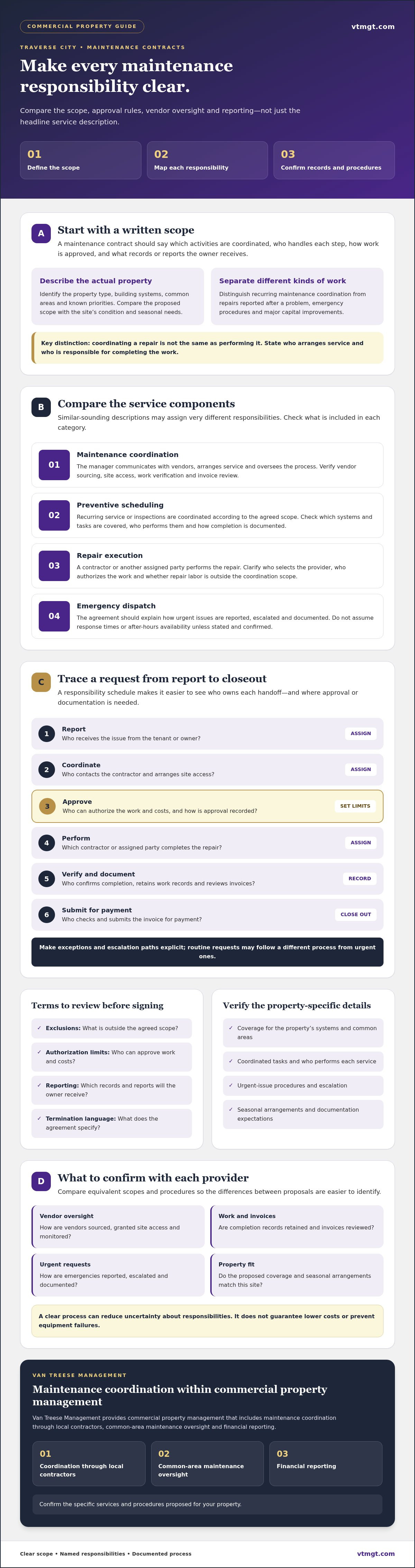
A commercial property maintenance contract is a written agreement that defines which maintenance activities a manager coordinates, who is responsible for each step, how work is approved, and what records or reports the owner receives. For commercial property maintenance contracts Traverse City owners are evaluating, this definition is a useful starting point. The agreement should describe the process rather than leave responsibilities to assumption.
Scope matters because coordinating maintenance is not the same as performing repairs. An agreement may cover arranging recurring service or routing a reported issue to a contractor, while the contractor remains responsible for completing the repair. Emergency response and capital improvements, such as a major building-system replacement, may also require separate procedures or approvals. A clear scope can reduce uncertainty about who does what, but it can’t guarantee lower costs or prevent equipment failures.
Maintenance is one part of broader Property management, which can also include operational and financial responsibilities. Connecting coordination with commercial management and reporting can help owners track maintenance activity alongside other property needs.
Which commercial properties and maintenance needs should the agreement identify?
Describe the property type, building systems, common areas, and known priorities instead of relying on a generic service label. Identify recurring maintenance coordination, such as scheduling routine services, separately from repairs initiated after a tenant or manager reports a problem. Specify who performs any inspection or repair. Traverse City buildings can differ in condition, systems, and seasonal needs, so compare the proposed scope with the actual site rather than assuming a standard package will fit.
Who coordinates vendors, approves work, and pays invoices?
Map each request from the initial report through closeout. Specify whether a tenant reports an issue to the owner or manager, who contacts a contractor, who arranges site access, and who confirms that the work was completed. State who can approve work and costs, how approval is recorded, and how invoices are checked and submitted for payment. For context on regional commercial oversight, see this commercial property management guide for Northern Michigan.
Before signing, owners should be able to trace responsibilities without guessing. A responsibility schedule can identify who reports, coordinates, approves, performs, verifies, and pays for each category of work. Confirm how exceptions are escalated, what documentation is retained, and whether routine coordination follows a different process from urgent requests. These details make competing scopes easier to assess and help identify what still needs confirmation for the property.
How to Compare Maintenance Coordination, Repairs, and Emergency Coverage
Service descriptions can sound alike while assigning very different responsibilities. Compare commercial property maintenance contracts offered in Traverse City by identifying who arranges service, who performs the work, and who has authority to approve it. The guide to property maintenance contracts from MRI Software also provides background on contract types and evaluation considerations.
Maintenance coordination: The manager communicates with vendors, arranges service, and oversees the process. Confirm whether vendor sourcing, site access, work verification, and invoice review are included.
Preventive scheduling: The manager coordinates recurring service or inspections according to the agreed scope. Verify which systems and tasks are covered, who performs each service, and how completion is documented.
Repair execution: A contractor or another assigned party performs the repair. The contract should identify who selects that provider, who authorizes the work, and whether repair labor is outside the coordination scope.
Emergency dispatch: An agreed process explains how urgent issues are reported, escalated, and documented. Don’t assume a particular response time or after-hours availability unless the agreement states and confirms it.
What is the difference between maintenance coordination and repair work?
Coordination means arranging, communicating with, and overseeing third-party service providers. It doesn’t mean the coordinator’s staff perform the repair. Van Treese Management describes its commercial maintenance service as coordination using local contractors, alongside vendor oversight. Owners should confirm which tasks can be coordinated for their property and who carries out the work. The agreement should also state who can approve the work scope or cost before a contractor proceeds.
How should emergency calls and after-hours issues be handled?
Ask for the documented process. Where does a tenant or site contact report an urgent issue? Who receives it, which contacts are used for escalation, when is the owner notified, and how are decisions and actions recorded? Verify any stated availability or response commitments in the proposed agreement. If approval authority is unclear, work may wait while the parties determine who can authorize it, or urgent work may proceed without the owner’s intended oversight.
Compare assigned responsibilities and exclusions, not service labels alone. A proposal described as “full-service maintenance” may still exclude repair labor or emergency dispatch, while a coordination-focused scope may clearly define vendor communication and work records. Compare the written process for each category, including invoice handling, rather than assuming similar labels mean equivalent coverage. Owners considering commercial management that includes maintenance coordination can review Van Treese Management’s commercial property management and confirm current property-specific scope, coverage, and terms directly.
Which Contract Terms Matter Most for Traverse City Commercial Properties?
A useful agreement turns broad service descriptions into terms an owner can verify. When comparing commercial property maintenance contracts in Traverse City, review the written scope, exclusions, authority to approve work, recordkeeping, and termination language. Confirm that the proposed vendor network can serve the property’s location and building systems. Don’t assume coverage based on a provider’s general service area.
- Included services and exclusions: Identify which recurring tasks, systems, and common areas are covered, and what falls outside the coordination scope.
- Approvals: Check who may authorize work, how approval is recorded, and what process applies if the owner or designated contact can’t be reached.
- Contractor documentation: Ask how contractor qualifications and insurance documentation are collected or reviewed. Confirm which records the owner can access.
- Work and financial records: Specify what work-order details, approvals, invoices, and completion records are provided, and when reporting is delivered.
- Term and termination: Review renewal, notice, and termination language, along with the steps for transferring open work orders or records.
Use this checklist to identify questions, not to assume that a particular legal or insurance requirement applies. Have qualified legal or other relevant professionals review contract language and any interpretation of your obligations before signing.
How should preventive maintenance and seasonal tasks be documented?
Request a property-specific schedule that names each coordinated task, its responsible party, and the record used to confirm completion. Local winter conditions and a building’s exposure may affect what an owner wants considered, but no single calendar fits every site. For related regional context, see this Northern Michigan rental property maintenance guide.
What should reporting and common-area oversight include?
Confirm whether owner reports include the issue description, vendor activity, work status, approvals, invoice details, and follow-up records. For common areas, clarify how maintenance oversight is documented and how records connect with lease-compliance processes and operating records. If expenses may be allocated under a lease, check the lease terms and the provider’s reporting scope rather than assuming coordination determines how charges are handled.
Before signing, ask the provider to map the proposed schedule and reporting process to your property, its systems, and its seasonal priorities. The written scope should make clear what is coordinated, what evidence is retained, and which items require separate review or approval.
How to Evaluate a Traverse City Maintenance Provider Before Signing
A structured review makes proposals easier to compare and gaps easier to spot. Give each provider the same property details and maintenance priorities, then work through five steps: define needs, request written scopes, compare responsibilities, verify coverage, and review the terms. This helps prevent broad service labels from obscuring differences in what is actually coordinated.
- Define needs: List the building systems, common areas, recurring tasks, and known priorities relevant to your property.
- Request written scopes: Ask each provider to identify included tasks, exclusions, owner responsibilities, and services handled by third parties.
- Compare responsibilities: Trace how a request is reported, assigned, approved, documented, and closed.
- Verify coverage: Confirm which services and vendors can be coordinated for your property’s location and systems in Traverse City.
- Review terms: Check approval rules, reporting expectations, and the proposed agreement before making a selection.
What questions should owners ask prospective providers?
Ask which maintenance tasks are coordinated and which are excluded, how additional work is authorized, and how vendors are selected. Request an explanation of how records are maintained, how issues are escalated to the owner, and what updates the owner receives. Then verify proposed coverage for your particular Traverse City property rather than relying on a general service-area statement.
How can owners compare proposals consistently?
Build a side-by-side matrix using identical property requirements. Record each provider’s scope, exclusions, communication process, documentation, vendor oversight, and owner responsibilities. If available, request a sample report to see whether it provides the information you need to track work and related invoices.
Separate confirmed commitments in the written proposal from verbal assurances, and ask for material terms to be documented. Don’t compare fees or savings claims in isolation. A lower figure may reflect a narrower scope or more exclusions, while a broader description may still leave important responsibilities undefined. Evaluate what each proposal actually covers.
Van Treese Management provides commercial property management that includes maintenance coordination, contractor oversight, and financial reporting. Owners should confirm current availability, property-specific scope, vendor coverage, and proposed procedures directly. Discuss your commercial property management needs with Van Treese Management to determine whether its coordination approach fits your property.
How Van Treese Management Coordinates Commercial Property Maintenance
Van Treese Management’s commercial property management includes maintenance coordination, contractor oversight, and financial reporting. Its coordination model uses a network of vetted local contractors and standardized systems. The service coordinates and oversees third-party providers, rather than performing repairs or providing general contracting services.
What maintenance coordination does Van Treese Management offer?
Owners can consider maintenance oversight alongside common-area responsibilities and property financial reporting to discuss how maintenance activity fits within broader commercial management. Specific tasks, vendor services, and reporting arrangements depend on the property and should be confirmed directly. Owners comparing commercial property maintenance contracts in Traverse City should also verify current coverage, availability, and proposed terms for their site.
Before making a decision, ask how responsibilities would be defined for your building: which work can be coordinated, how contractors are engaged, what owner approvals are needed, and what information appears in reports. These details help you assess whether the proposed coordination model matches your operating needs without assuming that every property receives the same scope.
What should owners prepare before discussing a contract?
A concise property brief helps make an initial discussion more specific. Gather the information you have and note any details that still need confirmation:
- Property profile: Location, building type, key systems, and common areas.
- Maintenance history: Recurring issues, known priorities, and services currently arranged by vendors.
- Coordination preferences: Who should approve work, how the owner wants to receive updates, and what reporting is useful.
- Seasonal considerations: Known building or site needs to discuss, without assuming a standard schedule.
- Open questions: Which tasks can be coordinated, what contractor coverage may be available, and how scope and terms would be documented.
Bring existing vendor details or maintenance records if they’re available. They can help clarify current responsibilities and identify what you want to retain, change, or discuss, but they don’t replace confirmation of the proposed service scope.
Van Treese Management lists Traverse City among its service locations, but owners should confirm current availability and property-specific coverage directly. For a focused discussion of your commercial property management needs, contact Van Treese Management with your property details and questions. Use the conversation to establish whether the proposed coordination scope, contractor oversight, common-area responsibilities, and reporting approach merit further review.
Choose a Maintenance Partner with Clear Responsibilities
The strongest commercial property maintenance contracts Traverse City owners consider make responsibilities visible: what gets coordinated, who performs repairs, how approvals are handled, and what reporting the owner receives. Compare providers using equivalent property needs, not broad service labels, and confirm coverage, exclusions, and escalation procedures in writing.
Van Treese Management connects commercial property management with maintenance coordination through a network of vetted local contractors and standardized systems. Its commercial management also includes common-area maintenance oversight and financial reporting, allowing owners to consider maintenance activity alongside other property records. Confirm the specific scope, availability, and terms for your property directly.
Clear expectations give owners a practical basis for vendor oversight and a more informed long-term decision. Discuss commercial property maintenance coordination with Van Treese Management to review your property’s needs and determine whether the proposed approach fits. Compare the written scope, responsibilities, and reporting process before moving forward.
Frequently Asked Questions
What should a commercial property maintenance contract include?
A commercial maintenance contract should define the coordination scope, assigned responsibilities, approval process, exclusions, and reporting. It should also explain how recurring maintenance is scheduled, how reported issues are routed, who performs repair work, and what records owners receive. Review the agreement’s term and termination language as well. Clear written terms help owners compare proposals and identify unanswered questions before authorizing a provider to coordinate maintenance.
Does a property maintenance contract include the actual repairs?
Not necessarily. A maintenance contract may cover coordination without including repair labor. The manager may arrange a third-party contractor, communicate about the work, and oversee records, while the contractor performs the repair. Check whether the agreement includes repair execution, excludes it, or treats it as a separate arrangement. Also confirm who selects the contractor, approves the work, and reviews the invoice before payment.
How do I compare commercial property maintenance providers in Traverse City?
Compare written scopes against the same property needs, not just providers’ service labels. When reviewing commercial property maintenance contracts in Traverse City, check included tasks, exclusions, contractor coordination, owner approval responsibilities, documentation, and reporting. Ask how local vendor coverage is confirmed for your building and its systems. Request a sample report if available, and get material commitments in writing so you can distinguish confirmed terms from verbal assurances.
Can a property manager coordinate emergency maintenance after hours?
That depends on the provider’s confirmed service scope and the agreement. Don’t assume commercial maintenance coordination includes after-hours intake, dispatch, or a specific response time. Ask how urgent issues are reported, who receives the escalation, when the owner is notified, and what approval authority applies. If after-hours coverage is offered, review the stated availability and procedures in writing before relying on them for your property.
What maintenance should Traverse City commercial properties plan for seasonally?
Seasonal planning should reflect the building, site exposure, systems, and known maintenance history rather than follow a universal calendar. Owners may want to discuss snow and ice management, exterior areas, drainage, and heating or cooling system service with the responsible provider or contractor. Identify who schedules each task and how completion is recorded. Confirm that any proposed seasonal arrangements, including service availability, are documented for your property.
Who pays for repairs under a commercial maintenance agreement?
Payment responsibility depends on the written agreement and any applicable lease terms. It shouldn’t be assumed from the fact that a manager coordinates the work. Review who receives and pays contractor invoices, how costs are approved, and whether the agreement distinguishes coordination from repair charges. For tenant-related or shared-area work, check the relevant lease language and ask a qualified professional to clarify any interpretation before assigning responsibility.
Can Van Treese Management coordinate maintenance for a commercial property in Traverse City?
Van Treese Management lists Traverse City among its service locations and provides commercial property management that includes maintenance coordination. Its documented approach uses a network of vetted local contractors and standardized systems, with common-area maintenance oversight and financial reporting as part of commercial management. Confirm current availability, property-specific coverage, coordinated tasks, and proposed terms directly. The company also lists Petoskey, Boyne City, Indian River, Gaylord, and Grand Rapids among its service locations.
What information should I provide when requesting a commercial maintenance proposal?
Provide the property’s location and building type, key systems, common areas, recurring issues, and known maintenance priorities. Include current vendor arrangements if available, along with your preferences for work approvals, owner notifications, and reporting. Note seasonal concerns and clarify which tasks you want coordinated. This information helps a provider assess property-specific scope and coverage, but you should still confirm proposed services, procedures, and availability in writing.