
Advertising Rental Property in Grand Rapids: A 2026 Landlord’s Strategic Guide

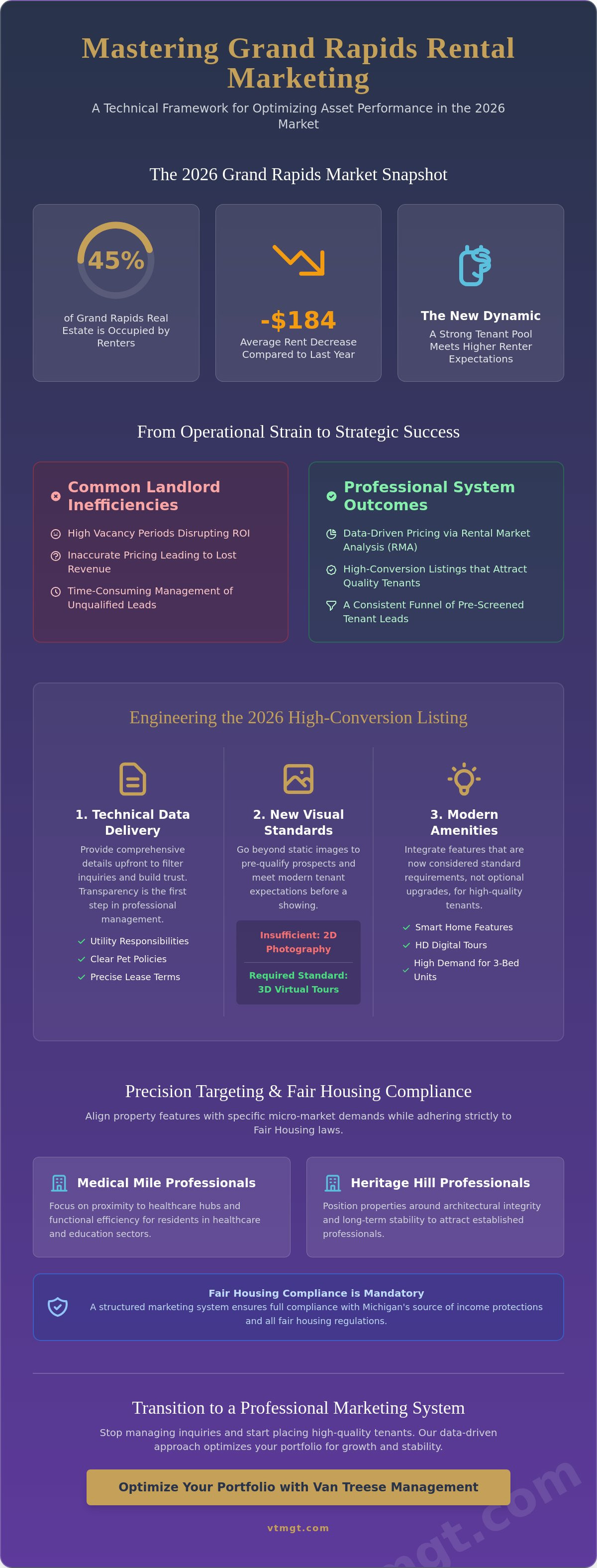
45% of Grand Rapids real estate is occupied by renters, yet the average rent across all property types has decreased by $184 compared to last year. This shift indicates that advertising rental property in Grand Rapids has evolved into a technical discipline that requires precision rather than just a creative eye. You're likely familiar with the operational strain caused by high vacancy periods, inaccurate pricing, or the time-consuming nature of managing leads that don't meet your standards. These inefficiencies disrupt your ROI and complicate your management workflow.
This guide provides a structured framework to help you master the strategic marketing of your assets. By applying these standardized processes, you'll learn how to attract pre-screened tenant leads and maintain market-leading rental rates in a competitive environment. We'll examine the 2026 market metrics, legal requirements like the Michigan security deposit limit, and the specific demand for larger three-bedroom units to ensure your portfolio remains optimized for growth and stability. We've designed this analysis to provide the technical clarity needed for professional property performance.
This strategic guide provides a technical framework for optimizing property marketing within the current Kent County landscape. You'll gain the following professional insights:
- Methods for calibrating asset positioning based on the 2026 supply-demand equilibrium and neighborhood-specific dynamics.
- Technical standards for high-conversion listing engineering, focusing on professional visual assets and search-optimized descriptive frameworks.
- Strategic approaches to advertising rental property in Grand Rapids through a balance of digital syndication and targeted local platforms.
- The application of systematic Rental Market Analysis (RMA) to establish data-driven pricing and minimize the fiscal impact of vacancy periods.
- Procedures for transitioning to professional marketing systems that integrate advertising with standardized tenant screening and placement protocols.
Navigating the Grand Rapids Rental Market Dynamics in 2026
The Kent County rental market has reached a complex equilibrium. While renters occupy 45% of the local real estate, the average rent for all property types has decreased by $184 compared to the previous year. This correction signals a transition from a period of rapid escalation to a phase where precision in market positioning is mandatory. Sustained interest rates in 2026 have effectively limited homeownership for many, maintaining a steady pool of high-quality tenants. However, these renters are increasingly selective, demanding a higher level of professional service and asset maintenance. To compete with institutional investors who use algorithmic pricing and standardized management, local landlords must adopt a disciplined, technical approach to their operations.
Effective advertising rental property in Grand Rapids requires an understanding of micro-market variances. A generic marketing strategy fails to capture the specific demand profiles of different neighborhoods. For instance, properties in Heritage Hill should be positioned around architectural integrity and long-term stability to attract established professionals. Conversely, the Medical Mile requires a focus on proximity to healthcare hubs and functional efficiency for residents working in the healthcare and education sectors. Successful landlords integrate these nuances into their broader digital advertising strategies to ensure their listings reach the most relevant demographic without wasting resources on unqualified leads.
Grand Rapids Rental Trends for 2026
The West Michigan corridor is currently seeing a shift toward long-term stability. Tenant expectations have evolved; smart home features and high-definition digital tours are no longer optional upgrades but standard requirements for 2026 listings. Data-driven research is the foundation of any successful placement. Landlords must analyze real-time metrics in Kent and Emmet counties to ensure their assets remain competitive against newer A-class developments while maintaining the value proposition of B-class properties.
Defining Your Target Tenant Profile
Identifying the ideal demographic is a prerequisite for any marketing campaign. Grand Rapids professionals in the healthcare and technology sectors prioritize different amenities than those in the hospitality or manufacturing industries. Aligning your property's specific features with these professional needs reduces friction during the leasing process. Professional oversight through a structured management system ensures that while you target a specific profile, your process remains fully compliant with Michigan's source of income protections and fair housing regulations. This balance of targeting and compliance is what defines a professionalized advertising rental property in Grand Rapids.
Engineering a High-Conversion Rental Listing: Technical Standards
Engineering a high-conversion listing requires a shift from subjective storytelling to technical data delivery. When you're advertising rental property in Grand Rapids, the listing functions as the primary interface between your asset and a potential lead. It must be calibrated for both search engine algorithms and human decision-making processes. Standardizing this framework ensures that every property in a portfolio maintains a consistent level of quality. This consistency is essential for competing with institutional operators who utilize sophisticated digital systems to dominate local search results.
A successful listing serves as a filtering mechanism. By providing comprehensive data upfront, you reduce the volume of unqualified inquiries and focus your resources on serious prospects. This data must include specific utility responsibilities, clear pet policies, and precise lease terms. Transparency in these technical details builds trust and establishes a professional tone before the first interaction. Transitioning to a standardized property marketing system allows you to maintain these high standards across multiple assets without increasing your manual workload.
Visual Documentation Standards
In the 2026 market, 2D photography is an insufficient baseline for professional listings. High-resolution 3D virtual tours have become the industry standard for filtering out non-serious inquiries before a physical showing is even scheduled. This technical barrier ensures that your time is only allocated to leads who have already verified the property's layout and structural condition virtually. A clean, professional aesthetic in your visual assets signals to the tenant that the property is under disciplined management. This perception of quality is a key driver in securing market-leading rental rates, especially for three-bedroom units which currently command an average of $2,229 in the local market.
Crafting the Technical Description
The architecture of your listing description should prioritize mobile readability. Most renters browse via mobile devices; therefore, long paragraphs must be replaced with structured bullet points and concise technical specifications. It's also critical to include disclosures required by Michigan landlord-tenant laws, such as the regulation that security deposits cannot exceed 1.5 times the monthly rent. Accurate legal documentation within the listing prevents future liability and sets clear expectations.
A strong technical hook should focus on a specific, high-value feature rather than generic adjectives. For example: This Midtown three-bedroom unit features a 2025-upgraded HVAC system and a private 2-car garage within walking distance of the Medical Mile. This level of specificity helps in advertising rental property in Grand Rapids by immediately identifying the property’s unique value proposition to the target demographic.
Multi-Channel Syndication vs. Targeted Local Advertising
Advertising rental property in Grand Rapids requires a dual-track distribution strategy to balance reach with lead quality. While broad digital syndication provides the necessary visibility to maintain low vacancy rates, targeted local channels often produce higher-quality applicants who are already integrated into the West Michigan economy. A disciplined approach treats these channels not as independent options, but as a unified technical framework designed to capture a specific tenant profile. Relying on a single platform creates a single point of failure in your marketing pipeline, whereas a multi-channel system ensures continuous lead flow even during seasonal market shifts.
The mechanics of digital syndication through platforms like Zillow, Trulia, and HotPads are essential for capturing the 45% of the Grand Rapids population currently renting. However, broad-scale exposure must be tempered with strict adherence to Michigan landlord laws. This includes following source of income protections, which prohibit landlords with five or more units from discriminating against tenants using housing vouchers. Professional owners often avoid "free" platforms like Facebook Marketplace because they lack the structured data fields and pre-screening tools required for high-precision management. These unmanaged environments frequently generate a high volume of unqualified inquiries, increasing the administrative burden on your team and extending the vacancy period.
Digital Syndication Strategies
Centralized management software is the engine behind successful syndication. It ensures that every listing update, whether a price adjustment or a change in availability, is reflected across all platforms in real time. This technical synchronization prevents the "stale listing" trap that can damage a professional brand's reputation. In the 2026 market, response time is a critical performance metric. We utilize standardized communication systems to manage inquiries instantly, ensuring that high-quality prospects are moved through the funnel before they engage with competing properties. Speed and data accuracy are the two primary variables that dictate your conversion rate.
Local Networking and Community Presence
Local niche platforms and employer relationships in Grand Rapids provide a level of lead quality that broad syndication cannot match. By leveraging professional networks within the healthcare and education sectors, we position your assets directly in front of stable, high-income professionals. This community-centric approach builds a layer of trust that digital ads alone cannot achieve. Van Treese Management focuses on building thriving local communities through disciplined interaction and professional brand management. This strategy ensures that when advertising rental property in Grand Rapids, your listing is perceived as a premium, professionally managed opportunity rather than a generic commodity.
Data-Driven Rent Pricing and Market Position Analysis
Precision in pricing is the most critical variable in the advertising rental property in Grand Rapids framework. We define Rental Market Analysis (RMA) as the systematic evaluation of comparable properties within a specific geographic radius to determine an asset's optimal market position. This isn't a speculative estimate; it's a technical calculation based on current supply-demand data. With the average rent for all property types in Grand Rapids decreasing by $184 over the last year, failing to adjust your pricing strategy can lead to the vacancy trap. A property priced even slightly above the market equilibrium will sit vacant, resulting in a total loss of monthly revenue that far exceeds the cost of a minor price correction. This disciplined approach to valuation is essential for maximizing the ROI of investing in rental property Northern Michigan.
Real-time data allows for adjustments based on seasonal demand fluctuations. While the average apartment rent in Grand Rapids is $1,380, three-bedroom units command a significant premium at $2,229. If your asset isn't capturing these benchmarks, your marketing process requires recalibration. We use standardized financial reporting to track the performance of every pricing adjustment, ensuring that each decision is backed by measurable results rather than intuition. This level of oversight is what separates professional operators from amateur landlords.
The Metrics of Rental Valuation
Our valuation process involves analyzing Price Per Square Foot (PPSF) across West Michigan sub-markets. We also factor in "invisible" value, such as professional maintenance coordination and standardized management systems, which justify higher retention rates even in competitive cycles. A technical 5% price adjustment can often reduce the vacancy period by 50% by aligning the asset with the current demand curve. This precision ensures your property remains competitive in expensive neighborhoods like Midtown or Eastown without sacrificing long-term valuation goals.
Dynamic Pricing Strategies
There are instances where offering one-time incentives is more fiscally responsible than reducing the base rent for the entire lease term. This strategy preserves the property's asset value while still attracting high-quality leads in a value-oriented market. Standardized financial reporting and accounting allow you to monitor these variables with total clarity. If you're looking to optimize your portfolio's performance through data-driven analysis, you can request a professional market evaluation to ensure your assets are positioned for maximum yield.
Implementing Professional Marketing Systems with Van Treese Management
Transitioning from manual advertising to a professional, standardized system is the final step in securing your property’s financial future. Advertising rental property in Grand Rapids shouldn't be a fragmented series of tasks performed in isolation. Instead, it must be part of a larger, technical workflow that integrates marketing with tenant placement and rigorous background checks. Van Treese Management provides this structured framework, ensuring that every lead generated by our marketing efforts is funneled through a high-precision screening process. This approach eliminates the variability inherent in manual management and replaces it with a predictable, data-driven outcome. We manage leads with a focus on speed and accuracy, ensuring that high-quality prospects are processed before they look elsewhere.
Our commitment to Northern Michigan and Grand Rapids property owners is rooted in the belief that property management is a technical discipline. We don't rely on generic marketing templates; we use an integrated system where maintenance coordination and financial reporting are linked directly to the marketing funnel. This ensures that the property's physical condition always matches the professional standard presented in our advertisements. By maintaining this level of operational control, we help owners avoid the common pitfalls of unqualified leads and prolonged vacancy periods.
Standardized Tenant Placement
Our screening process is a technical audit of a prospect’s financial and behavioral history. We conduct thorough background, credit, and rental history evaluations to ensure only the most qualified candidates proceed to lease execution. This isn't a subjective choice but a data-driven verification. These systems transform the property management experience for owners, moving it away from an unpredictable administrative burden toward a streamlined investment process. This level of discipline reduces owner stress and ensures that lease agreements are prepared with total legal and financial accuracy, reflecting the current 2026 Michigan regulations.
The Value of Professional Oversight
Scaling a rental portfolio requires more than just acquiring more assets; it requires more robust systems. Professional oversight ensures that every aspect of the property, from initial advertising to rental property maintenance in Northern Michigan, is managed within a unified framework. When maintenance coordination is integrated into the marketing promise, it attracts higher-quality tenants who value property integrity and professional responsiveness. This synergy between advertising rental property in Grand Rapids and operational excellence is what stabilizes long-term ROI in a shifting market. If you're ready to transition your portfolio to a more disciplined management structure, the next step is to Partner with Van Treese Management.
Optimizing Your Portfolio for the 2026 Grand Rapids Market
Succeeding in the West Michigan corridor requires more than just visibility; it demands a technical alignment of market data and operational execution. Throughout this guide, we've explored how advertising rental property in Grand Rapids has evolved into a structured process that prioritizes data-driven pricing and high-conversion visual standards. By moving beyond manual listing methods and adopting a framework that integrates marketing with disciplined tenant placement, you ensure your portfolio remains resilient against the pricing corrections observed over the last year. Precision in these early stages is what dictates the long-term yield of your investment.
Our approach focuses on total asset optimization through deep market research and standardized management systems. We provide the professional oversight necessary to maintain these standards, including 24/7 emergency response coordination and precise property valuations that reflect current neighborhood dynamics. Partner with Van Treese Management for Professional Rental Marketing to implement a system that transforms your rental property into a high-performing, professionally managed asset. We're committed to helping you navigate the complexities of the 2026 market with confidence, stability, and a focus on quality.
Frequently Asked Questions
Where is the best place to advertise a rental property in Grand Rapids?
The most effective strategy involves utilizing centralized syndication platforms such as Zillow, Trulia, and HotPads alongside targeted local networks. While broad digital reach is necessary to maintain low vacancy, high-quality leads in the West Michigan corridor often originate from professional connections within the healthcare and education sectors. A multi-channel approach ensures that your property maintains visibility across diverse demographic segments while prioritizing high-conversion local platforms.
How much does it cost to advertise a rental property professionally?
Professional advertising costs are typically integrated into a broader property management fee structure or a one-time leasing fee. In the Grand Rapids market, management fees often range between 6% and 12% of the monthly rent, which covers multi-channel distribution, lead management, and professional listing engineering. Owners should evaluate the cost of vacancy against these professional fees to determine the most fiscally responsible path for their portfolio.
Do I need professional photos for my Grand Rapids rental listing?
Professional visual assets, including 3D virtual tours and high-resolution photography, are essential for filtering out unqualified leads in the 2026 market. Static 2D images are often insufficient for capturing the attention of high-income professionals who expect a technical preview of the property. Standardizing your visual documentation reflects a disciplined management style and justifies market-leading rental rates, especially for premium three-bedroom units in competitive neighborhoods.
How long does it typically take to find a tenant in West Michigan?
The duration required to secure a qualified tenant typically ranges from two to four weeks when using a standardized marketing system. This timeline fluctuates based on neighborhood-specific demand and the accuracy of your initial pricing strategy. Properties in high-demand areas like Midtown or Eastown may convert faster if they're positioned correctly against current supply-demand metrics and Michigan's legal compliance standards.
Is it better to use Zillow or Facebook Marketplace for Grand Rapids rentals?
Zillow is generally superior for professional owners due to its structured data fields and integrated lead-tracking capabilities. While Facebook Marketplace offers high volume, it lacks the professional screening tools required to maintain a disciplined management process. When advertising rental property in Grand Rapids, prioritizing platforms that support legal disclosure and data accuracy reduces administrative friction and long-term liability.
What legal disclosures are required in a Michigan rental advertisement?
Michigan law requires clear disclosures regarding security deposit limits, which cannot exceed 1.5 times the monthly rent. Additionally, advertisements must comply with fair housing regulations and source of income protections for landlords with five or more units. Ensuring these technical details are present in the initial listing prevents legal disputes and establishes a professional tone with prospective residents before the first showing is scheduled.
How do I determine the right rent price for my Grand Rapids property?
Determining the correct price requires a systematic Rental Market Analysis (RMA) that evaluates comparable properties within the immediate West Michigan sub-market. We analyze Price Per Square Foot (PPSF) and adjust for specific asset features like upgraded HVAC systems or private garages. This data-driven approach prevents the "vacancy trap" where overpricing leads to a total loss of monthly revenue that exceeds the cost of a minor price correction.
Can a property management company help with advertising and tenant placement only?
Property management firms often provide specialized tenant screening and placement as a standalone service for owners who prefer to handle daily operations themselves. This service includes the full technical framework of advertising rental property in Grand Rapids, from professional listing engineering to lease agreement preparation. It allows owners to leverage professional marketing systems and background check protocols while maintaining direct control over their assets.