

What if a rent increase masks a growing maintenance burden or recurring vacancy? An investment property performance review should do more than compare rent collected with expenses. It should connect financial results to operating activity so you can see what’s working and what needs attention.
It can be difficult to interpret the numbers when leasing, tenant communication, rent collection, and maintenance records sit in separate places. A change in income or costs may have several possible causes, and one period rarely tells the whole story. Reviewing trends alongside the events that shaped them helps distinguish a temporary variance from an issue that may need action.
This practical 2026 guide explains how to assess a rental property’s financial and operating performance, investigate changes in vacancy, rent, and maintenance, and build a prioritized action plan. You’ll learn how organized financial reporting, management activity, and local market context can inform decisions about the property, including whether to continue self-managing or seek professional support.
Key Takeaways
- Use an investment property performance review to connect financial results with leasing, maintenance, and management activity.
- Set a clear review period, gather relevant records, reconcile figures, and compare consistent time periods before drawing conclusions.
- Assess net operating income, cash flow, occupancy, and maintenance trends together to identify changes that may need investigation.
- Prioritize next steps by financial effect, urgency, evidence quality, and owner priorities, then separate immediate actions from open questions.
- Organized rent collection, tenant communication, leasing records, maintenance coordination, and financial reporting can provide useful evidence for ongoing oversight.
What an Investment Property Performance Review Should Tell You
An investment property performance review is a scheduled assessment of a rental’s financial results, leasing activity, maintenance, and next steps. It connects the numbers to the events behind them: a vacancy may reduce collected rent, while repair costs may reflect a one-time issue or a recurring condition. The purpose is to identify meaningful changes, investigate their causes, and decide what to do next.
A recurring review is different from a rental valuation or purchase analysis. A valuation estimates a property’s value at a particular point in time; a purchase analysis helps assess a potential acquisition. A performance review looks back over a defined operating period and tracks whether the property is meeting its own objectives. Benchmarking can provide context, and this overview of real estate benchmarking and KPIs explains how measures can support property analysis. Benchmarks are reference points, not guaranteed returns or universal targets. The right interpretation depends on the property, its condition, lease arrangements, expenses, and the owner’s priorities.
Which questions should a rental-property review answer?
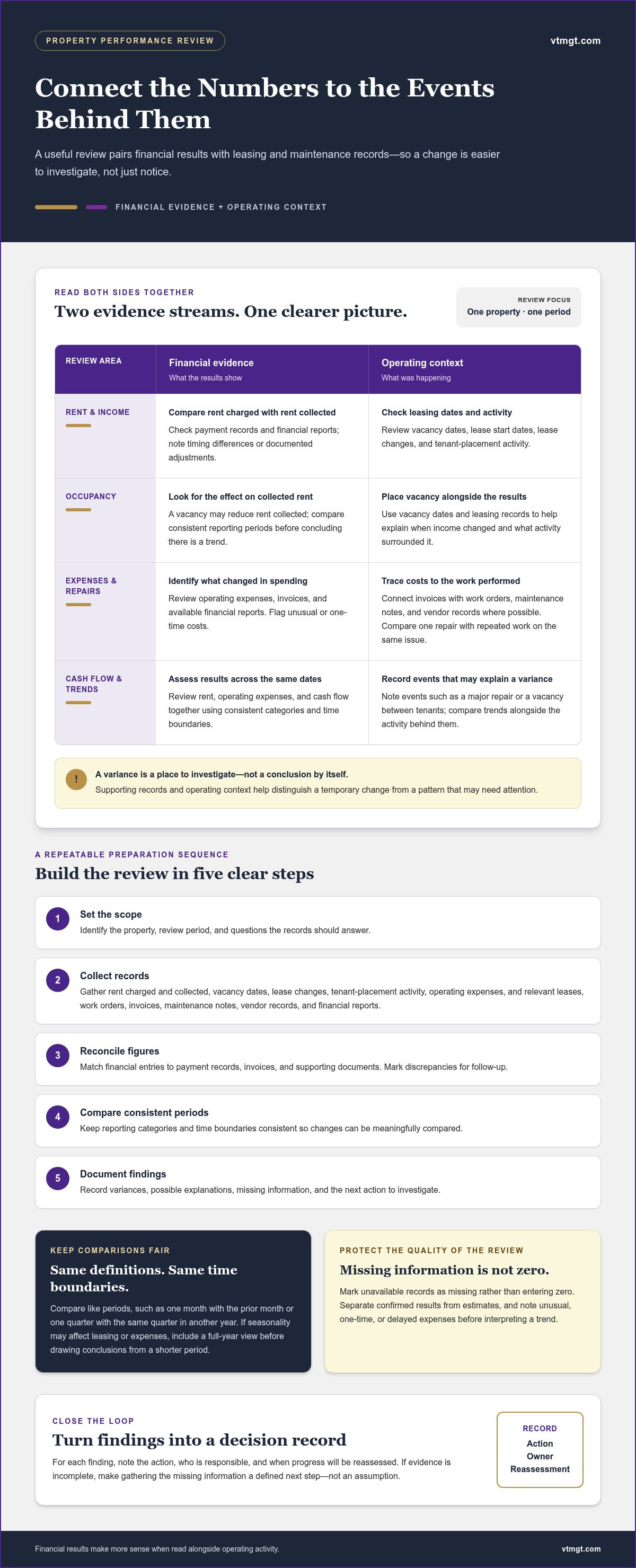
Start by asking whether rent collected, operating expenses, and cash flow align with expectations. Then review occupancy, lease activity, and maintenance patterns. If income is lower than expected, check vacancy dates, lease start dates, and whether rent charged matches rent collected. If maintenance spending has risen, compare invoices and work orders to see whether the increase came from one repair or repeated work on the same issue. The figures show where to look; supporting records and operating context help explain why.
End each review with a decision record, not just observations. Note the action, who is responsible, and when progress will be reassessed. If the evidence is incomplete, make gathering the missing information a defined next step rather than treating an assumption as a conclusion.
Choose a review period that supports useful comparisons
Compare consistent periods, such as one month with the prior month or one quarter with the same quarter in another year. Document unusual one-time events, such as a major repair or a vacancy between tenants, so they don’t obscure the underlying pattern. If seasonality may affect leasing or expenses, include a full-year view before drawing conclusions from a shorter period.
Set a recurring cadence that fits the property’s reporting and operating cycle. Monthly checks can help owners notice emerging variances; a broader quarterly or annual review can provide more context. Use the same definitions and time boundaries each time, then carry unresolved findings into the next review. That consistency helps distinguish a temporary fluctuation from a trend that warrants a change in management, leasing, or maintenance decisions.
How to Gather the Financial and Operating Data for Your Review
A useful investment property performance review depends on records that connect financial results with the activity that produced them. Gather information for one property and a clearly defined period, then check that the figures and operating notes cover the same dates. Missing records matter too: mark them as unavailable rather than entering zero, which could make an incomplete picture look like a confirmed result.
Build a consistent property-level record set
Use a repeatable sequence to prepare the review:
- Set the scope. Identify the property, review period, and questions you want the records to answer.
- Collect records. Bring together rent charged and collected, vacancy dates, lease changes, tenant-placement activity, operating expenses, and available financial reports. Add relevant leases, work orders, repair invoices, maintenance notes, and vendor records.
- Reconcile figures. Match financial entries to payment records, invoices, and supporting documents. Note discrepancies for follow-up.
- Compare periods. Use consistent reporting categories and time boundaries so changes are meaningful.
- Document findings. Record variances, possible explanations, missing information, and the next action to investigate.
Keep records organized by property and period. For maintenance, connect each invoice and note to its related work order where possible. This helps show whether an expense reflects a specific repair or a pattern of repeated work. Put vacancies, lease changes, and tenant-placement activity alongside financial results; otherwise, a change in collected rent may be difficult to interpret.
Check the figures before drawing conclusions
Compare rent collected with the rent roll and payment records, allowing for timing differences or other documented adjustments. Flag unusual, one-time, or delayed expenses instead of letting them distort the comparison. Keep categories stable across periods; if the way an expense is recorded changes, note that before interpreting the apparent trend.
Separate confirmed results from estimates. If a record is missing, label the gap and identify how it can be resolved. Don’t assume an undocumented expense or vacancy is zero. This distinction helps owners assess both the property’s performance and the reliability of the information used to make decisions.
For Northern Michigan owners, this overview of property management in Petoskey explains how local oversight relates to rent collection, leasing, maintenance coordination, and financial reporting.
How to Interpret Results Without Misreading Property Performance
A change in one measure rarely explains the whole story. In an investment property performance review, read income, expenses, leasing activity, and maintenance together, then check the records that could confirm or challenge your first interpretation. Compare equivalent periods and property types; a seasonal shift or a one-time repair shouldn’t automatically be treated as a lasting trend.
Read financial measures alongside operating activity
Net operating income (NOI) is rental income minus operating expenses, before financing costs. Cash flow reflects the money left after income and outflows for the period, including financing payments where applicable. These measures answer different questions: a property can have stable NOI but tighter cash flow if financing obligations or payment timing change. Occupancy shows how much of the property is rented, while maintenance trends reveal how repair activity and costs are changing. Rent growth alone doesn’t establish that overall performance has improved.
| Measure | Period-to-period change | Possible cause | Evidence to check | Potential response |
|---|---|---|---|---|
| NOI | Income or operating expenses shifted | Rent, vacancy, recurring costs, or a one-time expense | Financial reports, rent records, invoices | Separate recurring changes from unusual items |
| Cash flow | Available cash increased or decreased | Collection timing, financing outflows, or repair payments | Payment records, expense dates, financing statements | Clarify timing and assess ongoing obligations |
| Occupancy | More or fewer days or units were occupied | Lease end dates, time between tenants, or placement timing | Leases, vacancy dates, placement records | Review leasing activity and investigate delays |
| Maintenance | Work orders or repair costs changed | One-off repair, recurring issue, or changed work volume | Work orders, notes, invoices | Determine whether follow-up or further review is warranted |
Put local and property-specific context around the numbers
Property condition, lease timing, and location shape what a change means. A vacancy between leases may explain a temporary income dip; repeated repairs may point to a pattern that deserves investigation. Compare the property with its own history first. For market context, use current, comparable local information, and verify its date, geography, and property type before relying on it. Market research for Emmet or Charlevoix County can help frame an interpretation when it matches the property being reviewed, but it shouldn’t replace property-level evidence.
For broader regional context, see this guide to Northern Michigan rental-property investing. Treat market information as context, not a target or a promise of return.
How to Turn Review Findings Into a Prioritized Improvement Plan
A review only becomes useful when its findings lead to decisions that can be tracked. Rank each item by its potential financial effect, urgency, evidence quality, and fit with the owner’s priorities. A well-supported issue with immediate consequences may need action first; a possible long-term efficiency improvement can be investigated on a separate timeline.
Group findings into clear action types: corrective work, leasing decisions, recordkeeping improvements, and issues that need further investigation. For each action, record the evidence behind it and why it was selected. This makes decisions easier to revisit and helps prevent one unusual reporting period from driving a lasting change to rent, vendors, or operating procedures.
Prioritize issues without overreacting to a single period
Look for repeated variances before changing an established approach. A single increase in maintenance activity may reflect a one-time repair, while recurring work orders for the same issue could justify closer attention. Address urgent property or tenant concerns separately from longer-term optimization, and document any assumptions that still need confirmation. This gives each issue a proportionate response rather than placing every finding in the same queue.
A practical action record should include:
- Finding and evidence: What changed, and which records support the conclusion?
- Priority and reason: What makes the issue urgent or financially relevant?
- Action owner and target date: Who is responsible, and when should the next step occur?
- Expected result and measure: What should change, and what evidence will show whether it did?
Set practical measures for the next review
Choose follow-up measures that match the action. If the concern is rent collection, track collected rent against the rent due for the relevant period. If maintenance follow-up is the priority, review unresolved work orders and their status. Set a reassessment date that allows enough time for the action to progress and for reliable records to accumulate. If maintenance findings need wider regional context, consult this guide to rental-property maintenance in Northern Michigan.
Carry open items into the next review instead of closing the process when the report is filed. Compare the new evidence with the expected result, then continue, revise, or close each action. That recurring discipline turns an investment property performance review into a manageable operating process rather than a one-time summary.
For support with property management, maintenance coordination, and financial reporting, explore property management support.
How Professional Property Management Supports Ongoing Performance Reviews
A recurring investment property performance review is more useful when owners can connect financial results to the activity behind them. Organized rent collection and financial reporting help clarify what was charged, what was received, and how expenses changed. Leasing and tenant-placement records add context to occupancy and income, while tenant communication can help owners understand the events surrounding a lease change or maintenance request.
Where management systems can strengthen the review
Consistent records make it easier to examine changes across review periods. Lease and placement information can help explain a vacancy or a shift in rent collected. Maintenance coordination adds an operating record: work orders, repair details, and follow-up can help owners see whether an issue was isolated or has appeared repeatedly. These records support investigation; they don’t, on their own, establish that a property’s performance has improved or declined.
Van Treese Management provides residential property management for Northern Michigan owners, including rent collection, tenant communication, tenant placement, maintenance coordination, and financial reporting and accounting. Based in Petoskey, the company serves owners in Petoskey, Boyne City, Indian River, Gaylord, Traverse City, and Grand Rapids. These services bring financial and operational information into view, giving owners an organized basis for oversight. The review still depends on the owner’s objectives, the property’s circumstances, and the evidence available.
Prepare for a productive management conversation
Before discussing management needs, identify the review period, the property’s priorities, and any unresolved questions. Bring forward notable changes in rent collection, leasing, expenses, or maintenance, along with the records that support them. Then discuss how reporting, tenant communication, leasing, and maintenance coordination relate to the owner’s objectives, and clarify responsibilities and the next point for reviewing progress.
For owners in Charlevoix, use your review findings to guide a conversation about property-management needs and ongoing oversight.
Make Your Next Property Review Actionable
A useful investment property performance review connects financial results with leasing and maintenance activity, then turns the evidence into specific next steps. Compare consistent periods, investigate variances before reacting, and assign each priority a responsible person and a date for follow-up. This keeps the review focused on the property’s actual performance rather than an assumed benchmark.
Ongoing oversight can be easier when financial and operating records are organized together. Van Treese Management provides financial reporting and accounting as part of its property-management services, and maintenance coordination includes scheduling and oversight through a network of vetted local contractors. For owners in Emmet and Charlevoix counties, the company also provides market research and property valuations that can add local context to decisions.
If you’re considering support with rent collection, leasing, tenant communication, maintenance coordination, or financial reporting, explore property management with Van Treese Management. Start with the questions and priorities raised by your review, then build a manageable plan for the property’s next operating period. Consistent attention can help you make informed decisions with greater clarity.
Frequently Asked Questions
What is an investment property performance review?
An investment property performance review is a scheduled assessment of a rental property’s financial results and operating activity. It looks at income, expenses, occupancy, leasing, maintenance, and actions that may be needed. Reviewing these together helps explain why a figure changed instead of treating it as an isolated result. It’s different from a one-time valuation, which estimates property value, or a purchase analysis, which assesses a potential acquisition.
How often should I review my rental property's performance?
Choose a regular cadence that fits the property’s reporting and operating cycle. Monthly checks can help identify emerging changes, while quarterly reviews provide a broader comparison; a full-year view is useful when seasonality may affect leasing or expenses. Use consistent periods and categories each time. If an unusual event affects a shorter period, document it so you can distinguish a temporary fluctuation from a trend.
What should be included in an investment property performance report?
Include rent charged and collected, vacancy periods, operating expenses, net operating income, cash flow, and occupancy. Add lease changes, tenant-placement activity, maintenance work orders, repair invoices, and relevant financial reports to explain operating changes. Compare the results with a consistent prior period, flag unusual items, and note missing information rather than recording it as zero. Finish with findings, assigned actions, and a date to follow up.
How do I calculate net operating income for a rental property?
Calculate net operating income (NOI) by subtracting operating expenses from rental income for the same period. Use income attributable to the property, accounting consistently for vacancies and other documented adjustments. Operating expenses generally include costs required to operate the property, such as maintenance and insurance. NOI excludes financing payments and income taxes, so it isn’t the same as cash flow. Keep expense categories consistent when comparing periods.
How can I tell whether my rental property is performing well?
Assess performance against the property’s objectives and its own history rather than relying on one universal benchmark. Review income, expenses, cash flow, occupancy, and maintenance together, then investigate meaningful changes using leases, payment records, and work orders. Consider property condition, lease timing, and location before comparing results with market information. Any local data should be current and comparable to the property’s type and area.
Can a property manager help review rental property performance?
Yes. A property manager can support oversight by organizing information from rent collection, tenant communication, leasing, maintenance coordination, and financial reporting. Van Treese Management provides residential property management and financial reporting for owners in Northern Michigan, including Petoskey, Boyne City, Indian River, Gaylord, Traverse City, and Grand Rapids. These records can help owners investigate operating changes and plan follow-up, but they don’t guarantee a particular financial result.
What should I do if my rental property's expenses exceed expectations?
First, identify which expense categories changed and check supporting invoices, work orders, and payment dates. Separate one-time repairs from recurring costs, and note delayed or unusual items before deciding whether there’s an ongoing issue. Then assess the cause, urgency, and available evidence, and assign a next step with a follow-up date. If records are incomplete, document what’s missing and resolve that gap before drawing firm conclusions.