
Forecasting Rental Property Expenses: A Practical 2026 Guide

What if your rental property’s annual budget were a working plan rather than a single guess? Forecasting rental property expenses is difficult because routine bills can be planned months ahead, while repairs and seasonal maintenance may arise with little warning. Combining every cost into one annual estimate can hide those differences and leave cash-flow plans exposed.
Recurring bills, irregular repairs, and major replacements don’t follow the same schedule, and local conditions can affect when maintenance is needed. In Northern Michigan, seasonal changes are one factor to consider when setting assumptions for each property.
This practical 2026 guide explains how to build a transparent forecast from property records, recurring expenses, and realistic allowances for repairs and uncertainty. You’ll learn to separate routine operating costs from capital projects and reserves, account for local maintenance patterns, and compare projected expenses with actual results. Consistent records and financial reporting make each review more useful, helping you refine the next forecast and create a clearer cash-flow plan.
Key Takeaways
- Build a forecast around clear categories, time periods, and documented assumptions so every estimate has a traceable basis.
- Use invoices, lease details, insurance renewals, tax records, utility bills, and maintenance logs to ground projections in property records.
- Choose a forecasting method that suits your workflow, then keep categories and updates consistent so results remain comparable.
- When forecasting rental property expenses, account for property age, systems, occupancy, service history, and Northern Michigan’s seasonal conditions.
- Compare the forecast with actual transactions, record variances, and use recurring patterns to refine the next operating plan.
What Belongs in a Rental Property Expense Forecast?
A rental expense forecast is a forward-looking estimate organized by cost category and time period, with assumptions recorded so you can trace how each projection was developed. Forecasting rental property expenses works best when estimates reflect the property’s own bills, service history, lease terms, and known upcoming needs rather than a generic percentage. The general idea of Forecasting is to use available information to inform expectations about future conditions. For a rental, that means making assumptions visible and revising them when new information comes in.
A forecast is an evidence-based estimate of future expenses, not a guaranteed total. Some costs recur, such as insurance renewals or scheduled services. Others vary with use, occupancy, or utility rates. Seasonal work may be predictable in type but not exact in timing, while irregular repairs can be hard to schedule. Record these differences instead of blending every expense into a single annual figure.
Which rental property expenses should landlords track?
Start with expenses tied directly to operating the property. A practical inventory may include:
- Property taxes and insurance: Record current bills and renewal dates, then note known changes or uncertainty in your assumptions.
- Utilities and supplies: Track owner-paid utilities and routine maintenance supplies. Distinguish them from tenant-paid charges where applicable.
- Management and service costs: Include property management, maintenance coordination, and recurring services such as inspections or upkeep when they apply.
- Repairs and turnover: Track work orders, routine repairs, cleaning, and other preparation between tenancies. Include leasing-related expenses and carrying costs during vacancy.
- Variable and seasonal needs: Use the property’s records to plan for recurring seasonal tasks, while allowing for changes in timing or scope.
Keep property operating costs distinct from owner-level financing and tax decisions. Mortgage principal and interest affect the owner’s cash flow, but they aren’t property operating expenses. Owner distributions are transfers of funds, not costs of maintaining or operating the rental. Separate these lines to understand both property performance and the owner’s broader cash position.
How are operating costs different from capital expenses?
Routine repairs generally address wear or restore an item to working condition. A major replacement, such as a new roof, is a longer-term capital planning item, not simply another recurring service bill. Inspection findings and maintenance history can help inform its timing, but identify it separately from routine operating costs in the forecast.
Use consistent bookkeeping categories for regular operations, repairs, and major projects, and retain invoices and work-order details to support each entry. This makes forecasts easier to compare with actual transactions and helps prevent a large replacement from obscuring ordinary operating patterns. Tax treatment can depend on the specific work and circumstances, so consult a qualified tax professional when deciding how to classify an expense for tax purposes.
How to Forecast Rental Property Expenses Step by Step
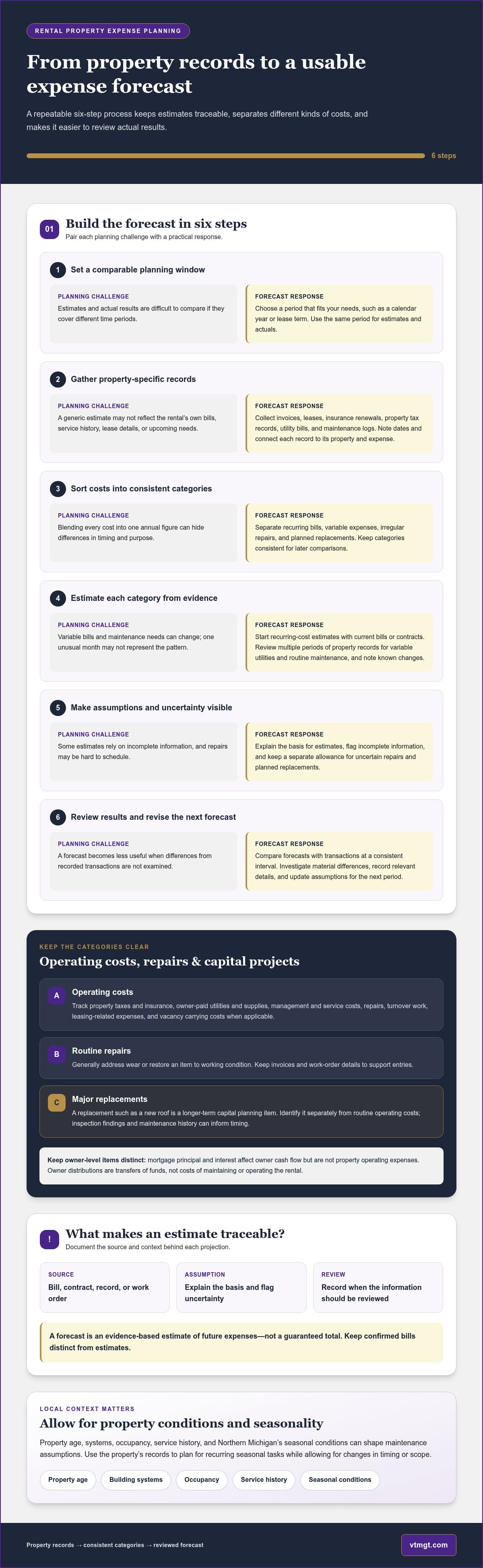
A repeatable process turns property records into a forecast you can review and update. Start with the rental’s own history, using broader assumptions only where records are incomplete. Keep estimates distinct from confirmed bills so anyone reviewing the forecast can tell what is known and what remains an estimate.
- Step 1: Define the forecast period. Choose a period that fits your planning needs, such as a calendar year or a lease term. Use the same period for estimates and actual results so the comparison is meaningful.
- Step 2: Gather source records. Collect invoices, leases, insurance renewals, property tax records, utility bills, and maintenance logs. Include dates and notes that connect each record to the property and expense.
- Step 3: Sort expenses into consistent categories. Separate recurring bills from variable expenses, irregular repairs, and planned replacements. For tax reporting context, consult IRS Publication 527, Residential Rental Property; management categories in a forecast may not match tax classifications.
- Step 4: Estimate each category. Use current contracts or bills for recurring items, noting renewal dates and known changes. For variable utilities and routine maintenance, review multiple periods of the property’s records rather than relying on one unusual month.
- Step 5: Document assumptions and uncertainty. Flag estimates based on incomplete information, explain their basis, and keep a separate allowance for uncertain repairs and planned replacements.
- Step 6: Review and revise. Compare the forecast with recorded transactions at a consistent interval. Investigate material differences, capture relevant details, and update assumptions for the next period.
Every forecast assumption should identify its source and review date. This makes it easier to trace a projection to a bill, work order, inspection finding, or clearly labeled judgment, and to know when to review that information again.
How should landlords estimate recurring and variable expenses?
For recurring costs, use the current bill or contract as a starting point, then record its renewal date and any known adjustment. For variable utilities or routine maintenance, review multiple periods and note factors that may have affected the pattern, such as occupancy changes or an unusual repair. If records are missing, label the estimate as an assumption and identify what information would make it more reliable.
How can you account for unpredictable repairs?
Keep a distinct reserve category rather than treating uncertain repairs as confirmed operating bills. Base planning scenarios on the property’s condition, inspection findings, and documented repair history. A property with an aging system may call for different assumptions from one with recent service records. Reserve targets require property-specific judgment, not one universal percentage.
Organized work orders and vendor records show what was repaired, when it occurred, and whether similar needs recur. Van Treese Management provides maintenance coordination and financial reporting as part of its residential property management. Learn about residential property management.
Which Forecasting Method Fits Your Rental Property?
The right method is one you can maintain with accurate records and a dependable review routine. A spreadsheet offers control, accounting software can organize transactions, and manager-prepared financial reporting can present operating activity consistently. Each approach has trade-offs, and none can predict every repair or change in operating conditions.
Reliable forecasts depend on relevant records and consistent updates. Use this comparison to choose a workflow that fits your property and the time you can devote to maintaining it.
| Method | Setup effort | Category consistency | Record visibility | Update frequency |
|---|---|---|---|---|
| Spreadsheet | Low to moderate; build categories and formulas manually | Depends on consistent data entry | High; owners can inspect the underlying entries | Manual, on the owner’s schedule |
| Accounting software | Moderate; configure accounts and transaction workflows | Can support repeatable categories once configured | Transactions and reports are available in the system | Depends on how often records are entered or imported |
| Manager-prepared financial reporting | Lower direct setup for the owner; depends on an established reporting process | Can provide consistent reporting categories over time | Depends on the reports and supporting records provided | Follows the reporting cycle |
Spreadsheet or accounting software: what changes?
A spreadsheet can suit a simple portfolio because its categories, assumptions, and formulas are easy to tailor. The trade-off is manual upkeep: late entries or inconsistent labels can weaken comparisons. Accounting tools can organize transactions, recurring categories, and reports in one system, but their usefulness still depends on accurate records and review. Neither approach removes uncertainty about future repairs or operating changes.
When does professional reporting add value?
Consistent manager-prepared reporting can consolidate rent, expenses, and maintenance activity, giving owners a clearer basis for comparing forecasts with recorded results. Owners still need to review assumptions and investigate unusual variances, such as a repair that differs from prior patterns. Broader rental housing context is available through the National Apartment Association, while property-level decisions should be grounded in that property’s own records.
Test your chosen method by checking whether it keeps source records visible, separates routine activity from irregular events, and makes updates straightforward. If a report shows a maintenance variance, for example, the work order and invoice should help explain whether it reflects a one-time repair, a recurring need, or an assumption that needs revision.
Owners comparing local management approaches can also explore a Petoskey property management guide for regional context.
Adapting Expense Forecasts for Northern Michigan Properties
Regional context is useful, but it shouldn’t replace property-level evidence. For a rental in Emmet or Charlevoix County, forecasting rental property expenses means considering the building’s age, systems, occupancy, and service history alongside local conditions. Two properties in the same area may have different maintenance needs because their construction, upkeep, and use differ.
Seasonal planning can help owners anticipate categories of work without assuming identical timing or costs from year to year. Winter weather exposure, property access, and upkeep needs may affect which services belong in a plan. Use past work orders and current vendor information to determine whether a regional assumption applies to a specific property.
Which local conditions can change expense assumptions?
Review how the property’s location and physical condition affect operating needs. Exposure to winter weather or access challenges may matter if records show they have affected maintenance or service work. Check leases for utility arrangements and owner-paid services, then review related contracts. Treat broader regional assumptions as provisional until property records and current vendor information support them.
How should owners review property-specific records?
Build the review from evidence: compare prior work orders, inspection notes, invoices, insurance or service renewals, and tenant-reported issues. Look for repeated repairs or needs that align with the building’s age and systems. Maintenance coordination records can connect a reported issue to follow-up work, vendor activity, and the resulting invoice, giving the forecast a clearer operating history.
Separate items with a known scope or scheduled work from risks that remain uncertain. An inspection may document a repair to plan for, while a potential future system failure belongs in a scenario allowance rather than as a confirmed bill. This keeps planned obligations visible without presenting uncertain work as inevitable.
For every adjustment, record why it applies to this property. A note might point to a prior invoice, an inspection observation, or a lease provision affecting a cost assumption. Don’t apply one building’s experience across an entire county without supporting records. Consistent notes also make it easier to compare the next forecast with actual transactions and decide whether an assumption still fits.
How can owners plan for seasonal maintenance?
Use the property’s service history to identify maintenance categories that may follow seasonal patterns, then confirm expected work and timing using current records and vendor information. Keep seasonal tasks separate from unplanned repairs, and revise the plan as conditions change. A Northern Michigan rental maintenance guide and a Michigan landlord laws guide can provide related context, but neither replaces property-specific documentation.
Van Treese Management coordinates maintenance and provides financial reporting to help owners maintain records across work orders, vendor activity, and expenses. Explore residential property management support for organized oversight of rental operations.
Turn Your Forecast Into a Manageable Rental Operating Plan
A forecast becomes useful when you compare it with actual transactions and apply what you learn. Choose a review interval, such as monthly, and use it consistently. Compare each expense category with its projection, then investigate differences before adjusting the plan. A variance is information to assess, not an automatic reason to change an estimate.
How do you turn forecast variances into better decisions?
First, classify the difference. It may reflect a timing change, a one-time event, or a cost pattern that could recur. An invoice received later than expected may shift timing without changing the underlying assumption. An unusual repair may be a one-time event, while repeated work in the same category may indicate a recurring need.
Record the amount and reason for each material variance, and link the note to its supporting invoice, inspection, work order, or management record. Then decide whether the forecast should change. Revise an assumption when evidence supports a different expectation, such as a documented renewal adjustment or a repeated maintenance pattern. Keep the prior assumption visible where practical so you can see how the plan developed and distinguish a lasting change from a temporary fluctuation.
What can structured property management contribute?
Property operations generate information across several activities. Rent collection and tenant communication help maintain records of income and reported issues. Maintenance coordination connects work orders with vendor activity and completed work, while financial reporting and accounting organize transactions for review. Consistent records make it easier to trace an expense, evaluate a variance, and carry verified information into the next planning period.
Owners still play an important role. Review reports for unusual items, identify what changed in the property’s operations, and decide whether the documented evidence supports updating an assumption. For example, read a maintenance entry alongside its work order and invoice. Recurring work may call for different forecast treatment than an isolated repair. This keeps the operating plan connected to the property instead of relying on generalized expectations.
To keep forecasting rental property expenses practical, record the review date, variance explanation, and any approved adjustment. This creates a traceable cycle: estimate, record actual activity, investigate differences, and refine the next forecast. Over time, this discipline can help you identify which assumptions remain useful and which need closer attention.
Van Treese Management supports organized rental oversight through residential property management, including rent collection, tenant communication, maintenance coordination, and financial reporting. Explore residential property management to learn how structured operational support can fit into your property plan.
Make Your Next Forecast More Useful
Make each review cycle produce a clearer decision. Keep a short record of what changed, what evidence supports the adjustment, and what still needs observation. Over time, that record helps you distinguish a lasting shift in property operations from a one-off event and focus on assumptions that need closer review. That is the practical value of forecasting rental property expenses: not certainty, but a more deliberate basis for planning.
For Northern Michigan owners, Van Treese Management brings financial reporting and accounting together with maintenance coordination through a network of vetted local contractors. This organized view of financial and maintenance information can help owners assess property activity and refine future assumptions. The firm serves communities including Petoskey, Boyne City, Indian River, Gaylord, Traverse City, and Grand Rapids.
Explore residential property management with Van Treese Management to see how structured operational support can fit your property plan. Start with a consistent process, then use each review to make the next forecast more informed.
Frequently Asked Questions
How far ahead should I forecast rental property expenses?
Forecast far enough ahead to support your budgeting and property decisions, often through the next operating year. If a lease, insurance policy, or service contract spans a different period, track its dates separately so renewals don’t get lost in the annual view. For longer-term planning, note anticipated replacements as future scenarios, then refine them as inspections and property records provide better information.
What expenses should be included in a rental property forecast?
Include costs required to operate the rental, and make clear which party is responsible for each one. In addition to property bills and upkeep, consider expenses tied to leasing activity, tenant turnover, and periods when the property is unoccupied. Track each rental separately, even if you own several, so a cost specific to one building doesn’t distort another property’s operating picture.
How do I forecast rental expenses when I have little or no history?
Start with what you can document: the lease, current bills, property condition, inspection findings, and service agreements. For a newly acquired rental, review available transaction and maintenance records, then mark estimates without a history as provisional. You can create a cautious planning scenario for uncertain items, but don’t present it as a proven pattern. Replace assumptions with actual invoices and service records as they accumulate.
Should capital improvements be included in rental operating expenses?
Track major improvements in the overall cash plan, but keep them separate from routine operating expenses. This lets you see ordinary property costs without hiding a substantial project inside a repair category. A project may also receive different tax treatment from maintenance, depending on its details. Keep the records and consult a qualified tax professional for classification or reporting questions.
How often should I update my rental property expense forecast?
Use a consistent review schedule, then revise sooner when a meaningful change affects the property. Examples include a new lease arrangement, an insurance renewal, a tax notice, or an inspection that identifies planned work. Record what prompted each revision and retain the earlier assumption for comparison. This makes it easier to tell whether the forecast changed because conditions changed or because an earlier estimate needed correction.
Can a property manager help forecast rental property expenses?
Yes. A property manager can organize operating records and provide financial reporting that owners use to assess expenses against expectations. Van Treese Management’s residential management includes financial reporting and accounting, rent collection, tenant communication, and maintenance coordination. These records give owners a clearer basis for forecasting rental property expenses, while owners review assumptions and make decisions about the property’s financial plan.
How should landlords plan for seasonal rental property expenses in Northern Michigan?
Use the property’s service records to build a calendar of maintenance tasks, then adjust it based on actual conditions, access, and vendor information rather than assuming the same timing for every rental. Confirm which services the lease assigns to the owner. This approach can support planning in Petoskey, Boyne City, Indian River, Gaylord, Traverse City, and Grand Rapids, while keeping each property’s assumptions distinct.