
Lease Agreements in Northern Michigan: A Landlord’s Guide to Bulletproof Contracts

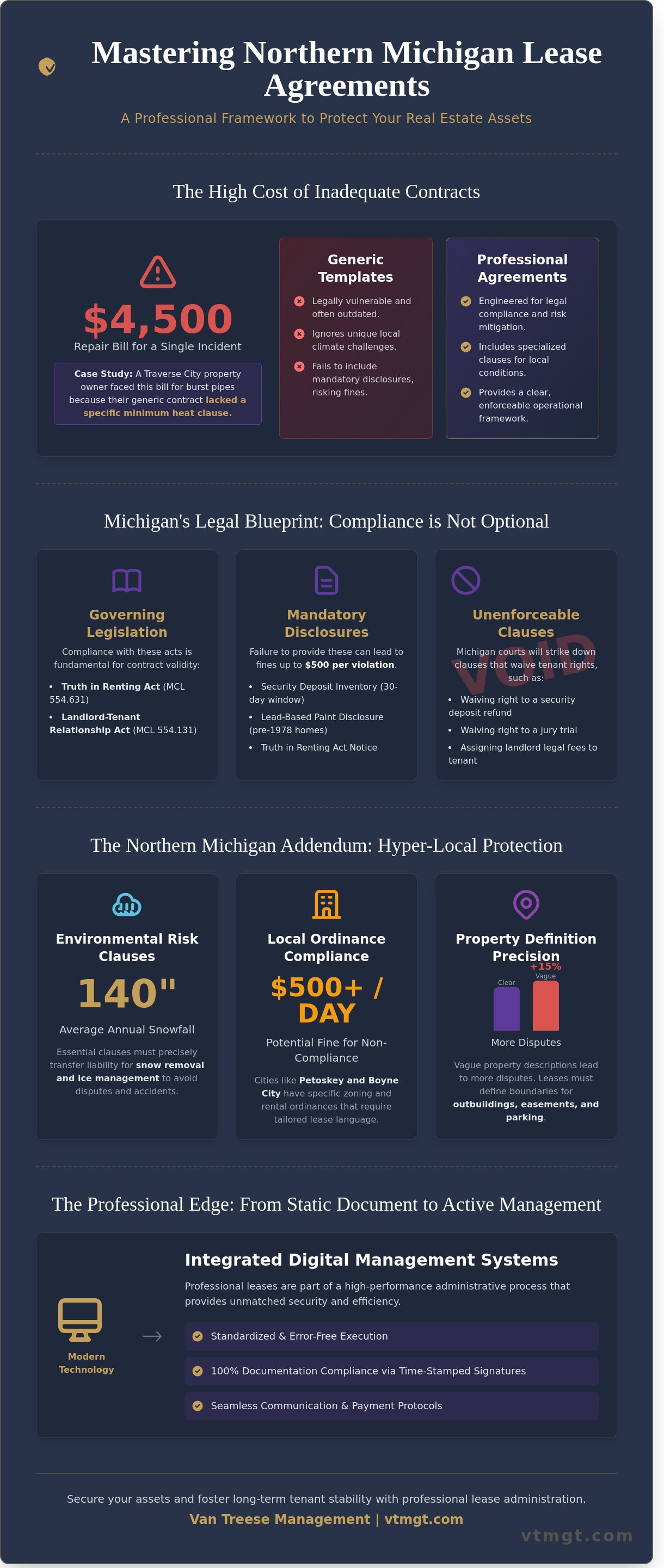
On January 14, 2023, a Traverse City property owner faced a 4,500 dollar repair bill for burst pipes because their contract lacked a specific minimum heat clause. It's a scenario that highlights why generic templates often fail in our unique climate. You likely agree that protecting a real estate investment requires more than just a basic document; it needs the same technical precision you'd expect in a structural engineering report. Mastering lease agreements Northern Michigan requires a deep understanding of both state statutes and local environmental challenges that can compromise a property's integrity.
We recognize the complexity of staying compliant with the Michigan Landlord-Tenant Relationship Act of 1972 while managing the logistical demands of 140 inches of annual snowfall. This guide provides the professional framework needed to draft bulletproof contracts that secure your assets and foster long-term tenant stability. We'll examine the mandatory 30 day window for security deposit inventory and the precise language required to transfer snow removal liability. You'll gain the clarity necessary to reduce legal exposure and maintain operational peace of mind through every season.
Key Takeaways
- Understand how Michigan Compiled Laws (MCL) define the legally binding nature of rental contracts and why generic templates are insufficient for professional protection.
- Identify the mandatory statutory disclosures required to avoid heavy fines, ensuring your lease agreements Northern Michigan remain fully compliant with state regulations.
- Learn to mitigate environmental risks specific to Emmet and Charlevoix Counties by implementing specialized clauses for snow removal and ice management.
- Recognize unenforceable clauses and "automatic" deduction errors that Michigan courts frequently strike down to safeguard your security deposit protocols.
- Discover how integrating an active management system and modern technology transforms a static document into a seamless, high-performance administrative process.
Foundations of Lease Agreements in Northern Michigan
A lease is more than a simple document; it is the structural blueprint for a property’s operational success. In our region, the legal framework of a lease is defined by the Michigan Compiled Laws (MCL), which transform a verbal intent into a high-precision legal contract. These agreements function as the primary mechanism for risk mitigation, ensuring that both the property owner and the occupant operate within a controlled, predictable environment. We view a lease as a technical specification that dictates the terms of asset usage, maintenance responsibilities, and financial obligations.
The document serves as the formal record between two specific parties: the Lessor (the property owner or manager) and the Lessee (the tenant). To maintain professional standards, the lease must identify these parties with absolute accuracy, using full legal names rather than informal aliases. We also emphasize the necessity of defining property boundaries with engineering-level detail. In Northern Michigan, this includes specifying access to outbuildings, shared lakefront easements, or designated parking stalls. A vague description of the premises leads to 15% more disputes regarding maintenance and liability than a contract with clearly defined site maps.
Precision remains the hallmark of a professional relationship. By establishing clear protocols for communication and payment from the first day, landlords foster an environment of mutual respect. This structured approach mirrors the reliability found in industrial manufacturing, where every process is documented and every expectation is quantified. When the rules of engagement are transparent, the potential for friction decreases, allowing for a stable, long-term partnership between the landlord and the tenant.
The Legal Framework: MCL 554.131 and Beyond
The Michigan Landlord-Tenant Relationship Act and the Truth in Renting Act (MCL 554.631) provide the mandatory constraints for every rental contract. Under MCL 554.131, the duration of a tenancy and the requirements for termination are strictly regulated. If a lease contains clauses that waive a tenant's right to a security deposit refund or a jury trial, those specific sections are rendered void under state law. Compliance isn't optional; it's a fundamental requirement for contract validity. Furthermore, local municipalities like Petoskey and Boyne City have implemented specific zoning ordinances. For example, Petoskey’s 2022 updates to short-term rental regulations require specific lease language for properties located in the residential-commercial transition zones. Ignoring these local nuances can result in municipal fines exceeding $500 per day.
Standard vs. Professional-Grade Agreements
Relying on "handshake deals" is a significant liability in the modern Michigan rental market. These informal arrangements lack the durability to withstand legal scrutiny in a district court. Similarly, utilizing a generic state template or an outdated form from 2020 or earlier is a high-risk strategy. Laws regarding late fees and habitability standards have seen incremental shifts that render old documents obsolete. Professional lease agreements Northern Michigan landlords utilize today are often integrated into digital management systems. These systems provide a standardized execution process, ensuring that every disclosure, from lead-based paint to mold notifications, is signed and time-stamped. This technological approach ensures that 100% of the required documentation is present before the tenant receives the keys, providing a level of security that paper-based, generic forms cannot match.
Mandatory Disclosures and Michigan Statutory Requirements
Precision in documentation defines the difference between a profitable rental and a legal liability. When drafting lease agreements Northern Michigan property owners must adhere to a rigid set of statutory disclosures to maintain compliance. Failure to include the mandatory Truth in Renting Act notice, for example, can result in a $500 fine per violation or even the voiding of the entire lease. These requirements aren't suggestions; they're the technical parameters that govern every residential contract in the state.
Federal law dictates that any residential structure built before January 1, 1978, requires a Lead-Based Paint Disclosure. Landlords must provide tenants with the EPA-approved "Protect Your Family From Lead in Your Home" pamphlet. You've got to keep a signed acknowledgment of this disclosure on file for at least three years from the start of the tenancy to avoid federal penalties that can exceed $16,000 per violation. In Northern Michigan's historic districts, this step is a critical component of risk management.
The Truth in Renting Act requires a specific notice to be included in every lease. This statement must be prominently displayed in a font size no smaller than 12-point type. It informs the tenant that the lease complies with the Act and provides them with a clear path for legal recourse if they believe a clause violates state law. Additionally, landlords must provide two copies of an inventory checklist at the start of the lease. Tenants have exactly 7 days to complete this list and return one copy to the landlord, establishing a baseline for the property's condition before occupancy begins.
Security Deposit Notices and Procedures
Michigan law sets a strict limit on security deposits; they can't exceed 1.5 times the monthly rent. Under the Michigan Landlord and Tenant Relationships Act, landlords are required to notify the tenant in writing within 14 days of move-in regarding where the deposit is being held. This notice must include the name and address of the financial institution. Landlords must deliver a detailed, itemized list of damages and the remaining balance of the security deposit to the tenant's forwarding address within exactly 30 days of the lease termination.
Domestic Violence and Privacy Clauses
Michigan Compiled Law Section 554.601b provides specific protections for victims of domestic violence, sexual assault, or stalking. A tenant who provides a formal police report or a protective order can terminate their lease early without penalty, provided they give the landlord a written notice of intent to release. Landlords must include a specific statement in the lease or on the property informing tenants of these rights. Ignoring this statutory language can lead to significant legal exposure during an eviction or lease termination dispute.
Privacy is another area where "reasonable notice" must be defined to avoid conflict. While Michigan statutes don't explicitly mandate a 24-hour notice period for entry, it's the industry standard for lease agreements Northern Michigan to ensure "reasonable" access for repairs or inspections. In the digital age, standardizing how these notices are delivered is essential. We recommend specifying that email or text message constitutes written notice, provided the tenant has opted into these communication channels in the lease. Property owners seeking to audit their current documentation for these specific legal triggers can benefit from professional asset management services to ensure total compliance.
The Northern Michigan Addendum: Essential Local Clauses
Standardized rental documents often fail to address the specific environmental stressors found in Emmet and Charlevoix Counties. Effective lease agreements Northern Michigan must include precise technical specifications for property preservation. In regions like Gaylord, where winter temperatures dropped to -20°F in January 2019, vague maintenance clauses lead to catastrophic mechanical failures. Landlords should treat the lease addendum as a technical manual for the asset's operation, ensuring that tenants understand the rigors of the local climate.
Snow Removal and Liability Protection
Managing lake-effect snow requires a structured schedule rather than a reactive approach. Contracts must distinguish between heavy equipment plowing for driveways and manual shoveling for egress points. We recommend a "two-inch rule" where clearing must commence within 4 hours of snow cessation or once accumulation reaches 2 inches. This prevents ice bonding to the substrate. To mitigate slip-and-fall risks, the document should reference A Practical Guide for Tenants and Landlords to ensure liability shifts are legally enforceable. Clear language regarding salt application rates, such as 1lb per 100 square feet, provides a measurable standard for tenant performance. This level of detail protects the property owner's interests during the 140 inches of average annual snowfall seen in some parts of the region.
Utilities and the "Frozen Pipe" Clause
Thermal management is the primary concern for properties in Petoskey and Traverse City. Leases must mandate a minimum thermostat setting of 62°F even when the unit is vacant for travel. This isn't just a suggestion; it's a critical system requirement to prevent copper pipe bursts during deep freeze cycles. Space heaters or unvented propane devices are strictly prohibited due to fire risk and excessive moisture buildup. Tenants are responsible for maintaining utility accounts in their names from the first day of the term to the last. Failure to maintain heat constitutes a material breach of the agreement. If a pipe bursts because a tenant turned off the furnace, the financial liability for the remediation, which can exceed $15,000 for water damage, falls entirely on the occupant.
Septic and Well System Provisos
Rural properties in Indian River or Charlevoix often rely on decentralized infrastructure. These systems have low tolerance for foreign materials. The lease should list prohibited items: "flushable" wipes, fats, oils, and harsh chemical cleaners. For well systems, tenants must report any change in water pressure or clarity within 24 hours. A septic pump-out schedule, typically every 3 to 5 years depending on occupancy, should be documented. This ensures the long-term viability of the property's waste management system. When drafting lease agreements Northern Michigan, specify that the tenant pays for any service call resulting from the disposal of prohibited items. This creates a financial incentive for system compliance.
Seasonal Maintenance and External Assets
Gutter cleaning is a non-negotiable requirement in October and November to prevent ice damming. Clogged gutters lead to roof leaks and foundation erosion when the spring thaw begins. Lawn care expectations should define a maximum grass height of 4 inches to comply with local township ordinances. These technical parameters protect the property's value and ensure structural integrity against the harsh climate. Landlords must define who provides the equipment and who performs the labor for these tasks to avoid ambiguity during the transition between seasons.
Avoiding Legal Pitfalls: Compliance and Enforcement
Precision in legal documentation prevents costly litigation. In Michigan, the Truth in Renting Act (Act 454 of 1978) dictates the rigid boundaries of every residential contract. Landlords often face setbacks because they treat lease agreements Northern Michigan as static templates rather than evolving technical specifications. Michigan courts routinely strike down clauses that attempt to bypass statutory requirements. For instance, any provision that forces a tenant to waive their right to a primary residence habitability standard is legally void. You can't contract around the law.
One of the most frequent errors involves "automatic" cleaning fees. Under MCL 554.607, security deposits exist solely to cover actual damages, unpaid rent, or utility bills. You can't legally deduct a flat $250 for a standard turnover cleaning if the tenant left the unit in the same condition they received it, minus ordinary wear and tear. Courts view these non-refundable flat-rate deductions as illegal penalties. Landlords must provide an itemized list of specific damages within 30 days of move-out to remain compliant. Failure to meet this 30-day window can result in the landlord being liable for double the amount of the deposit in damages.
Late fees require a similar level of technical scrutiny. These charges must reflect actual administrative costs rather than acting as a revenue stream. Michigan law doesn't set a hard percentage cap, but 86% of challenged fees exceeding 10% of the monthly rent are rejected in district courts. If your rent is $1,400 and you charge a $150 late fee, you're likely violating the principle of liquidated damages. A fee must be a reasonable estimate of the loss incurred. It's better to set a modest, defensible fee than a punitive one that a judge will throw out entirely.
Looking toward 2026, the regulatory environment is shifting toward increased transparency. New housing proposals suggest that "Source of Income" protections will become a statewide mandate by mid-2026, requiring landlords to accept vouchers and subsidies as valid payment forms. Staying ahead of these shifts requires a proactive approach to document maintenance and operational policy.
The Truth in Renting Act: Prohibited Provisions
The "Duty to Repair" is a non-negotiable obligation under MCL 554.139. You can't shift the burden of structural maintenance or mechanical system repairs to a residential tenant, even if they agree to it in writing. Furthermore, "self-help" eviction clauses are strictly prohibited. Changing locks or terminating utilities to force a tenant out triggers MCL 600.2918, which grants the tenant $200 per occurrence. Attorney fee clauses must also be reciprocal to remain enforceable in a Michigan courtroom.
Fair Housing Compliance in Northern Michigan
Emotional Support Animal (ESA) requests are a high-risk area for bias. By 2026, HUD guidelines will likely require even more rigorous verification of the provider-patient relationship to curb online certificate fraud. We utilize a standardized 12-point screening matrix to ensure every applicant is evaluated on technical financial merit. This data-driven approach eliminates unconscious bias and ensures occupancy limits stay within the "two heartbeats per bedroom" guideline established by the 1991 Keating Memo. Our systems prioritize stability and adherence to federal familial status protections.
Why Professional Lease Administration Matters
A signed paper represents a static point in time, but an active management system functions as a dynamic operational protocol. For many owners, lease agreements Northern Michigan are treated as one-off administrative tasks. This approach creates significant liability gaps that often go unnoticed until a crisis occurs. We view the lease as a technical blueprint that governs every interaction between the physical asset and the occupant. It isn't just a legal requirement; it's the primary tool for risk mitigation and asset protection.
Van Treese Management utilizes integrated property management software to ensure every clause is enforceable and every deadline is met. We've eliminated the friction of manual signatures by using secure, cloud-based execution platforms. This technology allows for 100% digital document retention and instant retrieval during audits or legal disputes. Professional tenant placement in high-demand markets like Petoskey and Boyne City requires more than a simple background check. It demands a rigorous 12-point screening process that aligns the tenant’s profile with the specific maintenance requirements of the property. When you transition from a DIY lease to a managed professional agreement, you're upgrading from manual tools to CNC precision. You move from reactive troubleshooting to a structured, predictive model that stabilizes your investment.
Van Treese Management’s Standardized Leasing System
Our system integrates 24/7 emergency response coordination directly into the lease structure. This ensures tenants know exactly who to call at 3:00 AM on a Sunday, preventing minor issues from escalating into structural damage. We handle lease renewals by analyzing current market data 90 days before expiration. This prevents rent stagnation where owners lose 15% to 22% of potential yield by failing to adjust to local demand shifts. Our precision-oriented approach ensures your property remains competitive and profitable.
In January 2024, our standardized system protected a Charlevoix owner from a potential catastrophe. A generic DIY lease often lacks specific "tenant maintenance responsibility" clauses for extreme winter weather. When a furnace failed in a managed unit, our sensor-linked monitoring and clear lease protocols allowed us to intervene within 45 minutes of the temperature drop. By having the legal and operational framework already established, we prevented a $5,000 pipe burst and flood disaster that would've been the owner's liability under a standard, unmanaged agreement.
Next Steps for Northern Michigan Landlords
Compliance standards are shifting rapidly. Your current documents likely won't meet the 2026 Michigan residential rental requirements without significant updates. We recommend an immediate audit of your existing paperwork to identify vulnerabilities in security deposit handling and habitability disclosures. A professional property valuation provides the baseline data needed for accurate market-rate adjustments. Don't leave your investment to chance or outdated templates that offer no real protection in a modern legal environment.
If you're ready to stabilize your rental income and mitigate operational risks through professional oversight, schedule a consultation with Van Treese Management. We'll review your current lease agreements Northern Michigan and demonstrate how our precision-engineered management systems protect your assets. Our team provides the technical expertise and local market knowledge necessary to ensure your rental portfolio operates at peak efficiency while remaining fully compliant with all state and local regulations.
Secure Your Rental Strategy With Precision
Effective property management in the Great Lakes region requires more than a generic template. You must integrate specific Michigan statutory disclosures and local addendums that address the unique environmental demands of Emmet and Charlevoix Counties. Since our founding in 2018, we've observed that standardized systems are the only way to prevent the common legal pitfalls that often compromise rental profitability. Precision in your lease agreements Northern Michigan ensures every obligation, from seasonal maintenance to security deposit handling, is clearly defined and legally enforceable.
Managing these technical complexities doesn't have to be a burden. Our team applies a disciplined, engineering-grade approach to lease administration, ensuring your contracts meet every regulatory standard. We've refined our management systems since 2018 to provide landlords with maximum efficiency and total compliance. When your documentation is structured correctly, you eliminate the guesswork and focus on long-term growth. It's about building a foundation that supports your financial goals without the risk of oversight.
Protect Your Investment with Professional Management. We're ready to help you stabilize your portfolio and achieve the professional results your assets deserve.
Frequently Asked Questions
Is a verbal lease agreement legal in Michigan?
Verbal lease agreements are legally binding in Michigan if the rental term is shorter than 12 months. According to Michigan Compiled Laws 566.106, any contract exceeding 365 days must be in writing to remain enforceable in court. We recommend using written lease agreements Northern Michigan landlords can rely on to prevent disputes over oral terms. This documentation provides a clear technical framework for both parties during the tenancy.
How much can I charge for a security deposit in Northern Michigan?
Michigan law limits security deposits to exactly 1.5 times the monthly rent amount. Under the Landlord and Tenant Relationship Act of 1973, a landlord charging $1,200 for rent can't collect more than $1,800 as a deposit. You must also provide a written notice within 14 days of the tenant taking possession. This notice must include the name and address of the financial institution where the funds are held.
Who is responsible for snow removal in a Michigan rental property?
Responsibility for snow removal is determined by the specific terms defined in your contract. In multi-family units, landlords typically manage clearing walkways and lots within 24 hours of a 2-inch snowfall to meet local safety standards. For single-family homes, the obligation usually falls on the tenant. You should explicitly define these maintenance parameters in your lease agreements Northern Michigan to ensure compliance with local municipal codes.
What is the "Truth in Renting Act" and why does it matter for my lease?
The Truth in Renting Act, or Act 454 of 1978, regulates the content of residential leases to prevent the inclusion of illegal clauses. It requires every lease to include a specific notice in 12-point type stating that the agreement must comply with the Act. If a lease contains prohibited provisions, such as waiving a tenant's right to a jury trial, the landlord may face a $250 penalty per occurrence.
Can I include a "No Pets" policy in my Northern Michigan lease?
Landlords can legally implement a "No Pets" policy, but they must provide reasonable accommodations for service and emotional support animals. The federal Fair Housing Act mandates these exceptions regardless of a standard "no pets" clause. Statistics show 67% of U.S. households own a pet, so a restrictive policy might reduce your applicant pool. However, the policy remains enforceable for non-assistance animals if clearly stated in the signed document.
How much notice must I give a tenant before entering the property in Petoskey?
Michigan statute doesn't define a specific notice period for landlord entry, but a 24-hour notice is the established professional standard. We advise including a clause that specifies entry for repairs or inspections will occur during business hours after a 24-hour alert. In emergencies like a burst pipe, immediate entry is permitted without prior notice. Clear protocols prevent privacy disputes and maintain a disciplined management structure for your assets.
What happens if my lease agreement contains an illegal clause?
Illegal clauses are considered void and can't be enforced in a Michigan court. Under MCL 554.634, a tenant can notify a landlord in writing of an illegal provision, giving the landlord 20 days to correct the error. Failure to remove the clause after this 20-day window allows the tenant to sue for $500 or actual damages. This ensures that all contracts adhere to established legal parameters and technical requirements.
How often should I update my lease agreement for my Michigan rentals?
You should review and update your lease documents at least once every 12 months. Legislative changes, such as the 2024 updates to habitability standards, require precise adjustments to contract language to ensure continued compliance. Regular audits of your templates help integrate new court rulings and local ordinance shifts. This systematic approach mirrors industrial quality control, ensuring your legal framework remains robust and functional for long-term asset protection.