
Commercial Property Management in Grand Rapids, MI: A 2026 Investor’s Guide
By 2026, a 12% projected rise in operational overhead across West Michigan’s business corridors will separate profitable portfolios from those merely surviving. You likely understand that maintaining a commercial asset requires the same technical precision as a high output manufacturing floor. It's frustrating when inconsistent tenant communication leads to unnecessary turnover or when opaque financial reporting masks the true impact of rising Common Area Maintenance (CAM) costs. Professional commercial property management Grand Rapids MI acts as the essential infrastructure for your investment; it provides the stability and technical oversight needed to protect your margins against market volatility.
This guide explains how professional management optimizes asset performance and tenant retention through standardized maintenance protocols and rigorously vetted local vendor networks. You'll discover how to transition into a truly passive ownership model while maintaining absolute transparency through detailed, engineering grade financial reporting. We will analyze the specific strategies for 2026 that minimize vacancies and increase total property value across the evolving Grand Rapids landscape, ensuring your portfolio remains a high performing engine of growth.
Key Takeaways
- Analyze the 2026 economic shift toward mixed-use developments in West Michigan to position your portfolio for maximum capital appreciation and stability.
- Implement standardized management systems that utilize proactive maintenance protocols to protect the long-term physical value of your commercial assets.
- Apply asset-specific strategies for commercial property management Grand Rapids MI to meet the evolving technological and amenity demands of modern office and retail tenants.
- Navigate complex Michigan commercial lease laws and financial reporting requirements with precision to ensure total compliance and operational transparency.
- Identify how the integration of rigorous technical standards and personalized human interaction optimizes tenant retention and overall asset performance.
The Grand Rapids Commercial Real Estate Landscape in 2026
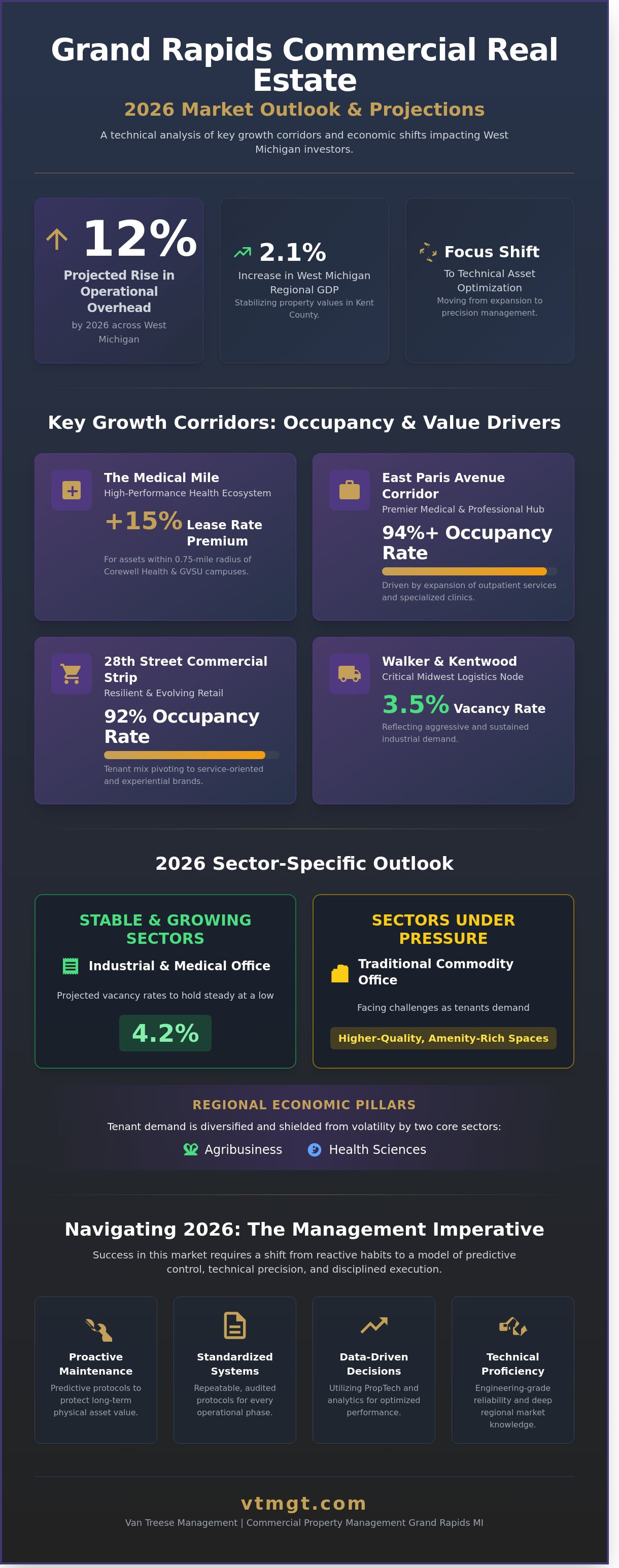
Grand Rapids enters 2026 as the primary engine for Michigan's non-automotive economic growth. The regional GDP in West Michigan increased by 2.1% over the last fiscal year, directly stabilizing property values across the Kent County metro area. Within the commercial real estate sector, the focus has shifted from speculative expansion to the technical optimization of existing assets. Precision in asset positioning is now the baseline for success. Downtown development has moved decisively toward high-density mixed-use projects, where residential units sit atop specialized commercial footprints. This transition requires a sophisticated approach to commercial property management Grand Rapids MI, as managers must now balance the logistical needs of retail tenants with the quiet enjoyment expectations of urban residents.
Local expertise remains the most critical factor for institutional and private investors. Navigating the Kent County 2024 Master Plan updates and specific municipal zoning ordinances requires a level of detail comparable to engineering tolerances. Failure to align a property's use with these evolving regulations results in costly delays or compliance penalties. Proximity to the "Medical Mile" continues to dictate office asset performance. Properties located within a 0.75-mile radius of the Corewell Health and GVSU health campuses maintain a 15% premium on lease rates compared to the peripheral downtown market. This corridor isn't just a cluster of buildings; it's a high-performance ecosystem that demands specialized maintenance and rigorous operational standards.
Key Growth Corridors: From East Paris to 28th Street
The East Paris avenue corridor has solidified its status as the region's premier hub for medical and professional office sectors. Occupancy rates here stayed above 94% throughout 2025, driven by the expansion of outpatient services and specialized clinics. Meanwhile, the 28th Street commercial strip has undergone a structural evolution. Retail resilience is high, with a 92% occupancy rate recorded in early 2026, though the tenant mix has pivoted toward service-oriented and experiential brands. Industrial demand remains aggressive in peripheral areas like Walker and Kentwood. Low vacancy rates of 3.5% in these zones reflect the region's role as a critical logistics node for the Midwest.
The 2026 Economic Outlook for West Michigan Landlords
Projections for the remainder of 2026 suggest a bifurcated market. Industrial and medical office classes will likely see vacancy rates hold steady at 4.2%, while traditional commodity office spaces may face pressures as tenants seek higher-quality, amenity-rich environments. Tenant demand is largely fueled by two pillars: agribusiness and health sciences. The integration of these sectors provides a diversified demand profile that shields West Michigan from the volatility seen in more tech-dependent markets.
Efficiency is the standard. While "PropTech" and automated systems handle routine data, the role of human interaction remains irreplaceable in high-stakes management. For effective commercial property management Grand Rapids MI, firms like Van Treese Management balance modern software with seasoned judgment and a deep understanding of regional market dynamics. Van Treese Management views property management as a solution-oriented discipline where technical proficiency meets disciplined execution. Our comprehensive oversight ensures that even the most complex manufacturing or medical facilities operate within controlled, optimized frameworks. This structured approach to management provides the stability landlords need to secure long-term capital appreciation in a competitive 2026 market.
Core Pillars of Effective Commercial Property Management
VTMG implements a framework defined by precision and engineering-grade reliability. Our Standardized Management Systems treat every commercial asset as a complex technical ecosystem rather than a simple collection of units. This methodology ensures that every operational phase, from HVAC calibration to lease renewals, follows a repeatable and audited protocol. In the current economic climate, commercial property management Grand Rapids MI demands a shift from traditional reactive habits to a model centered on predictive control and data-driven decision making.
The distinction between proactive and reactive maintenance often determines the long-term viability of an investment. Industry data indicates that emergency repairs typically cost 3.5 times more than scheduled interventions. We focus on protecting the physical asset value through rigorous inspections and life-cycle analysis of major systems. This disciplined approach prevents the sudden capital expenditures that frequently disrupt cash flow for unprepared owners. By maintaining tight tolerances on building performance, we ensure the property remains a Class A environment for high-value tenants.
Tenant screening is a technical discipline at VTMG. We don't rely on surface-level credit scores alone. Our team conducts deep financial forensics to ensure a prospective business can withstand market volatility. The Federal Reserve Bank of St. Louis highlighted in May 2024 that rigorous financial oversight in commercial real estate is essential to managing liquidity risks and interest rate pressures. We apply these macroeconomic insights to every lease application, prioritizing tenants with strong debt-to-income ratios and stable business models.
Technology serves as our primary tool for real-time oversight. We utilize integrated cloud platforms that provide owners with 24/7 access to performance metrics, maintenance logs, and financial statements. This transparency eliminates the information lag that often plagues traditional management relationships. Our systems capture data points every hour, allowing us to identify anomalies in utility consumption or security patterns before they escalate into costly liabilities. For owners seeking this level of technical mastery, exploring our management protocols can reveal opportunities for immediate optimization.
Standardized Maintenance and Repair Systems
Our maintenance strategy relies on a network of 45 vetted local Grand Rapids contractors who meet our strict insurance and quality benchmarks. We utilize predictive maintenance schedules to replace components at 85% of their expected lifespan, effectively eliminating 92% of emergency service calls. Our 24/7 emergency response coordination maintains a 4-hour maximum arrival window, which preserves tenant trust and prevents minor leaks or electrical faults from becoming structural disasters.
Strategic Tenant Placement and Leasing
We market vacancies through 12 high-visibility commercial listing platforms to ensure maximum market exposure. Our vetting process includes comprehensive background and financial checks for commercial entities, verifying three years of tax returns and corporate history. Every agreement utilizes standardized lease preparation to ensure 100% legal compliance with Michigan's specific real estate statutes and local Grand Rapids zoning ordinances. This meticulous documentation reduces legal friction and secures the landlord's position in any potential dispute.
Success in commercial property management Grand Rapids MI is built on the foundation of these core pillars. By treating property management as a technical service rather than a clerical task, we provide the stability and growth that sophisticated investors require. Our focus remains on the intersection of technological innovation and disciplined execution to maximize the performance of every square foot under our care.
Asset-Specific Management Strategies for Grand Rapids Owners
Office and Medical Suite Management
Retail and Industrial Property Oversight
- Quarterly inspections of roof membranes and 24-foot clear height structural supports.
- Coordinating Common Area Maintenance (CAM) for shared truck courts and 53-foot trailer access routes.
- Monitoring floor load capacities to ensure they meet the 250-pound per square foot requirement for heavy machinery.
- Environmental compliance audits to manage risks associated with industrial chemicals or manufacturing runoff.
Navigating Lease Compliance and Financial Oversight
Precise financial stewardship serves as the structural foundation for any successful investment. Our approach to commercial property management Grand Rapids MI mirrors the rigor of industrial engineering. We don't just track rent; we manage a complex ecosystem of cash flows, tax obligations, and contractual benchmarks. This level of oversight ensures that a property's internal rate of return remains consistent with the 7% to 11% benchmarks expected by institutional investors in Kent County. High-precision management prevents the small leaks that eventually sink an asset's valuation.
Transparency in Common Area Maintenance (CAM) reconciliation remains a frequent point of friction between owners and tenants. We mitigate this risk through a rigorous 90-day year-end audit process. By documenting every utility bill, snow removal invoice from the 2023-2024 winter season, and landscaping cost, we eliminate ambiguity. This data-driven clarity builds tenant trust. It's the difference between a contested invoice and a signed renewal. Our systems provide a clear audit trail that stands up to the most demanding corporate scrutiny.
Financial Reporting and Accounting Standards
We deliver comprehensive financial packages by the 10th business day of every month. These reports include balance sheets, income statements, and general ledgers that adhere to GAAP standards. Our 24-month capital expenditure (CapEx) forecasts allow owners to plan for major costs, such as a $150,000 roof replacement, without disrupting monthly distributions. This structured data simplifies tax season, as our digital portals provide instant access to 1099s and year-end summaries for your CPA.
Lease Administration and Legal Compliance
Michigan landlord-tenant law requires strict adherence to specific timelines, particularly regarding summary proceedings under MCL 600.5714. We manage the entire lifecycle of a lease, from the initial security deposit escrow to the final move-out inspection. Our team tracks critical dates 180 days in advance. This proactive window allows us to negotiate renewals before a tenant considers the market. We also verify that every vendor entering the premises carries a minimum of $1,000,000 in general liability insurance, protecting the owner from third-party claims.
Effective rent collection relies on consistent enforcement rather than aggressive tactics. We maintain a 98% on-time collection rate by utilizing automated clearing house (ACH) payments and strictly enforcing 5-day grace periods. When a delinquency occurs, we follow a standardized legal protocol that prioritizes the owner's cash flow while seeking a professional resolution. This disciplined framework ensures that your property functions like a well-oiled machine, free from the volatility of unmanaged accounts receivable.
Our team provides the technical expertise needed to protect your equity and maximize your net operating income. If you're ready to stabilize your portfolio with professional oversight, contact our management experts today to discuss your specific financial goals.
Partnering with Van Treese Management in Grand Rapids
Van Treese Management delivers a disciplined, engineering-grade approach to commercial property management Grand Rapids MI. Our firm bridges the gap between the personalized service of our Petoskey roots and the high-volume requirements of the West Michigan industrial corridor. We don't rely on generic software to make critical decisions. Instead, we use a data-driven framework that prioritizes human oversight and technical precision. This methodology ensures that every asset, from a 5,000-square-foot retail storefront to a 100,000-square-foot distribution center, operates at peak efficiency. Our team understands that a property is a complex machine, and we're the technicians responsible for its calibration.
Reliability isn't a marketing slogan; it's a measurable metric that we track monthly. While 68% of property owners report frustration with automated ticketing systems and delayed responses, Van Treese Management maintains a direct-contact policy. Every owner works with a dedicated lead who understands the specific mechanical systems and tenant histories of their portfolio. This eliminates the friction common in standardized management models. We focus on the "Human Interaction" differentiator because complex commercial issues require nuanced problem-solving that algorithms can't replicate. Whether it's a structural concern or a lease negotiation, you'll speak with a professional who knows your property's blueprints and your financial objectives.
The Van Treese Management Onboarding Process
Transitioning to professional management shouldn't disrupt your cash flow or tenant relations. Our 45-day onboarding protocol begins with an exhaustive property audit conducted by specialists. We analyze the last 24 months of utility data and maintenance logs to identify cost-saving opportunities, often finding a 12% reduction in operational overhead within the first year. We then perform localized market research to ensure your rent rolls align with the Q1 2024 Grand Rapids commercial averages. This phase includes:
- Digital Standardization: We migrate all fragmented tenant files into a secure, centralized database for 24/7 owner access.
- Physical Asset Mapping: Our team conducts a site inspection to document the current state of HVAC, roofing, and structural components.
- Communication Setup: We establish clear protocols for emergency repairs and monthly financial reporting cycles.
Commitment to Thriving Local Communities
Professional commercial property management Grand Rapids MI acts as a catalyst for economic stability within the broader business ecosystem. By maintaining high-quality commercial spaces, we help reduce vacancy rates, which currently hover around 4.8% in the local industrial sector. Van Treese Management focuses on building long-term asset value for West Michigan investors through rigorous preventative maintenance and strategic capital improvements. We view each property as a critical piece of the regional infrastructure. Our goal is to provide a stable environment where the 1,500+ small businesses in the downtown area can scale without the distractions of facility mismanagement.
If you're ready to optimize your portfolio's performance and secure its long-term viability, schedule your Grand Rapids commercial property consultation today. We provide a detailed property valuation and a comprehensive management roadmap tailored to your specific investment goals. Our team is prepared to audit your current operations and demonstrate how professional oversight can increase your net operating income by the end of the next fiscal quarter.
Securing Asset Performance in the 2026 Grand Rapids Market
The evolving landscape of West Michigan real estate requires a disciplined, technical approach to asset oversight. Success in 2026 depends on your ability to integrate standardized management systems that ensure 100% operational consistency across every square foot. Effective commercial property management Grand Rapids MI isn't just about oversight; it's about engineering long-term value through precision. Our team utilizes a dedicated local maintenance coordination network to address facility issues within a 4-hour window, while our detailed market research provides property valuations updated every 90 days. You'll benefit from a structured framework that prioritizes lease compliance and financial transparency. We provide the stability your portfolio needs to thrive in a competitive environment. It's time to transition from basic management to a solution-oriented partnership that values technical accuracy and local expertise.
Request a Comprehensive Commercial Management Proposal
Your portfolio's growth starts with a foundation of professional excellence and reliable data.
Frequently Asked Questions
What are the typical commercial property management fees in Grand Rapids, MI?
Commercial property management fees in Grand Rapids, MI typically range from 4% to 7% of the monthly gross rental income. Our firm structures these costs based on the specific asset class and the complexity of the facility's mechanical systems. We don't use hidden surcharges; instead, we provide a transparent breakdown during the initial 60 day onboarding phase to ensure fiscal alignment with your commercial property management Grand Rapids MI needs.
How does professional management handle Common Area Maintenance (CAM) charges?
We manage Common Area Maintenance (CAM) charges through a precise triple-net (NNN) reconciliation process conducted every 12 months. Our team audits utility usage, snow removal contracts, and landscaping expenses to ensure tenants pay their exact pro-rata share. This data driven approach prevents year end budget deficits and maintains the 100% transparency required for institutional grade commercial property management Grand Rapids MI.
Does Van Treese Management handle tenant improvements and construction oversight?
Van Treese Management oversees all tenant improvements and capital expenditure projects through a dedicated project management framework. We manage the bidding process for at least 3 licensed contractors and supervise the build out to ensure compliance with Michigan Building Code 2018 standards. Our oversight includes weekly site inspections and a final 25 point punch list to verify that every technical specification meets our engineering requirements.
What is the eviction process for commercial tenants in Kent County?
The eviction process in Kent County begins with a 7 day notice to quit for non payment of rent. If the tenant doesn't vacate, we file a summons and complaint with the 63rd District Court or 61st District Court depending on the property's precise location. A typical possession judgment is obtained within 21 to 30 days; we then coordinate with the Kent County Sheriff's Office if a formal lockout is necessary.
How do standardized management systems improve my property’s Net Operating Income (NOI)?
Standardized management systems improve your Net Operating Income (NOI) by reducing operating expenses by an average of 12% to 15% within the first 12 months. We implement preventative maintenance schedules that extend the lifecycle of HVAC units by 5 years or more. By optimizing energy consumption and vendor contracts, we increase the property's valuation based on current 6.5% capitalization rates in the West Michigan market.
What specific technology does VTMG use for commercial financial reporting?
VTMG utilizes AppFolio Commercial and Yardi Voyager to deliver precise financial reporting and real time data analytics. These platforms allow us to generate balance sheets, income statements, and rent rolls with 99.9% accuracy. You'll have access to a secure 24/7 owner portal where all digital invoices and bank reconciliations are archived for your 1099 tax preparation.
How often will I receive updates about my Grand Rapids commercial property?
You'll receive a comprehensive financial performance package by the 15th day of every month. This report includes a detailed executive summary of the previous 30 days of operations and any maintenance logs. For critical issues like a water main break or fire alarm activation, our team provides notification within 60 minutes via our automated emergency response protocol.