
Avoiding Bad Tenants in Grand Rapids: A Landlord’s Guide to Professional Screening

A single placement error in the 61st District Court can result in filing fees up to $160 plus the significant costs of lost revenue and property restoration. While Grand Rapids maintains an exceptionally tight rental market with occupancy rates often exceeding 99 percent, high demand does not eliminate the necessity for precision. Effectively avoiding bad tenants Grand Rapids requires moving beyond intuition; it demands a structured, data-driven system that prioritizes stability and legal compliance.
We understand the frustration of dealing with property damage or the complexity of Michigan's evolving Fair Housing laws. You deserve a predictable return on your investment and a tenant who respects the terms of their lease. This guide provides the exact framework professional property managers use to identify high-risk applicants before a lease is signed. We'll cover the critical April 2025 updates regarding source of income discrimination, the 1.5 times monthly rent security deposit limit, and the repeatable vetting protocols that ensure your portfolio remains both profitable and protected.
Key Takeaways
- Understand the total financial impact of high-risk placements, including legal fees and property restoration costs that extend far beyond lost rent.
- Learn to identify specific red flags, such as inconsistent Kent County housing histories or unverifiable income, to filter out problematic applicants during the initial phase.
- Master the systematic approach for avoiding bad tenants Grand Rapids while ensuring full compliance with Michigan’s evolving Fair Housing and source of income regulations.
- Establish a rigorous five-step verification protocol that utilizes professional-grade background checks and documented income analysis to ensure long-term stability.
- Discover how standardized management systems and professional software eliminate subjective bias and provide a higher level of precision than manual DIY screening methods.
The High Cost of Bad Tenants in the Grand Rapids Market
A "bad tenant" represents a failure in the initial risk assessment process. While non-payment of rent is the most visible symptom, professional property management defines high-risk tenants by a broader set of criteria, including property neglect, unauthorized subletting, and persistent lease violations that disturb the community. In a market where 45 percent of Grand Rapids real estate is renter-occupied, the operational stability of a portfolio depends on avoiding bad tenants Grand Rapids through systematic verification rather than luck.
The cascading effects of a poor placement extend far beyond the immediate ledger. A single problematic residency can degrade the physical asset, trigger neighbor complaints that damage the landlord's reputation, and consume dozens of hours in administrative overhead. In the current 2026 market, where occupancy rates exceed 99 percent, the pressure to fill units quickly often leads to dangerous shortcuts. These shortcuts create vulnerabilities that professional fraudsters are specifically trained to exploit.
Financial and Legal Risks for West Michigan Landlords
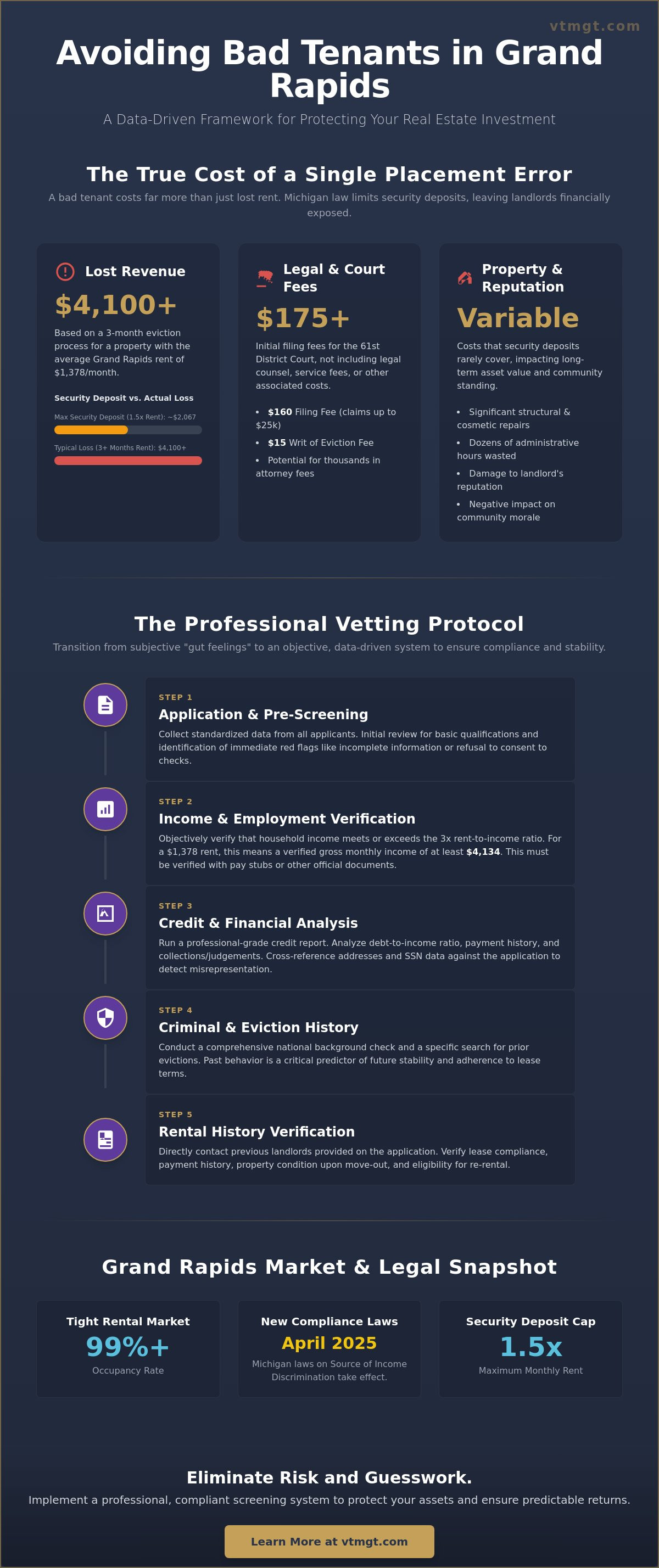
Financial losses during a tenant dispute are rarely covered by the security deposit alone. Michigan law strictly limits security deposits to 1.5 times the monthly rent. When a tenant causes significant structural damage or requires a formal eviction through the 61st District Court, these costs frequently exceed that reserve. For claims between $10,000 and $25,000, the court requires a $160 filing fee, plus an additional $15 for a Writ of Eviction. When you factor in the average Grand Rapids rent of $1,378 per month, a three-month legal process results in over $4,100 in lost gross revenue before accounting for legal counsel or physical repairs.
Why 'Gut Feeling' Fails in Modern Property Management
Relying on personal impressions or a "gut feeling" is an unstructured approach that invites significant legal and financial exposure. Professional fraudsters often present as the most "charming" or "urgent" applicants, specifically targeting DIY landlords who lack a rigorous professional screening protocol. They rely on the landlord's psychological bias to overlook missing documentation in favor of a positive social interaction. It's a tactic designed to bypass the standard vetting process.
Modern management requires the transition from subjective impressions to objective, third-party data. This transition is essential for avoiding bad tenants Grand Rapids and ensuring compliance with the 2025 source of income regulations. By prioritizing verified credit histories, criminal background checks, and documented rental references, we remove the "human error" component from the selection process. This disciplined approach ensures that every applicant is measured against the same quality-controlled standards, protecting the long-term ROI of your investment.
Identifying Red Flags: Spotting High-Risk Applicants Early
Effective risk management in property investment begins with the identification of anomalies during the initial data collection phase. For landlords focused on avoiding bad tenants Grand Rapids, these anomalies often manifest as inconsistencies between stated history and verifiable records. A candidate who exhibits "landlord hopping" across Kent County or provides an employment history that lacks chronological continuity presents a higher probability of future lease default. We approach these discrepancies as technical failures in an applicant's profile that require immediate investigation.
The refusal to provide standard documentation or consent to a background check is a definitive barrier to entry. In a professional framework, every data point must be cross-referenced. Discrepancies between an application and the official credit report, such as undisclosed previous addresses or mismatched social security data, are common indicators of intentional misrepresentation. These red flags are designed to bypass the standard vetting process and must be handled with a structured, non-negotiable response.
Income and Credit Red Flags
A standard benchmark for financial stability is the 3x rent-to-income ratio. With the average rent in Grand Rapids reaching $1,378 as of May 2026, a qualified household must demonstrate a gross monthly income of at least $4,134. While the April 2, 2025, Michigan law prohibits discrimination based on the source of income, it doesn't exempt tenants from meeting this fundamental solvency threshold. We prioritize payment history over the raw credit score. A high score can mask recent late payments, whereas a consistent history of on-time fulfillment of obligations is a more accurate predictor of future performance under Michigan Landlord-Tenant Law. Verifying income for those receiving "cash" or non-traditional payments requires bank statements and tax returns to ensure the numbers align with the reported figures.
Behavioral Warning Signs During the Tour
Data points aren't limited to paper. Behavioral indicators during a property tour provide critical context. An applicant who arrives late or submits incomplete paperwork often reflects the same lack of discipline they'll apply to rent deadlines. Requests for "urgent" move-ins should be treated with extreme caution. In a market where occupancy rates exceed 99 percent, legitimate tenants typically plan their transitions well in advance. An immediate need for housing often signals a pending eviction or a recent breakdown in a previous rental agreement. Observing the condition of an applicant's vehicle can also serve as a proxy for how they'll treat the physical asset. Neglected maintenance or excessive interior debris often correlates with how a tenant manages their living environment. By maintaining a standardized screening process, we eliminate the bias of personal appeal and focus on the technical indicators of tenant quality.
Navigating Michigan Landlord-Tenant Law and Fair Housing
Legal compliance is a technical requirement that functions as the structural foundation of any successful investment strategy. For property owners focused on avoiding bad tenants Grand Rapids, the screening process must operate within the strict parameters defined by federal and state regulations. Failure to maintain a fegyelmezett, standardized approach doesn't just lead to poor placements; it exposes the landlord to significant litigation risks within the 61st District Court. We treat legal adherence as a quality control protocol that protects the asset from both high-risk occupants and discrimination claims.
The regulatory environment in West Michigan is complex. While the Federal Fair Housing Act provides the baseline for protected classes, Michigan law extends these protections to include age and marital status. Most notably, as of April 2, 2025, it's illegal for a landlord to discriminate based on an applicant's source of income. This includes Section 8 vouchers, emergency assistance, or government benefits. To remain compliant, we must evaluate every applicant through the lens of objective financial stability rather than the origin of their funds. Understanding Michigan landlord-tenant law is the only way to ensure your selection process remains defensible under scrutiny.
Setting Legally Defensible Screening Criteria
Precision in management requires the distribution of written rental criteria to every prospective applicant before they pay an application fee. This document serves as your operational blueprint, outlining the exact parameters regarding credit history, income-to-rent ratios, and criminal background checks. By applying these rules without exception, you eliminate the subjectivity that often leads to Fair Housing complaints. Consistency is the primary defense against allegations of bias. We recommend reviewing the latest updates in Michigan landlord laws to ensure your criteria align with current 2026 standards, including the local ordinance that restricts application fees to the actual cost of the background check.
Avoiding Common Legal Pitfalls in Kent County
Operational errors often occur in the nuances of daily management. For example, "steering"—the practice of suggesting specific units based on family status—is a direct violation of Fair Housing principles. Similarly, landlords must distinguish between pets and service or emotional support animals. Under the law, these are not pets but necessary accommodations; therefore, "no pet" policies and pet deposits cannot be applied to them. When it comes to criminal history, a blanket "no felony" policy is no longer sufficient. HUD guidelines and Michigan's evolving legal framework require an individualized assessment of the nature and severity of the offense. By maintaining a structured, data-driven approach to these variables, we ensure that the process of avoiding bad tenants Grand Rapids remains both effective and legally sound.
The 5-Step Professional Screening Protocol for Grand Rapids
Operationalizing a rental strategy requires a fegyelmezett, five-step framework that removes subjectivity from the selection process. This sequence functions as a quality control filter, ensuring that only applicants who meet every technical parameter are approved for residency. By treating the application as a data-gathering mission rather than a social interaction, we maintain the precision necessary for avoiding bad tenants Grand Rapids. This repeatable system protects your asset from the high costs of turnover and legal disputes discussed in previous sections.
The protocol begins with a comprehensive written application that includes a clear authorization for background and credit checks. We then move to rigorous income verification, requiring at least two consecutive months of pay stubs or the most recent two years of tax returns for self-employed individuals. In a market where rents average $1,378, verifying the 3x income ratio is a non-negotiable step in maintaining portfolio stability. Only after these financial benchmarks are met do we proceed to the historical and behavioral phases of the vetting process.
Mastering the Landlord Reference Call
Verifying rental history requires a critical eye. A current landlord might be incentivized to provide a positive reference simply to facilitate the departure of a problematic occupant. We prioritize speaking with the previous property manager, as they no longer have a vested interest in the applicant's current status. The "Golden Question" we ask is direct: "Given the opportunity, would you rent to this individual again?" We also cross-reference the contact information provided with property tax records. This ensures the "landlord" isn't a friend or relative posing as a professional reference to bypass our avoiding bad tenants Grand Rapids protocols.
Verifying the Background Check Data
Data integrity is paramount. While a Michigan ICHAT report provides detailed state-level criminal records, it's insufficient for a comprehensive risk assessment. We utilize national criminal and eviction databases to capture out-of-state records that a local search might miss. It's also vital to identify "hidden" evictions; these are cases filed in district court that haven't yet reached the credit reporting bureaus. Utilizing standardized tenant screening checklists ensures that no component of this technical search is overlooked. This level of detail is what separates professional management from DIY attempts.
The final step is the lease orientation. This isn't just a signing ceremony; it's a structured meeting to set clear expectations regarding maintenance, payment deadlines, and community standards. If you want to delegate this complex process to a team that prioritizes precision, our tenant screening and placement services provide the professional infrastructure your Grand Rapids investment requires.
How Standardized Management Systems Eliminate Tenant Risk
Eliminating operational volatility requires the implementation of integrated technology and standardized protocols. For investors focused on avoiding bad tenants Grand Rapids, professional property management software offers a level of precision that manual DIY methods cannot replicate. These systems automate the collection of sensitive data, ensuring that every applicant is subjected to the same rigorous background checks and financial verifications without the risk of human bias or oversight. This structural approach transforms property management from a reactive task into a controlled, predictable process.
The transition from a stressed landlord to a passive investor is only possible through such oversight. When systems handle the complexities of legal compliance, applicant vetting, and financial reporting, the owner is free to focus on portfolio growth rather than daily conflict resolution. Standardized systems don't just filter out high-risk individuals; they create a professional environment that attracts and retains the highest quality residents in the West Michigan market.
The Van Treese Approach to Tenant Placement
We utilize a proprietary vetting process specifically calibrated for the Grand Rapids and Northern Michigan demographic. This protocol involves more than just verifying a credit score; it includes a multi-layered analysis of an applicant's technical and behavioral history. Our local team conducts in-person showings to observe applicant behavior firsthand, providing a qualitative layer of data that automated systems might miss. Once a placement is made, we prioritize rental property maintenance to ensure the physical asset remains in peak condition. By providing 24/7 emergency response and standardized repair workflows, we maintain high tenant satisfaction, which is the most effective strategy for reducing long-term turnover costs.
Protecting Your ROI with Professional Systems
The financial stability of a rental property depends on the velocity and accuracy of the placement process. Our systems reduce vacancy rates by quickly processing qualified leads while simultaneously avoiding bad tenants Grand Rapids who would otherwise cause costly delays. Standardized rent collection protocols ensure that payments are handled with industrial-grade consistency, preventing minor delays from escalating into legal disputes. This fegyelmezett framework ensures that your investment continues to generate yield without the administrative burden of self-management. For owners seeking to secure their portfolio with professional residential management, our infrastructure provides the necessary control and transparency to succeed in the 2026 market.
Securing Long-Term Performance for Your Grand Rapids Portfolio
Success in the West Michigan rental market is a function of disciplined systems and technical accuracy. By implementing a standardized vetting protocol, you move from reactive management to a controlled investment strategy. We've explored the high financial costs of placement errors in the 61st District Court and the absolute necessity of adhering to Michigan’s 2025 source of income regulations. These technical frameworks are essential for avoiding bad tenants Grand Rapids and protecting your property’s long-term ROI. A "gut feeling" is never a substitute for the objective data provided by national background searches and verified income analysis.
Transitioning to a passive investment model requires the infrastructure of a professional partner. Our team provides standardized screening systems used across Northern Michigan, combined with deep local expertise in Kent County and comprehensive 24/7 maintenance coordination. This structure ensures your properties remain occupied by qualified residents while you stay legally protected. It's time to replace management stress with predictable, professional results. Secure Your Investment with Van Treese Professional Management to ensure your portfolio reaches its full potential. We're ready to help you build a more stable and profitable future.
Frequently Asked Questions
What is the most common red flag of a bad tenant in Grand Rapids?
The most frequent indicator is a discrepancy between the applicant's stated history and verifiable third-party data. When an application shows a different address history than the credit report or contains unexplainable employment gaps, it suggests intentional misrepresentation. Identifying these technical inconsistencies early is the most effective method for avoiding bad tenants Grand Rapids. We treat any mismatched data as a failure in the applicant's quality control process.
Can I legally refuse a tenant with a past eviction in Michigan?
Yes, you can deny an applicant based on a previous eviction provided this standard is part of your written, consistently applied screening criteria. While Michigan law allows for this, we recommend evaluating the age and context of the filing. A single eviction from several years ago may carry less weight than multiple recent filings. Consistency is vital to ensure your selection process remains compliant with federal and state Fair Housing regulations.
How do I verify a tenant's income if they are self-employed or work for cash?
Verification requires the analysis of at least two years of federal tax returns and three to six months of consecutive bank statements. This allows us to cross-reference reported earnings with actual cash flow to ensure the applicant meets the 3x rent-to-income threshold. Under the April 2025 Michigan law, you cannot discriminate based on the source of income, but you must still verify that the total amount is sufficient and stable.
What should I do if a tenant's reference from their current landlord is 'too good'?
We recommend contacting the landlord prior to the current one to obtain a more objective assessment. Current property managers might provide an overly positive reference to facilitate the exit of a problematic occupant. A previous landlord has no such incentive and will typically provide more accurate data regarding payment history and property care. This historical perspective is a critical component of avoiding bad tenants Grand Rapids and Northern Michigan.
Are there specific Grand Rapids ordinances I need to follow for tenant screening?
Yes, Grand Rapids has specific local ordinances regarding application fees and security deposits. You're prohibited from charging a prospective tenant an application fee that exceeds the actual, documented cost of the background check. Additionally, both city and state laws limit security deposits to 1.5 times the monthly rent. Violating these technical requirements can expose you to legal penalties and financial liability within the Kent County court system.
How does the Grand Rapids Eviction Prevention Program affect me as a landlord?
This program provides a structured mediation pathway and potential financial assistance for tenants facing temporary hardship. For landlords, it offers an alternative to the formal eviction process in the 61st District Court, which can cost up to $160 in filing fees alone. Engaging with these programs can often resolve rent arrears faster than traditional litigation while maintaining the stability of your rental unit and avoiding the costs of a total turnover.
Should I accept a co-signer if the primary applicant has poor credit?
A co-signer should only be accepted if they meet significantly higher financial standards than a primary applicant. We require co-signers to undergo the same rigorous screening protocol, including a credit check and income verification. While a co-signer provides an additional layer of financial security, they don't mitigate behavioral risks. If an applicant has a history of property damage or lease violations, a co-signer's financial stability doesn't resolve those fundamental red flags.
How long does a professional tenant screening process typically take?
A comprehensive screening process generally requires two to four business days to complete with precision. This timeline accounts for the time needed to receive responses from previous landlords and employers, as well as the processing of national criminal and eviction database reports. Rushing this sequence often leads to the omission of critical data points. A fegyelmezett, structured approach ensures that every placement is based on verified facts rather than the pressure of a vacancy.